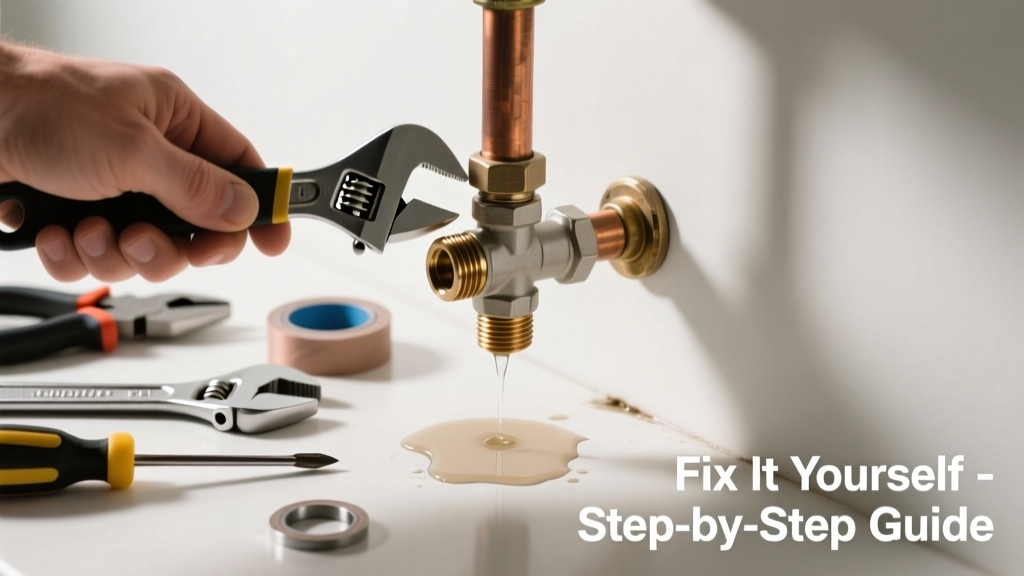
A small drip from your kitchen’s angle stop valve might seem minor—until it soaks the cabinet floor, warps particleboard, or spikes your water bill by $30–$50/month. These quarter-turn shutoff valves fail more often than people realize, especially in homes built before 2010 or where valves haven’t been cycled in years.
Quick Diagnosis
Before grabbing tools, confirm the leak source isn’t misidentified. A dripping valve looks like water escaping at the handle stem, base, or outlet connection—but it could also be a cracked supply line, corroded compression nut, or worn-out washer inside the valve body.
- Leak at the handle stem: Usually a failed O-ring or packing nut too loose
- Leak at the valve body/base: Often caused by mineral buildup or a cracked brass body
- Leak at the outlet (where supply line attaches): Typically a loose compression nut or damaged ferrule
- Valve won’t fully shut off: Internal seat erosion or debris jamming the ball or ceramic disc
Tools & Materials Needed
| Item | Purpose | Estimated Cost |
|---|---|---|
| Adjustable wrench (10-inch) | Tightens compression nuts without rounding them | $12–$22 |
| Small flathead screwdriver | Removes handle cap and loosens retaining screws | $4–$8 |
| Replacement O-rings (size #10 or #11) | Seals the valve stem; most common fix for stem leaks | $2–$5 |
| Brass compression ferrules (1/2" or 3/8") | Replaces deformed or cracked ferrules on supply lines | $3–$7 per pair |
| Dielectric union (if replacing valve) | Prevents galvanic corrosion between copper and steel pipes | $6–$11 |
Step-by-Step Fix
Most kitchen angle stop leaks can be resolved with one of these three approaches—start with the simplest:
- Tighten the packing nut: Turn off main water supply, open faucet to relieve pressure, then gently tighten the hex nut just below the handle (¼ turn max). Over-tightening cracks brass.
- Replace the O-ring: Remove handle cap, unscrew retaining screw, pull out stem, swap old O-ring (often brittle or flattened) with a silicone #10 O-ring, reassemble.
- Swap the entire valve: If body is cracked or internal seat is pitted, cut supply line 2 inches back, deburr pipe, install new 1/2" FIP x 3/8" compression angle stop (e.g., SharkBite or brass sweat-on).
When to Call a Pro
Don’t risk flooding or code violations if you encounter any of these:
- Valve is soldered directly to a copper main line with no isolation point upstream
- Leak persists after O-ring replacement and packing nut adjustment
- You notice green corrosion or pinhole leaks on the supply line itself
- Your home uses polybutylene (gray plastic) piping—valve replacement requires full system evaluation
According to the Insurance Institute for Business & Home Safety's 2023 report, 68% of water damage claims involving under-sink leaks stemmed from DIY repairs that compromised valve integrity or used incompatible parts.
Prevention Tips
Extend valve life and avoid repeat issues with these habits:
- Cycle each angle stop valve fully open and closed every 6 months—even if you never use it—to prevent seizing
- Install lever-style valves instead of knob types; they’re less prone to stem wear and easier to operate
- Use dielectric unions when connecting brass valves to galvanized or steel pipes to reduce electrolytic corrosion
- Label valves clearly (e.g., "Dishwasher", "Faucet") with waterproof tape to avoid confusion during emergencies
Can I use Teflon tape on the valve threads?
Yes—but only on the male pipe threads *before* attaching the valve to the water line. Never wrap Teflon tape on compression fittings (the nut-and-ferrule type), as it interferes with the metal-to-metal seal and increases leak risk.
How long do kitchen angle stop valves last?
Brass compression-type valves typically last 10–15 years. Ceramic disc or quarter-turn ball valves may last 20+ years if cycled regularly. The U.S. EPA estimates that 14% of household water usage is from leaks—including aging shutoffs—so age matters more than appearance.
Why does my valve leak only when I turn the water back on?
This points to a compromised compression seal: either the ferrule didn’t seat properly during reassembly or the pipe wasn’t fully inserted into the fitting. Shut off water, loosen the nut, push pipe in firmly until it stops, then retighten to 1.5 turns past hand-tight.
Can I replace just the handle without buying a whole new valve?
Sometimes—but only if the stem and internal mechanism are intact. Most modern valves (like Moen or Delta) don’t sell handles separately. Generic replacement handles cost $4–$9 but often require filing or adapter kits to fit nonstandard stems.
Is it safe to use an adjustable wrench on the valve body?
No. Use a second wrench to hold the valve’s inlet hex while tightening the outlet nut—otherwise, torque twists the valve body, cracking solder joints or stripping threads. Always support the valve body with a backup wrench.
What’s the difference between a 1/2" and 3/8" angle stop?
The numbers refer to pipe thread size—not flow capacity. Most kitchen faucets use 3/8" compression outlets; 1/2" is common for dishwasher or refrigerator lines. Mismatching causes leaks or stripped threads. Verify yours using a pipe thread gauge or compare to a known fitting.
Fixing a leaking angle stop valve isn’t about perfection—it’s about control, timing, and knowing when to pause and reach for the phone. A well-maintained valve saves you from soggy cabinets, mold spores, and surprise bills. Keep spare O-rings in your toolbox, label your shutoffs, and test them twice a year. For deeper plumbing concerns, check our guide on kitchen faucet base leaks or copper pipe leak repair.