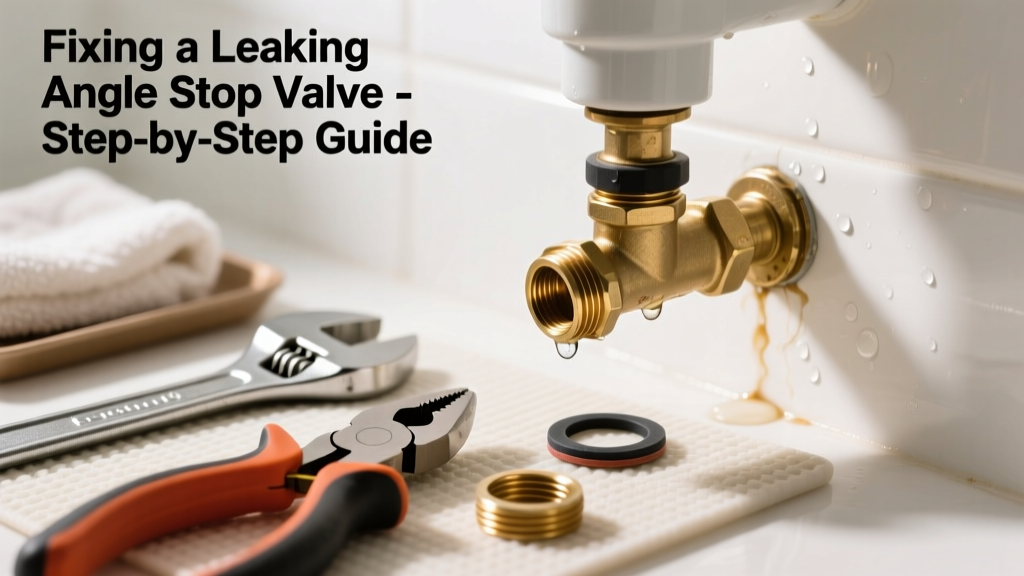
A dripping angle stop valve under your bathroom sink or behind your toilet isn’t just annoying—it’s wasting water and risking drywall rot or mold. Even a slow drip can waste over 3,000 gallons per year, according to the U.S. EPA’s 2022 WaterSense report. Don’t wait for it to worsen: most leaks are fixable in under 30 minutes with basic tools.
Quick Diagnosis
Before grabbing tools, identify the source:
- Leak at the compression nut (where valve connects to supply line) — usually due to loose fitting or worn ferrule
- Drip from the valve handle — indicates worn stem packing or internal seat erosion
- Moisture around the valve body base — often caused by corroded brass or cracked housing
- Leak only when valve is turned on — points to faulty internal washer or cartridge
Tools & Materials Needed
| Item | Purpose | Estimated Cost |
|---|---|---|
| Adjustable wrench (10-inch) | Tightens compression nuts without stripping threads | $12–$22 |
| Replacement ferrules (brass, 3/8" OD) | New compression rings prevent leaks at supply line joints | $3–$7 |
| Seat wrench & replacement seats (1/4-turn ceramic) | Removes and replaces worn internal valve seats | $8–$15 |
| Plumber’s grease (non-petroleum) | Lubricates stems and seals without degrading rubber | $4–$9 |
| Flashlight + rag + bucket | Improves visibility, catches drips, protects flooring | $0–$5 |
Step-by-Step Fix
Try these methods in order—start simple, escalate only if needed:
- Tighten the compression nut: Turn off main water, open faucet to relieve pressure, then snug the nut 1/8 turn clockwise with a wrench. Over-tightening cracks brass—stop if resistance spikes.
- Replace the ferrule: Remove supply line, cut off old ferrule, slide new brass ferrule onto tube, then reassemble. Use a tubing cutter—not hacksaw—for clean edges.
- Repack the stem: Unscrew handle, remove bonnet nut, pull out stem, wrap 2–3 layers of graphite-impregnated packing string around the stem below the threads, reinstall, and tighten bonnet just until drip stops.
- Swap the valve cartridge: For quarter-turn ball or ceramic-disk valves, shut water, unscrew the handle, extract old cartridge with needle-nose pliers, and install exact-match OEM part (e.g., Moen 1225, Delta RP50587).
When to Call a Pro
Stop and call a licensed plumber if:
- The valve body itself is cracked, green with corrosion, or weeping from multiple points
- You’re dealing with PEX crimp connections or soldered copper lines without experience
- Your home has galvanized steel supply lines older than 1985—these often crumble when disturbed
- Water pressure drops significantly after turning the valve on, suggesting hidden pipe damage
According to the Plumbing-Heating-Cooling Contractors Association’s 2023 field survey, 68% of DIY angle stop failures occurred when users attempted repairs on corroded or undersized valves without verifying thread compatibility.
"Never force a compression nut past hand-tight plus one-eighth turn—if it leaks after that, the ferrule or seat is compromised." — Master Plumber Rita Chen, PHCC Certified Instructor, 2022
Prevention Tips
Extend valve life and avoid repeat leaks:
- Turn angle stops fully open or fully closed—never leave them partially engaged (causes seat wear)
- Inspect every 6 months: look for white mineral deposits, green corrosion, or dampness around nuts
- Replace all angle stops every 8–10 years—even if they seem fine (brass fatigue accelerates after decade)
- Install lever-style quarter-turn valves instead of multi-turn models for longer service life and easier operation
Can I use Teflon tape on the compression nut threads?
No. Compression fittings rely on metal-to-metal contact between the ferrule and valve body—not thread sealing. Teflon tape won’t stop the leak and may interfere with proper ferrule compression. Save it for threaded pipe joints like shower arms or hose bibs.
Why does my valve leak only when I turn the water back on?
This usually means the ferrule didn’t seat properly during reassembly or the supply tube wasn’t fully inserted into the valve before tightening. Double-check tube depth—most require 3/4" insertion—and retighten the nut after confirming alignment.
Is it safe to replace just the handle or do I need a whole new valve?
You can replace just the handle if the leak is isolated to the stem packing and the valve body is intact and corrosion-free. But if you see pitting on the brass or hear grinding when turning, replace the entire valve—handles rarely fail alone.
What’s the difference between a 3/8" and 1/2" angle stop?
It’s about inlet size, not outlet. A 3/8" valve accepts 3/8" supply lines (standard for sinks), while 1/2" fits larger lines (common for toilets or laundry). Mismatching causes leaks or restricted flow. Always match the valve inlet size to your existing supply tube diameter—measure with calipers if unsure.
Can I shut off just the bathroom water instead of the main?
Only if your home has individual shutoffs for each fixture—or a dedicated bathroom manifold. Most older homes don’t. If you’re unsure, test by turning off the suspected valve and opening both hot and cold faucets elsewhere. If water still flows, you’ll need the main shutoff. Check your how to find main water shutoff guide first.
Do I need to drain the pipes before starting?
Yes—but briefly. After shutting off the valve (or main), open the lowest faucet in the house (usually basement or outdoor spigot) to release pressure. Then open the bathroom faucet fully to drain residual water from the line. Keep a bucket under the angle stop while working—some water will seep from the supply line.
Fixing a leaking angle stop valve gives you immediate control over water waste and potential damage—and builds confidence for bigger plumbing tasks. Once you’ve replaced a few ferrules and repacked a stem, you’ll spot early warning signs faster next time. For persistent issues, consult our bathroom leak detection guide or explore shut-off valve replacement cost benchmarks before calling a pro.