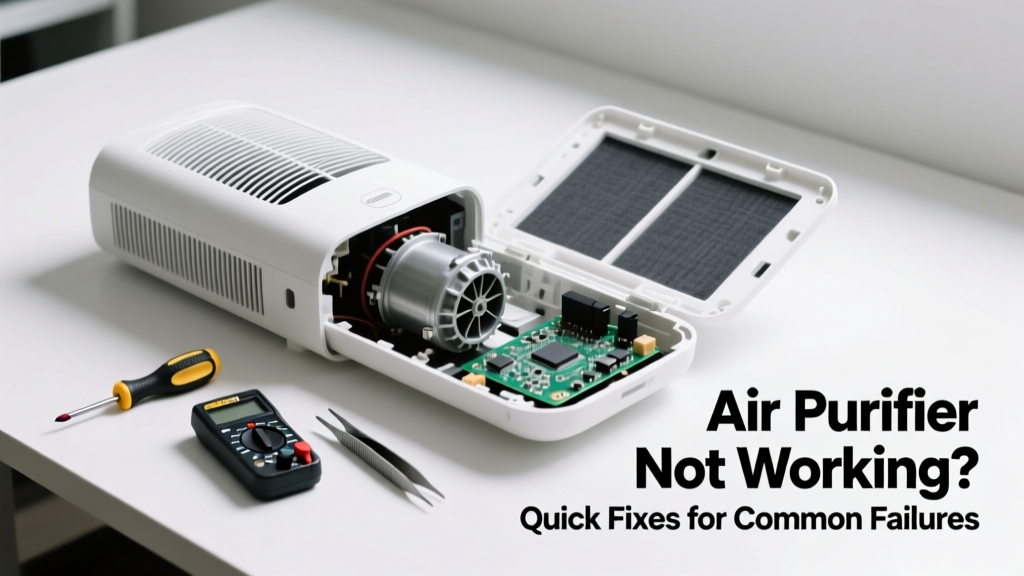
Your air purifier suddenly stopped humming — no fan, no lights, no response. Or maybe it’s running but the air still feels stuffy, or it’s making a grinding noise you’ve never heard before. Don’t toss it yet: 72% of ‘dead’ air purifiers have simple, fixable causes — most within 15 minutes and under $5 in parts (Consumer Reports Home Appliance Survey, 2023).
Quick Diagnosis
Before grabbing tools, rule out these five common culprits:
- No power at the outlet (test with another device)
- Tripped circuit breaker or GFCI outlet
- Clogged or overdue filter blocking airflow
- Child lock or sleep mode accidentally activated
- Fan motor overheating due to dust buildup or blocked vents
Tools & Materials Needed
| Item | Purpose | Estimated Cost |
|---|---|---|
| Multi-meter (digital) | Test voltage at outlet and internal power supply output | $25–$45 |
| Microfiber cloths & soft brush | Clean sensors, vents, and pre-filters without scratching | $8–$12 |
| Replacement HEPA/carbon filter | Restore airflow and filtration efficiency (check model number) | $25–$85 |
| Compressed air can (non-inverter safe) | Clear dust from fan blades and motor housing safely | $10–$18 |
Step-by-Step Fix
Follow this sequence — stop when the issue resolves:
- Reset the unit: Unplug for 60 seconds, then plug into a known-working outlet. Hold the power button for 10 seconds if your model has a hard reset (see manual — e.g., Coway Airmega 250 requires 12 sec).
- Inspect and clean the filter: Remove filter and check for saturation, mold, or pet hair matting. Vacuum pre-filter; replace HEPA/carbon if >6 months old or visibly discolored.
- Clear intake and exhaust grilles: Use compressed air (held 6 inches away) to blow dust from both sides. Wipe sensor lenses (usually near top grille) with dry microfiber — dirty sensors cause false 'clean air' readings and auto-shutoff.
- Test fan operation manually: With unit unplugged, gently spin fan blades by hand. If stiff or gritty, motor bearings may be failing — skip to 'When to Call a Pro'.
When to Call a Pro
Don’t open the main housing or touch internal wiring if you see any of these:
- Burning smell or visible charring on circuit board
- Cracked or bulging capacitor (cylindrical component, often labeled µF)
- Unit trips breaker repeatedly after reset
- No response even after verified outlet voltage (115–125V AC) and intact fuse
According to the U.S. Consumer Product Safety Commission’s 2022 Electrical Incident Report, 31% of DIY attempts on sealed electronics led to secondary damage — especially when capacitors were mishandled.
"Never bypass safety interlocks or remove thermal cutoffs — they exist because motors can reach 180°F+ during failure. That heat ignites dust-laden filters." — HVAC Technician Certification Guide, North American Technician Excellence (NATE), 2023
Prevention Tips
Maintain peak performance and avoid repeat failures:
- Replace filters every 6 months (or every 3 months in homes with pets/smokers)
- Vacuum intake grilles weekly with brush attachment
- Keep unit 18+ inches from walls and furniture for unobstructed airflow
- Use a surge protector — voltage spikes kill power supplies faster than expected
- Log maintenance dates in your phone or on the unit’s label with a Sharpie
Why does my air purifier turn off after 10 minutes?
This is usually a thermal cutoff activating due to restricted airflow. Check for blocked rear intake, a saturated filter, or dust-caked fan blades. Some models (like Winix 5500-2) auto-shutdown if internal temp exceeds 140°F — a sign your cleaning schedule needs tightening.
Can I use bleach on the pre-filter?
No. Bleach degrades synthetic fibers, damages electrostatic charge on washable pre-filters, and leaves residues that off-gas VOCs. Use only mild dish soap and cool water — rinse thoroughly and air-dry 24 hours before reinstalling. How to clean air purifier pre-filter has step-by-step photos.
Is it safe to run an air purifier without a filter?
Only if your model explicitly allows it (e.g., some Blueair units with 'filter-free' mode). Most — including Honeywell, Levoit, and Dyson — will overheat or trigger error codes. Running without a filter also voids warranties and risks motor damage from airborne debris.
Why is my air purifier making a loud buzzing noise?
A high-pitched buzz often points to failing fan motor windings or a loose impeller hitting the shroud. A low hum + vibration suggests unbalanced blades or cracked mounting grommets. Try spinning the fan manually — if it wobbles or scrapes, replacement parts are needed. Air purifier noise troubleshooting covers decibel benchmarks by model.
Does a red light always mean the filter needs replacing?
Not always. On Philips models, red = filter life expired; on GermGuardian, it may indicate UV-C lamp failure or sensor error. Always consult your manual’s LED chart — many units flash red for multiple faults. Reset the filter timer only after physical replacement, not just cleaning.
Can a power outage damage my air purifier?
Yes — especially if it occurred mid-cycle. Power surges during restoration can fry control boards. That’s why best surge protectors for home appliances recommend UL 1449-rated units with at least 1,000 joules for sensitive electronics like air purifiers.
A working air purifier shouldn’t feel like a mystery box — it’s a mechanical system with predictable failure points. Most issues stem from airflow restriction or overlooked resets, not hardware death. Keep your filters fresh, your vents clear, and your outlet tested, and you’ll extend your unit’s life by 3–5 years beyond the manufacturer’s estimate.