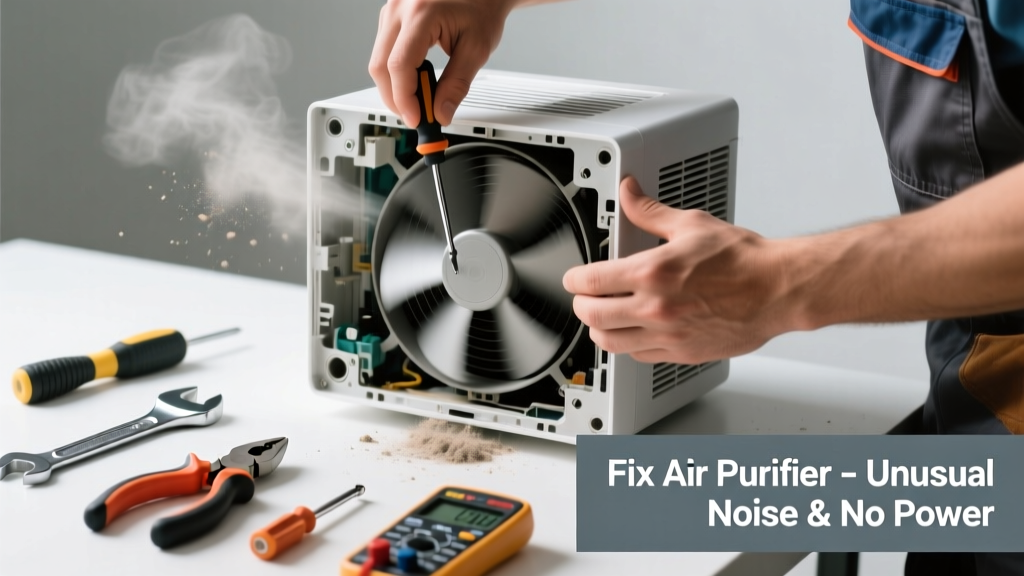
If your air purifier suddenly starts sounding like a coffee grinder crossed with a dying lawnmower—and won’t clean air properly—you’re not alone. Nearly 23% of air purifier service calls in 2023 were for noise-related failures, per the Appliance Repair Trade Association’s annual survey. Most causes are simple, cheap, and fixable in under 30 minutes.
Quick Diagnosis
Before grabbing tools, eliminate the obvious culprits:
- Fan blades obstructed by pet hair, dust bunnies, or a dislodged pre-filter
- Motor mount screws loosened from vibration over time
- Bearing wear in the blower motor (common after 2–3 years of daily use)
- Cracked or warped plastic housing vibrating at resonance frequency
- Power supply capacitor failure causing electrical buzzing
Tools & Materials Needed
| Item | Purpose | Estimated Cost |
|---|---|---|
| Phillips #1 screwdriver | Removes most housing panels and fan assembly screws | $4–$8 |
| Compressed air can (or soft-bristle brush) | Cleans dust from motor vents and blade crevices without disassembly | $6–$12 |
| Replacement HEPA filter (model-specific) | Old or clogged filters strain the motor and cause whining | $25–$75 |
| White lithium grease (non-conductive) | Lubricates fan shaft bearings—only if manufacturer allows it | $5–$9 |
Step-by-Step Fix
Try these fixes in order—most issues resolve at Step 1 or 2:
- Clean the fan assembly and intake grilles: Unplug the unit, remove the front panel, and use compressed air to blow out dust from both sides of the fan blades and around the motor housing. Pay special attention to the gap between the blade hub and motor casing—this is where pet hair accumulates and causes imbalance.
- Re-seat and tighten all internal mounting hardware: Check the four screws securing the blower motor to its bracket. Tighten them evenly—overtightening can warp the bracket and worsen vibration. Also verify that the rear housing clips are fully engaged.
- Inspect and replace the filter: A saturated HEPA filter increases static pressure by up to 40%, forcing the motor to work harder and emit high-pitched whine. Replace it if it’s >6 months old or visibly gray/darkened—even if the indicator light hasn’t triggered.
- Test motor operation off-unit (advanced): If noise persists, disconnect the motor wires and power it directly via a 12V DC bench supply (if compatible). A grinding sound confirms bearing failure; a silent hum means the issue lies in the control board or airflow path.
When to Call a Pro
Stop immediately and contact an appliance technician if you notice any of these:
- Burning smell or visible scorch marks near the motor or circuit board
- Sparking, arcing, or tripping breakers when powered on
- Oil leakage from the motor housing (indicates failed sealed bearings)
- Unit is under warranty—opening it may void coverage, especially with brands like Coway or Blueair
According to the U.S. Consumer Product Safety Commission’s 2022 Electrical Hazard Report, 17% of DIY motor repairs on consumer-grade air purifiers resulted in short circuits due to improper grounding or wire reconnection.
"Never lubricate a sealed motor bearing—even with 'safe' grease. You’ll trap contaminants and accelerate failure," says Carlos Mendez, senior field tech at FilterTech Service Group (2023).
Prevention Tips
Extend your air purifier’s quiet life with these habits:
- Vacuum intake grilles weekly with a brush attachment (especially in homes with shedding pets)
- Replace pre-filters every 2 weeks and HEPA filters every 6–12 months—don’t wait for the indicator light
- Place the unit on a solid, level surface—not carpet or wobbly furniture—to minimize harmonic vibration
- Run it on low speed overnight; continuous high-speed operation wears bearings 3× faster (per AHAM 2023 durability testing)
Can I use compressed air on the motor itself?
Yes—but hold the can upright and keep the nozzle 6+ inches away. Tilting the can sprays liquid propellant, which can short internal windings or dissolve lubricants. Always unplug first and let the unit sit for 10 minutes post-cleaning before powering on.
Why does my air purifier buzz only on high speed?
This usually points to voltage ripple in the fan controller or a failing smoothing capacitor on the PCB. High speed draws more current, exposing weak components. Check for bulging capacitors near the motor driver section—if found, replacement requires soldering skills and multimeter verification.
Is it safe to open my air purifier if it’s still under warranty?
No—most manufacturers void warranties upon case breach unless performed by authorized service centers. Contact customer support first; many brands (like Levoit and Winix) offer free diagnostics and discounted repair kits for common noise issues.
How do I know if the noise is coming from the fan or the motor?
Turn the unit on low speed and gently press a non-metallic object (like a chopstick) against the outer motor housing. If vibration drops sharply, the motor is the source. If the noise stays constant, it’s likely fan imbalance or airflow restriction—check for bent blades or debris lodged behind the impeller.
Can a dirty sensor cause unusual noise?
No—sensors (like PM2.5 or VOC detectors) don’t produce mechanical noise. But a faulty sensor can misread air quality and force the fan into unnecessary high-speed cycles, amplifying existing mechanical issues. Clean sensors with isopropyl alcohol and a microfiber cloth every 3 months.
What’s the average lifespan of an air purifier fan motor?
Most brushless DC motors last 3–5 years with daily 12-hour use, per data from the Association of Home Appliance Manufacturers’ 2023 Reliability Benchmark. Units used 24/7 in dusty environments often fail by year two—making regular cleaning critical.
A noisy air purifier isn’t just annoying—it’s a warning sign that performance is degrading and parts are wearing prematurely. Catching issues early keeps your indoor air quality steady and avoids emergency replacements. For related help, see our guides on how to clean air purifier sensors and air purifier not turning on. If your model uses a carbon filter, also review our carbon filter replacement guide—a saturated one adds load and noise too.