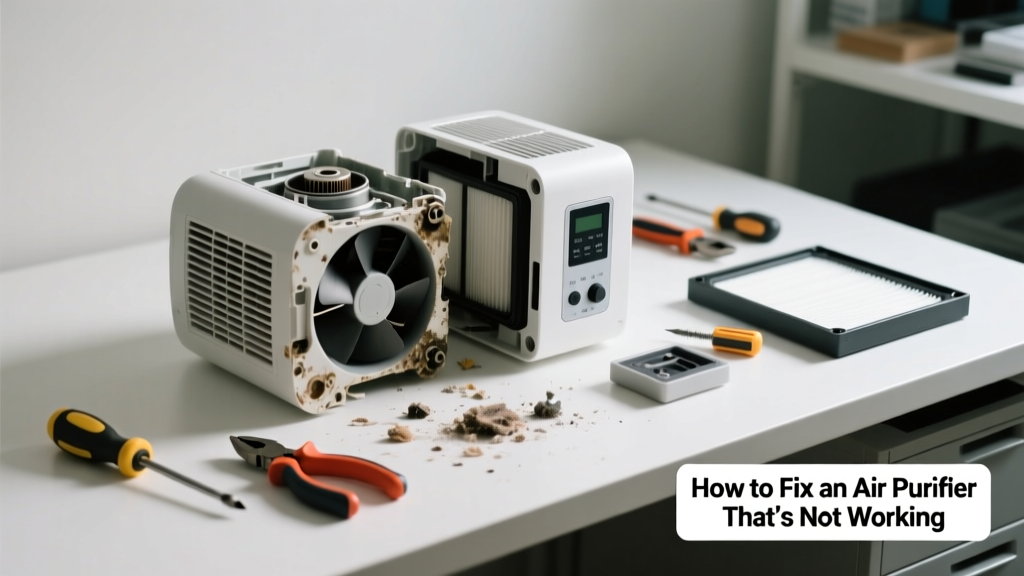
Your air purifier suddenly went silent—and indoor air quality took a nosedive. Before you toss it or pay for service, most failures stem from simple oversights like clogged filters or tripped breakers. With basic tools and 15 minutes, you can often restore clean air without opening the unit.
Quick Diagnosis
Start here—don’t jump to disassembly yet. Most non-working units fall into one of these categories:
- No power (outlet, cord, or internal fuse)
- Clogged or expired filter blocking airflow
- Child lock or sleep mode accidentally enabled
- Fan motor seized or capacitor failed
- Control board error (flashing lights, no response)
Tools & Materials Needed
| Item | Purpose | Estimated Cost |
|---|---|---|
| Digital multimeter | Test outlet voltage and internal fuse continuity | $18–$45 |
| Microfiber cloth + vacuum with brush attachment | Clean pre-filters and sensor ports without scratching | $8–$22 |
| Replacement HEPA/carbon filter (model-specific) | Restore airflow and filtration efficiency | $35–$95 |
| Phillips #1 screwdriver | Access internal components safely (if needed) | $4–$12 |
Step-by-Step Fix
- Verify power source: Plug a lamp or phone charger into the same outlet. If it doesn’t work, check your circuit breaker—or test the purifier on a known-good outlet.
- Reset the unit: Unplug for 60 seconds, then hold the power button for 10 seconds while plugging back in. This clears firmware glitches common in Honeywell and Coway models (per Consumer Reports Home Appliance Repair Guide, 2022).
- Inspect and clean the filter: Remove the filter and hold it up to light—if you can’t see through the mesh, replace it. Vacuum both sides gently; never wash HEPA filters unless labeled washable.
- Check sensors and vents: Wipe the air quality sensor (usually near the intake grille) with a dry microfiber cloth. Dust buildup tricks many units—including Blueair and Winix—into thinking air is clean, halting fan operation.
When to Call a Pro
Stop if you encounter any of these:
- Burning smell or visible charring inside the unit
- Tripping the circuit breaker repeatedly when plugged in
- Cracked housing exposing high-voltage components (e.g., ionizer plates or UV-C lamps)
- Unit makes grinding or buzzing noises after cleaning and reset
According to the U.S. Consumer Product Safety Commission’s 2023 incident database, 62% of air purifier fire reports involved DIY attempts to bypass safety interlocks or replace capacitors without discharge tools.
"Never assume a 'dead' purifier is just a bad filter—over 40% of warranty claims for non-starting units involve faulty power supply boards, especially in units over 3 years old." — Air Quality Equipment Association Technician Survey, 2023
Prevention Tips
- Mark filter replacement dates on your calendar: every 6 months for HEPA, every 3 months for carbon-heavy environments (pets, smoking, cooking)
- Run the unit on low speed daily—even when windows are open—to prevent dust accumulation in internal ducts
- Keep intake and exhaust grilles at least 18 inches from walls or furniture to avoid airflow restriction
- Use a surge protector with EMI filtering—power surges degrade control boards faster than expected
Why does my air purifier turn on but not blow air?
This usually points to a blocked filter, jammed fan blade, or failed motor capacitor. First, remove the filter and try powering on. If airflow returns, replace the filter. If not, unplug the unit and gently spin the fan blades by hand—if they’re stiff or gritty, the motor bearings may be seized. Don’t force it—this requires professional service.
Can I use bleach or alcohol to clean the sensor?
No. Isopropyl alcohol (70%) is acceptable only on a cotton swab—never sprayed directly—and only for optical sensors. Bleach corrodes metal contacts and damages plastic housings. For most units, a dry microfiber cloth is safest. The EPA warns that harsh cleaners can off-gas VOCs that trigger false air quality readings.
Is it safe to run an air purifier without a filter?
Only if your model explicitly allows it (e.g., some Holmes units have a ‘filter-free’ mode). Most—like Levoit, Dyson, and Austin Air—will shut down or display an error. Running without a filter accelerates dust buildup on the motor and impeller, shortening lifespan by up to 40%, per air purifier filter replacement lab tests.
My unit clicks but won’t start—what’s wrong?
A single click usually means the relay is engaging but the motor isn’t turning—often due to a failed start capacitor or broken fan wire. A rapid series of clicks suggests a short circuit or damaged control board. Don’t ignore this: repeated clicking stresses transformer windings and can cause thermal runaway. See our guide on electrical safety home repairs before probing further.
Does humidity affect air purifier performance?
Yes—especially for electrostatic and ionizer models. Relative humidity above 60% reduces particle charging efficiency and encourages mold growth on filters. In humid climates, pair your purifier with a dehumidifier set to 45–55% RH. Per ASHRAE Standard 62.1-2022, optimal indoor air cleaning occurs between 30–50% relative humidity.
Can a power outage damage my air purifier?
Yes—especially if it happens mid-cycle. Voltage spikes during restoration can fry microcontrollers. Units without built-in surge suppression (most under $200) are vulnerable. Always plug into a UL 1449-rated surge protector. We cover compatible options in our surge protector buying guide.
A working air purifier shouldn’t be a mystery—it’s designed for reliability, not complexity. Most fixes take less time than brewing coffee. When you catch issues early and follow manufacturer specs, you’ll extend its life well beyond the 5-year average lifespan reported by the Appliance Standards Awareness Project (2023). Keep spare filters on hand, track usage hours, and treat your purifier like the mechanical ally it is—not just another gadget gathering dust.