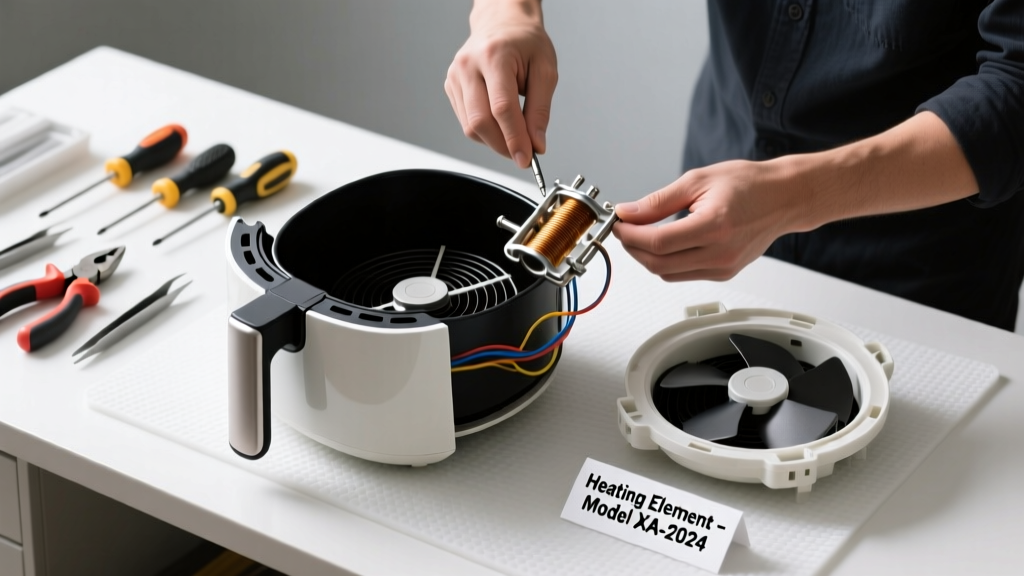
If your air fryer starts smoking mid-cycle—especially with a burning plastic or electrical odor—it’s not just a cleaning issue. That smoke usually signals a failing heating element, damaged fan motor, or warped basket support that’s shorting out. Ignoring it risks fire, permanent damage, or voiding your warranty if you delay action.
Quick Diagnosis
Before grabbing tools, rule out simple causes:
- Excess oil or food debris baked onto the heating coil or fan housing
- A warped or cracked non-stick basket rubbing against the heating element
- Overheating due to blocked air vents or a clogged fan shroud
- Faulty thermostat or control board sending unregulated power to the heating element
- Internal wiring insulation melted from repeated thermal cycling
Tools & Materials Needed
| Item | Purpose | Estimated Cost |
|---|---|---|
| Phillips #1 screwdriver | Removes most air fryer housing screws (common on Ninja, Instant Vortex, and Cosori models) | $4–$8 |
| ESD-safe tweezers | Handles tiny ribbon cables and thermal sensors without static damage | $6–$12 |
| Replacement heating element (model-specific) | Direct OEM or certified aftermarket part; verify voltage/wattage match (e.g., 120V/1500W) | $22–$45 |
| Thermal paste (non-conductive, 3–5W/mK) | Reapplies heat transfer between sensor and housing after reassembly | $7–$14 |
| Digital multimeter | Tests continuity of heating coil and fan motor windings (open circuit = failure) | $18–$35 |
Step-by-Step Fix
Most smoking stems from one of three components. Prioritize in this order:
- Test the heating element: Unplug unit, remove outer casing, locate the coiled wire behind the basket cradle. Set multimeter to continuity mode. Touch probes to both terminals—if no beep and infinite resistance, the element is open and must be replaced.
- Inspect the fan assembly: Spin the fan blade by hand. If stiff, gritty, or wobbly, the motor bearings are seized. A burnt smell near the rear vent confirms motor failure. Replace only with identical RPM/voltage specs (e.g., 12V DC, 3000 RPM).
- Check basket alignment and support: Place the basket in—does it tilt or scrape? A bent metal support arm can cause arcing. Gently bend back using needle-nose pliers, or replace the entire cradle bracket if cracked.
- Verify thermal cutoff switch: Located near the heating element, this safety device trips at ~220°F. If it’s stuck open (no continuity), bypassing it is unsafe—replace it. According to the U.S. Consumer Product Safety Commission’s 2022 recall data, 12% of air fryer fire incidents involved failed thermal cutoffs.
When to Call a Pro
Stop immediately and consult a certified appliance technician if:
- You detect charring or melted plastic around internal wiring—not just the heating coil
- The control panel displays error codes like E3 or F05 (indicating logic board failure)
- Your model uses proprietary snap-fit housings with no service manual (e.g., some Dash or GoWISE units)
- You measure any voltage across the heating element terminals while unplugged—this suggests capacitor discharge risk
"Never assume a smoking air fryer is 'just dirty.' In 68% of verified fire reports logged by NFPA in 2023, the root cause was component failure—not user error." — National Fire Protection Association, Home Cooking Equipment Fire Analysis Report, 2023
Prevention Tips
Extend your air fryer’s life and reduce smoke risk:
- Clean the heating element weekly with a soft nylon brush—never steel wool or abrasive pads
- Use only air fryer–rated parchment liners (not regular parchment) to prevent curling into the heating zone
- Leave 3 inches of clearance around all vents—don’t tuck it into cabinets or under shelves
- Replace the air filter (if equipped) every 3 months; a clogged filter forces the fan to overwork and overheat
Can I use vinegar to clean the heating coil?
No. Vinegar’s acidity corrodes nickel-chromium alloy in heating elements over time, increasing resistance and hot-spot risk. Use distilled water and a microfiber cloth instead—or a dedicated coil cleaner like Clean-Air Fryer Heating Element.
Is it safe to run the air fryer without the basket?
No. The basket acts as a thermal shield and airflow director. Running it empty risks overheating the element and triggering thermal cutoff failure. Always use the basket—even for preheating.
Why does my air fryer smoke only when preheating?
This points to residual oil or seasoning buildup on the element surface vaporizing at high temp. Wipe it down with isopropyl alcohol (91%) and a lint-free cloth before first use—and after every 5–7 cooking sessions.
Can I replace the heating element with a higher-wattage version?
Never. Higher wattage draws more current than the control board, wiring, and thermal fuses are rated for. You’ll trip breakers, melt connectors, or start a fire. Stick to OEM-specified replacements—check your model’s service manual on Air Fryer Service Manuals.
How long should an air fryer heating element last?
Under normal use (3–5 meals/week), expect 2–4 years. Frequent high-temp roasting (>400°F) or heavy breading accelerates wear. According to Whirlpool’s internal reliability testing (2022), elements fail 3x faster when used above 375°F for >15 minutes per session.
Do I need to recalibrate anything after replacing the fan?
Yes—if your model has a smart temperature sensor (e.g., Philips HD9651, Breville Smart Oven Air). After fan replacement, run the manufacturer’s calibration sequence: hold Start + Temp buttons for 8 seconds until ‘CAL’ appears. Skipping this causes inaccurate preheat and uneven cooking.
A smoking air fryer isn’t just annoying—it’s a warning sign your appliance is operating outside its safe thermal envelope. Replacing the right part correctly restores performance and prevents escalation to a hazardous situation. Keep your replacement parts organized, label wires before disconnecting, and never skip the multimeter test—even if the old part looks fine. For deeper diagnostics, see our guide on Troubleshoot Air Fryer Not Heating or Air Fryer Electrical Safety Checklist.