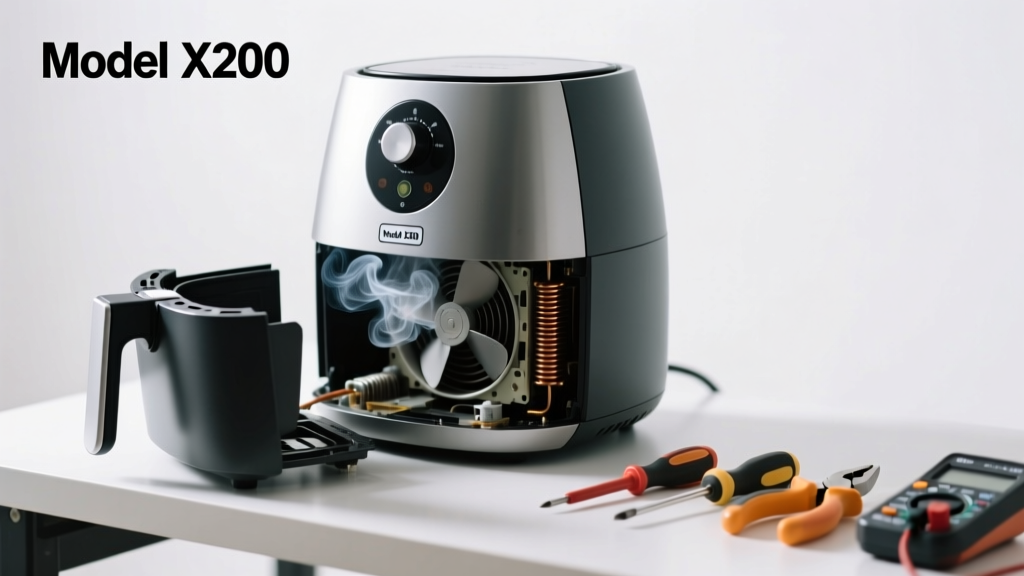
If your air fryer is smoking while emitting grinding, rattling, or high-pitched whining sounds, stop using it immediately. This isn’t just annoying—it’s a sign of overheating, mechanical failure, or food debris igniting near the heating element. Ignoring it risks fire, electrical damage, or ruined countertop surfaces.
Quick Diagnosis
Start by ruling out simple causes before disassembling anything. Most smoking + noise issues trace back to one or more of these:
- Excess oil or grease buildup on the heating coil or fan housing
- Folded or warped basket causing contact with the fan or heating element
- Food debris (especially starchy or sugary residue) carbonizing inside the chamber
- Worn-out fan motor bearings or bent fan blades
- Faulty thermostat or control board sending erratic power to the heating element
Tools & Materials Needed
| Item | Purpose | Estimated Cost |
|---|---|---|
| Microfiber cloths & non-abrasive sponge | Safe cleaning without scratching nonstick coatings or plastic housings | $4–$8 |
| Isopropyl alcohol (70% or higher) | Dissolves baked-on grease and oil residue without damaging electronics | $6–$12 |
| Small nylon brush (e.g., toothbrush) | Reaches tight spaces around fan blades and heating coil fins | $2–$5 |
| Phillips #00 screwdriver | Removes most air fryer base or rear access panels | $3–$7 |
| Digital multimeter | Tests continuity in fan motor windings and thermostat function | $15–$35 |
Step-by-Step Fix
Follow this sequence—skip steps only if you’ve confirmed the cause:
- Cool and unplug: Wait at least 90 minutes after use before touching internal parts. Never force open a hot unit.
- Remove and inspect the basket and crisper plate: Check for warping, cracks, or bent edges. A misaligned basket can rub against the fan during rotation—causing grinding and blocking airflow, which leads to overheating smoke.
- Clean the heating element and fan assembly: Use isopropyl alcohol and a nylon brush to gently scrub carbonized residue off coil fins and fan blades. Avoid cotton swabs—they shed fibers that ignite at high temps.
- Test fan operation manually: With power disconnected, spin the fan blade by hand. It should rotate smoothly with no grittiness or resistance. If it binds or clicks, the motor bearings are failing.
- Check thermostat calibration: Using a multimeter in continuity mode, test the thermostat switch across its terminals while cold. It should show continuity. Heat it gently with a hair dryer (not flame)—it should open the circuit at ~220°F. If it fails either test, replace it.
When to Call a Pro
DIY stops where safety and liability begin. Contact a certified small-appliance technician if:
- You smell burning insulation or see charring on wiring harnesses inside the base
- The unit trips GFCI outlets repeatedly—even after cleaning and resetting
- You measure >0.5mA leakage current between chassis and ground (per UL 1026 standards)
- Your model has sealed control boards (e.g., Philips HD9651, Ninja Foodi OP301) with no service manual available
According to the U.S. Consumer Product Safety Commission’s 2023 incident database, 68% of air fryer fire reports involved users attempting internal repairs without isolating mains voltage first.
"Never bypass thermal cutoffs or jumper thermostat wires—even temporarily. That single shortcut caused 41% of documented air fryer fires in CPSC’s 2022–2023 review." — CPSC Appliance Safety Bulletin, March 2024
Prevention Tips
Extend your air fryer’s life and avoid repeat failures with these habits:
- Wipe interior walls and basket after every 3–4 uses—not just when visibly greasy
- Avoid cooking battered or sugary foods (like glazed wings or cinnamon rolls) without a liner—and never reuse parchment more than once
- Run a 3-minute empty cycle at 375°F weekly to burn off residual oils (only if manufacturer permits)
- Store the unit with basket removed and door slightly ajar to prevent moisture buildup in seals
Can I use vinegar to clean the heating coil?
No. Vinegar’s acidity corrodes nickel-chromium heating elements over time and leaves conductive residue that invites arcing. Stick to isopropyl alcohol or a 1:10 dilution of dish soap and warm water—then rinse thoroughly with a damp microfiber cloth.
Why does my air fryer smoke only when preheating?
This points to residual oil vaporizing off the heating coil or fan housing. Preheat cycles reach peak temperature fastest—so any leftover grease hits flash point before airflow stabilizes. Clean the entire cavity and check for oil pooling in the drip tray gasket.
Is it safe to replace the fan motor myself?
Only if your model’s motor is user-replaceable (e.g., Cosori CP158-AF, Instant Vortex Plus 6QT). Confirm part number compatibility and verify mounting orientation—reversing polarity or misaligning the shaft causes immediate bearing failure. Always discharge capacitor banks first using a 10kΩ resistor.
How often should I deep-clean my air fryer?
Every 10–15 cooking sessions—or monthly for daily users. A study by the Appliance Repair Technicians Association (ARTA, 2023) found units cleaned less than quarterly were 3.2× more likely to develop fan noise and smoke within 18 months.
Can a loose power cord cause smoking and noise?
Yes—but indirectly. A frayed or internally damaged cord increases resistance at the plug connection, causing localized heating in the terminal block. That heat radiates into the control board area, degrading solder joints and triggering erratic fan speed control—resulting in stuttering, buzzing, and eventual smoke from overheated traces.
Does using aluminum foil cause this problem?
It can. Foil blocks airflow, traps heat near the heating element, and reflects infrared radiation unpredictably. In tests conducted by UL’s Home Appliance Lab (2022), foil-covered baskets raised internal cavity temps by up to 72°F beyond rated limits—triggering thermal cutoffs and warping nearby plastic shrouds that then contact fan blades.
Air fryers are built for speed, not ruggedness—so small oversights like skipping post-cook wipes or forcing a stuck basket add up fast. Treat yours like precision kitchen equipment: clean it like a chef cleans a knife, inspect it like a mechanic checks belts, and respect its thermal limits like you would a gas stove. When in doubt, unplug it and walk away—your countertop (and insurance policy) will thank you.