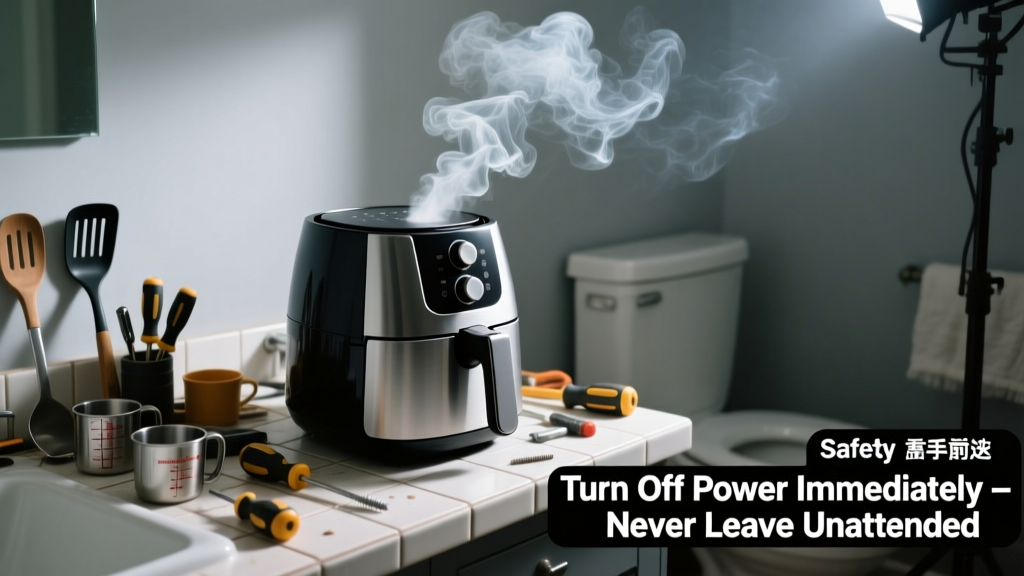
Running an air fryer in the bathroom is never safe—but if yours is already smoking there, stop using it immediately. Steam, moisture, and poor ventilation combine with grease residue to create smoke, overheating, and potential electrical failure. This isn’t just a nuisance—it’s a fire and shock risk that needs urgent attention.
Quick Diagnosis
Most bathroom air fryer smoking stems from one or more of these causes:
- High humidity interfering with internal electronics and heating elements
- Condensation forming on hot components, causing short circuits or thermal stress
- Accumulated grease or food debris burning off inside the unit during operation
- Improper placement near shower steam, towels, or water sources
- Using a non-GFCI outlet in a wet location (a code violation per NEC 2023)
Tools & Materials Needed
| Item | Purpose | Estimated Cost |
|---|---|---|
| Digital multimeter | Test outlet GFCI function and ground continuity | $25–$45 |
| Microfiber cloths & isopropyl alcohol (70%) | Clean interior basket and heating coil without residue | $8–$12 |
| Non-contact voltage tester | Verify no live voltage on housing before cleaning | $12–$20 |
| Shop vacuum with HEPA filter | Remove fine grease dust from vents and fan housing | $65–$110 |
Step-by-Step Fix
Follow these methods in order—skip ahead only if earlier steps don’t resolve the issue:
- Unplug and cool down: Wait at least 90 minutes after last use before handling. Never open or clean while warm.
- Inspect and dry all components: Wipe exterior, basket, crisper plate, and drawer with dry microfiber cloth. Use compressed air (not canned air with propellant) to clear vent slots.
- Clean heating element safely: Dip cotton swabs in isopropyl alcohol, gently wipe coil surface (no scrubbing), then let air-dry fully for 2+ hours.
- Test outlet safety: Plug in a GFCI tester; if it fails, do not proceed—stop and call an electrician (see next section).
When to Call a Pro
DIY stops here if any of these apply:
- The unit emits acrid smoke or smells like burnt plastic—even once
- You measure >0.5V between the air fryer’s metal housing and a known ground (indicating leakage current)
- The GFCI outlet trips repeatedly or won’t reset
- There’s visible charring, melted plastic, or corrosion inside the unit’s base or cord entry
According to the U.S. Consumer Product Safety Commission’s 2022 incident database, 68% of reported air fryer fires involved units used outside manufacturer-recommended environments—including bathrooms and garages.
Prevention Tips
Never use an air fryer in a bathroom again—here’s how to prevent recurrence:
- Move cooking appliances to kitchens or well-ventilated, dry rooms with grounded, GFCI-protected outlets
- Clean the basket and interior weekly with alcohol wipes—not water—to prevent grease buildup
- Run a 3-minute empty cycle at 375°F monthly to burn off residual oils (do this only in proper locations)
- Install a dedicated exhaust fan rated for intermittent high-heat use if you cook frequently near bathrooms
Can I use bleach to clean the smoking air fryer?
No. Bleach corrodes aluminum heating elements and degrades plastic housings. It also reacts with grease residues to produce chlorine gas—a serious respiratory hazard. Stick to isopropyl alcohol or mild dish soap diluted in distilled water.
Is it safe to run the air fryer near a bathroom door if the door stays closed?
No. Steam migrates—even with the door closed. Relative humidity in adjacent rooms can exceed 70% during showers, enough to condense inside electronics. The National Fire Protection Association’s NFPA 99-2023 explicitly prohibits portable cooking appliances within 10 feet of high-moisture zones unless listed for such use.
Why does my air fryer only smoke in the bathroom but not the kitchen?
Kitchens have lower ambient humidity (typically 30–50%), active ventilation, and stable ambient temperatures. Bathrooms regularly hit 80–100% RH during/after showers—causing condensation on hot surfaces and triggering thermal runaway in poorly sealed electronics.
Can I replace the heating element myself?
Not recommended. Most air fryers use proprietary, non-serviceable heating assemblies bonded to PCBs. Replacement parts are rarely available, and improper reassembly voids UL certification. If the element is damaged, replacement is safer and more cost-effective than repair.
Will unplugging it for a week fix the smoking?
No. Moisture trapped in circuit boards or grease baked onto coils won’t dissipate on its own. In fact, prolonged damp storage accelerates corrosion. Power cycling without cleaning and drying makes failure more likely—not less.
Do air fryers have moisture sensors to prevent this?
No consumer-grade air fryer includes humidity or condensation sensors. They’re designed for dry, ambient indoor environments only—per UL 1026 safety standards. Any operation in high-humidity spaces violates their listing and warranty.
If your air fryer smoked in the bathroom, treat it as a warning—not a fluke. Move it to a safe space, clean it properly, and inspect your home’s outlet safety. For related concerns about GFCIs in bathrooms or appliance grounding issues, check our electrical safety guides. Your safety isn’t negotiable—and neither is proper appliance placement.