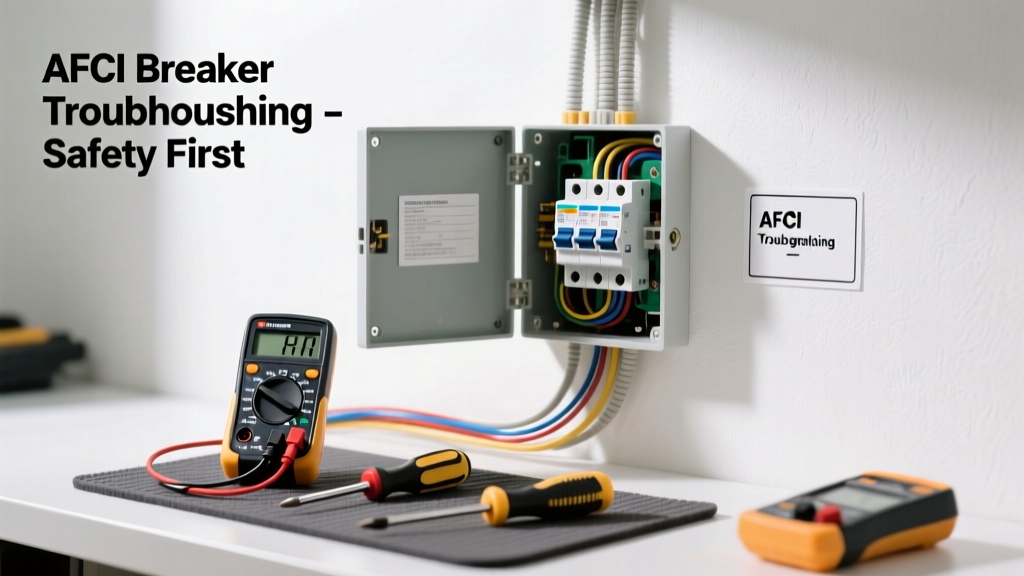
If your AFCI (Arc-Fault Circuit Interrupter) breaker keeps tripping, it’s not just an annoyance—it’s your home’s electrical system sounding an alarm. Unlike standard breakers, AFCIs detect dangerous arcing that can ignite fires, so frequent trips often signal real hazards like damaged wiring, overloaded circuits, or faulty devices. Ignoring them risks fire—not just inconvenience.
Quick Diagnosis
Before grabbing tools, narrow down the cause. AFCI breakers trip for specific reasons—most commonly:
- Frayed, pinched, or aged NM-B (Romex) cable behind outlets or in walls
- Loose or corroded connections at receptacles, switches, or the breaker itself
- Old or failing appliances (especially vacuum cleaners, hair dryers, or power tools)
- Shared neutrals between circuits—a code violation common in older homes
- Moisture intrusion in outdoor or bathroom outlets triggering nuisance arcs
Tools & Materials Needed
| Item | Purpose | Estimated Cost |
|---|---|---|
| Digital multimeter | Test voltage, continuity, and ground-fault leakage on branch circuits | $45–$85 |
| Non-contact voltage tester | Safely verify power is off before opening boxes | $12–$25 |
| Insulated screwdrivers (VDE-rated) | Prevent accidental shorts while working inside panels and outlets | $20–$35 |
| AFCI circuit tester (e.g., Ideal SureTest) | Verify AFCI functionality and detect arc faults under load | $110–$160 |
| Wire nuts (red and yellow) | Secure reconnections after inspecting splices or devices | $3–$8 |
Step-by-Step Fix
Work methodically—and always shut off the main breaker before touching any panel interior. Never bypass or replace an AFCI with a standard breaker.
- Unplug everything on the tripped circuit, then reset the breaker. If it holds, plug devices back in one at a time—trip point reveals the culprit appliance.
- Inspect all outlets and switches on the circuit: remove faceplates and check for scorch marks, melted plastic, loose backstab connections (replace with screw terminals), or frayed wires.
- Test for shared neutrals: Turn off the suspect breaker and use your multimeter to check voltage between its neutral and other circuit neutrals in the panel. Any reading >0.5 V AC indicates a shared neutral—a serious code violation requiring rewiring.
- Check for damaged cable runs: In accessible areas (basement, attic), look for nail/screw damage, rodent chewing, or kinked Romex. Replace damaged sections with new 12/2 NM-B (for 20A circuits) using proper clamps and junction boxes.
- Verify grounding and bonding: An improperly grounded system can cause false AFCI trips. Confirm the panel’s neutral and ground bars are isolated (except at main service) and all grounds are continuous per NEC 2023 Article 250.50.
When to Call a Pro
Stop and call a licensed electrician if you encounter any of these:
- The breaker trips immediately upon reset—even with zero loads connected
- You find aluminum wiring on the circuit (requires COPALUM crimps and special expertise)
- Tripping occurs only during rain or high humidity—suggesting hidden moisture in conduit or underground feeders
- You’re uncomfortable removing the panel cover or testing live bus bars
- Your home was built before 1999 and lacks updated AFCI protection at outlets (NEC 2017 requires retrofitting in many cases)
According to the Electrical Safety Foundation International’s 2022 report, 51% of home electrical fires involve circuits without AFCI protection—and improper DIY repairs increase risk by up to 3.7×.
"AFCIs don’t trip because they’re ‘sensitive’—they trip because they’re working. Every trip is evidence of a condition that could become a fire in minutes." — Mike Holt, NECA Certified Electrical Inspector, 2023
Prevention Tips
Extend AFCI reliability with routine maintenance and smart upgrades:
- Replace backstabbed outlets with screw-terminal models every 10 years (backstabs fail at 3–5× the rate of side screws)
- Install GFCI + AFCI dual-function breakers in kitchens, bathrooms, and laundry rooms where both shock and arc protection are critical
- Use surge protectors with joule ratings ≥1,000 on electronics—voltage spikes mimic arc signatures
- Label circuits clearly in your panel; mislabeled circuits delay diagnosis and increase error risk
Why does my AFCI trip only when I turn on a light switch?
This points to arcing at the switch—often from worn contacts, loose wire nuts, or carbon tracking inside the device. Replace the switch with a spec-grade, commercial-duty model rated for 15–20A resistive loads. Always torque terminal screws to manufacturer specs (typically 14–18 in-lbs).
Can I replace an AFCI breaker with a GFCI breaker instead?
No. GFCIs protect against ground faults (current leakage), while AFCIs detect series and parallel arcs. They address different hazards and aren’t interchangeable. Some breakers combine both (dual-function), but swapping types violates NEC 210.12 and voids UL listing. See our guide on GFCI vs AFCI breakers.
Will a whole-house surge protector stop AFCI tripping?
Not directly—but it reduces voltage transients that can mimic arc signatures. The U.S. Department of Energy estimates transient-related nuisance trips account for ~12% of AFCI callbacks. Pair it with a Type 1+2 SPD installed at the meter base for best results.
Do LED bulbs cause AFCI tripping?
Sometimes. Cheap or non-dimmable LEDs on dimmer circuits generate high-frequency noise that confuses older AFCIs. Use only ENERGY STAR–certified bulbs labeled “AFCI-compatible” and avoid mixing brands on the same circuit. For persistent issues, try an LED-compatible dimmer with trailing-edge design.
How long do AFCI breakers last?
Most last 15–25 years, but performance degrades after 10. Siemens and Eaton recommend replacement at 15 years—even if functional—due to sensor drift. Test monthly using the breaker’s built-in test button; failure to trip means immediate replacement.
Is it safe to reset an AFCI breaker repeatedly?
No. Repeated resetting without diagnosis heats internal components and masks worsening faults. The National Fire Protection Association’s NFPA 70E 2023 standard prohibits more than two resets without investigation. Each reset risks thermal runaway in compromised wiring.
Fixing AFCI trips isn’t about silencing the alarm—it’s about listening carefully to what your wiring is telling you. Most issues resolve with methodical inspection and proper materials, but never trade speed for safety. When in doubt, reach out to a local electrician certified in AFCI diagnostics—your home’s fire safety depends on it. For related troubleshooting, see our guides on circuit breaker tripping and dead outlet repair.