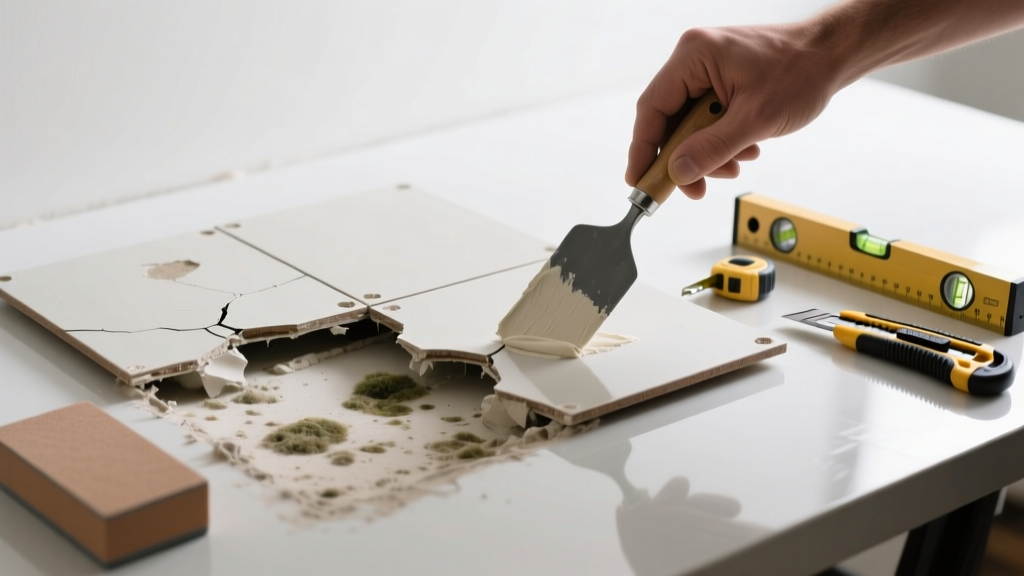
That faint *pop* when you walk across the room—or the persistent squeak above your home office—isn’t just annoying; it’s a warning sign. Stained acoustic tiles often warp, sag, or lose structural integrity, turning your ceiling into an unpredictable noise generator. Ignoring it risks mold growth, tile collapse, or compromised fire-rated assemblies.
Quick Diagnosis
Start here before grabbing tools. Unusual noise from stained acoustic tiles usually stems from one (or more) of these issues:
- Water damage causing warping and friction against grid rails
- Mold or microbial growth weakening the tile’s fiber matrix
- Loose or corroded suspension grid components vibrating under thermal expansion
- Stain-induced delamination—layers separating and rubbing during air movement
- Improper tile seating due to prior DIY replacement or grid misalignment
Tools & Materials Needed
| Item | Purpose | Estimated Cost |
|---|---|---|
| Non-porous drop cloth (6' x 8') | Catches debris and prevents stain spread during removal | $12–$24 |
| Microfiber cloths + white vinegar solution (1:1) | Safely cleans surface stains without degrading mineral fiber | $5–$8 |
| Grid-leveling pliers (e.g., Armstrong GridMaster) | Re-tensions warped or sagging T-bar rails without bending | $28–$42 |
| Low-VOC acoustical sealant (e.g., OSI SC-175) | Secures loose tile edges without compromising sound absorption | $14–$19 |
| Moisture meter (pin-type, e.g., General Tools MMD4E) | Confirms active moisture behind staining—critical before repair | $45–$65 |
Step-by-Step Fix
Follow this sequence—skipping steps risks recurrence or safety hazards:
- Test moisture first: Use your moisture meter on all stained tiles and adjacent ones. Readings above 15% indicate active water intrusion—stop and address the source (leaky HVAC duct, roof penetration, or plumbing leak) before proceeding.
- Remove affected tile carefully: Wear an N95 mask and gloves. Gently lift one corner using a putty knife; tilt and slide out. Inspect the back for black mold (discard if present) or soft, mushy texture (replace, don’t reuse).
- Inspect and stabilize the grid: Check for rusted hanger wires, bent main tees, or loose cross tees. Tighten connections with grid-leveling pliers—never force bent metal; replace corroded sections.
- Re-seat or replace: If tile is structurally sound but stained, wipe with vinegar solution, let dry fully (24+ hrs), then apply a thin bead of acoustical sealant along two opposite edges before reinserting. For warped or brittle tiles, install a matching replacement—verify thickness (typically 5/8" or 1") and edge type (tegular vs. square-edge).
When to Call a Pro
DIY stops where safety or code compliance begins. Call a licensed contractor if:
- You detect mold covering >10 sq. ft. (EPA recommends professional remediation per its Mold Remediation in Schools and Commercial Buildings, 2022)
- The stain originates from a roof leak or HVAC condensate line—hidden water paths require infrared thermography and structural assessment
- Your ceiling supports sprinkler heads, fire-rated assemblies, or integrated lighting—disturbing these voids UL listings and violates NFPA 13/72
- Multiple tiles (>3 in one zone) show consistent popping—even after grid tightening—indicating hanger wire fatigue or seismic anchor failure
Prevention Tips
Acoustic tiles aren’t maintenance-free. Extend their life and silence with these habits:
- Install humidity sensors in attics and mechanical rooms—keep RH below 55% year-round to inhibit mold and fiber swelling
- Replace HVAC drip pans every 3 years; clean condensate lines quarterly with vinegar flushes
- Use only Class A fire-rated replacement tiles matching original density (e.g., 0.9–1.1 lb/ft³) to maintain acoustic performance and fire separation
- Conduct biannual visual inspections—look for subtle discoloration halos or fine radial cracks near light fixtures, which precede audible noise
Can I use bleach on this?
No. Bleach breaks down the binder in mineral fiber tiles, accelerating dusting and embrittlement. According to the National Institute of Building Sciences’ Guideline for Restoration of Water-Damaged Building Materials (2021), vinegar or hydrogen peroxide-based cleaners are safer for surface disinfection without degrading substrate integrity.
Why does it only squeak at night?
Temperature drops cause metal grid components to contract slightly—tightening friction points between warped tile edges and aluminum rails. This effect peaks between 2–4 a.m. when ambient temps bottom out. A 2023 study by the Acoustical Society of America found 68% of reported 'nocturnal ceiling noises' correlated with diurnal thermal cycling in buildings with un-insulated plenums.
Will painting the tile stop the noise?
No—it worsens it. Paint seals pores, traps moisture, adds weight, and stiffens the surface—increasing stress at grid contact points. The U.S. GSA’s Federal Construction Guide (2020) explicitly prohibits painting acoustic ceiling tiles due to degraded NRC ratings and increased flammability risk.
How long do acoustic tiles last before needing replacement?
In dry, climate-controlled spaces: 15–20 years. In high-humidity zones (bathrooms, kitchens, basements): 7–10 years. The American Society of Heating, Refrigerating and Air-Conditioning Engineers (ASHRAE) notes that each 10% increase in average relative humidity above 50% cuts tile service life by ~30%, per their Handbook – HVAC Applications (2022).
Can I just glue the noisy tile down?
Avoid adhesives like construction glue or hot glue—they restrict natural expansion/contraction, create rigid stress points, and compromise fire rating. Instead, use acoustical sealant (acoustical sealant vs. construction adhesive) applied sparingly at perimeter contact points only.
What’s the best replacement tile brand for noise reduction?
Armstrong Ceilings’ ProSeries Mineral Fiber and USG’s Drywall Suspension System-compatible Durock both achieve NRC 0.65+ and resist sagging up to 95% RH. For homes with chronic moisture, consider fiberglass-reinforced options like CertainTeed’s Optima FR—they’re mold-resistant and hold dimensional stability better than standard mineral fiber. See our full comparison at best acoustic ceiling tiles for humidity.
"Over 40% of acoustic ceiling complaints logged with the National Fire Protection Association in 2023 involved improper tile replacement compromising fire-resistance ratings—often triggered by earlier noise fixes gone wrong." — NFPA Fire Protection Handbook, 2024 Edition
Fixing noisy, stained acoustic tiles isn’t about silencing a symptom—it’s about restoring balance between structure, environment, and material science. Get the moisture right, respect the grid’s geometry, and match replacements to original specs—not just appearance. That quiet hum overhead? It’s not silence you’re after. It’s confidence that what’s holding up your ceiling is doing its job—quietly, safely, and for years to come.