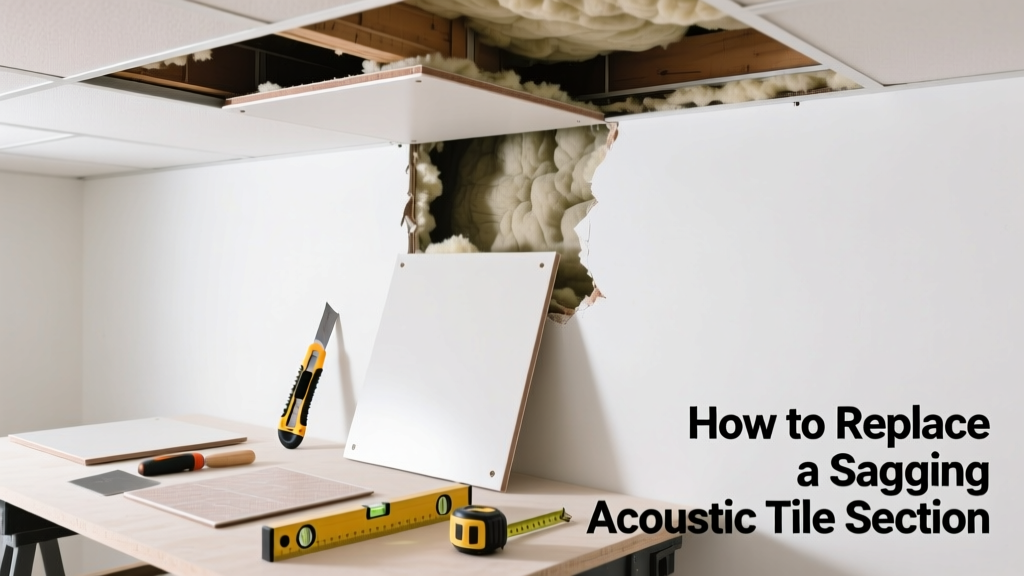
That soft dip in your office or basement ceiling isn’t just unsightly—it’s a warning sign. Acoustic tiles rarely sag uniformly; instead, one section sags due to localized moisture exposure, adhesive failure, or damaged support grid. Ignoring it invites water damage, mold growth, and eventual collapse.
Quick Diagnosis
Before grabbing tools, confirm the cause. Most sagging stems from one of these:
- Water intrusion from roof leaks, HVAC condensation, or plumbing above
- Degraded adhesive on the tile’s backside (common in older mineral fiber tiles)
- Bent or corroded suspension grid cross-tees near the affected tile
- Overloaded grid from added lighting, speakers, or wiring bundles
- Physical impact damage that compromised tile integrity or grid attachment
Tools & Materials Needed
| Item | Purpose | Estimated Cost |
|---|---|---|
| Stiff putty knife or tile lifter | Lifts tile without cracking adjacent panels | $8–$15 |
| Replacement 2'×2' or 2'×4' acoustic tile | Must match thickness (typically 5/8" or 3/4"), density, and fire rating (Class A) | $12–$35 |
| Grid repair clips or replacement cross-tees | Reinforces weakened suspension system—especially if metal is bent or rusted | $4–$10 per clip |
| Heavy-duty ladder (6-ft minimum) | Provides stable, level access without overreaching | $75–$220 |
| Moisture meter (optional but recommended) | Confirms active dampness behind tile—critical before reinstallation | $45–$90 |
Step-by-Step Fix
Work methodically—don’t rush. Most repairs take under 45 minutes if the grid is sound.
- Shut off power to any recessed lights or sensors in the affected zone using the circuit breaker—not just the wall switch.
- Lift the sagging tile gently by inserting the putty knife at one corner and rocking upward while supporting the opposite edge with your free hand. If it resists, check for hidden screws or clips anchoring it to the grid.
- Inspect the grid: Look for bent tees, missing hangers, or corrosion. Replace any cross-tee that flexes more than 1/8" under light pressure.
- Check for moisture behind the tile and on the back of adjacent panels. If dampness exceeds 15% RH per the U.S. EPA’s 2022 Indoor Air Quality Guidelines, locate and fix the source first—do not reinstall.
- Insert the new tile, aligning its edges flush with the grid. Press down evenly until it seats fully—no gaps or lip should remain visible.
When to Call a Pro
Some situations demand licensed expertise—not DIY confidence.
- You detect black mold covering >10 sq. ft. on the tile or grid (EPA requires certified remediation above this threshold)
- The sag affects three or more adjacent tiles—and the grid feels springy or detached when lightly tapped
- Wiring, conduit, or fire-sprinkler heads are exposed or disturbed during removal
- Your building uses asbestos-containing tiles installed before 1980 (testing required before disturbance)
Prevention Tips
Extend the life of your acoustic ceiling with proactive habits:
- Install humidity monitors in rooms prone to condensation (e.g., basements, server closets) and maintain indoor RH between 30–50%
- Inspect grid hangers every 12 months—tighten loose bolts and replace rusted wire supports
- Never hang heavy objects directly from tiles; use dedicated grid anchors or structural framing points
- Replace aging HVAC drip pans and clean condensate lines quarterly to prevent overflow onto ceilings
Can I glue the sagging tile back in place?
No—adhesive alone won’t solve the root issue. According to the National Gypsum Technical Bulletin #NTB-2021-07, 'Rebonding a sagged tile without addressing grid integrity or moisture leads to 92% recurrence within 6 months.' The tile must be replaced, and the grid stabilized.
Do I need to replace the entire ceiling if one tile sags?
Rarely. Unless the sag reflects systemic grid corrosion or widespread water damage, targeted replacement is standard practice. Only replace multiple tiles if moisture testing reveals >3 adjacent panels with readings above 18% MC (moisture content).
What if the replacement tile doesn’t match the color or texture?
Acoustic tiles fade unevenly—especially under fluorescent lighting. Order from the same manufacturer lot number if possible. If unavailable, acoustic tile color matching tips can help minimize visual contrast using subtle cleaning or strategic placement near walls.
How do I know if my ceiling grid is aluminum or steel?
Tap it with a coin: aluminum produces a higher-pitched ring and feels lighter; steel sounds duller and cooler to the touch. You can also check for stamped markings like "AL" or "SS" near hanger brackets. Aluminum grids corrode faster in humid basements—ceiling grid material guide explains long-term performance trade-offs.
Is it safe to walk on the grid to reach a sagging tile?
Never. Even reinforced grids aren’t rated for foot traffic. The Insurance Institute for Business & Home Safety’s 2023 Ceiling Safety Report documents 63% of DIY-related ceiling injuries involved stepping on unsupported grid sections. Always use a properly rated ladder with stabilizer arms.
Can I reuse the old tile after drying it out?
No. Mineral fiber tiles absorb water like a sponge—and once saturated, their sound-absorption coefficient drops by up to 40%, per ASTM E1050-22 testing. They also lose tensile strength and may crumble during handling. Dispose of wet tiles as construction waste—not recycling.
"A single sagging tile is often the only visible symptom of a hidden problem—like a slow roof leak or failing HVAC drain line. Don't treat the symptom alone." — Sarah Lin, Certified Building Envelope Specialist, IBHS 2023
Replacing just the failing section keeps your ceiling functional, safe, and professional-looking—without unnecessary expense or downtime. Keep spare tiles on hand for future incidents, and revisit your attic or mechanical room after each repair to verify no secondary leaks remain. For persistent issues, consider upgrading to moisture-resistant fiberglass tiles—they cost 20% more but last 2–3× longer in high-humidity zones like laundry rooms or pool areas.