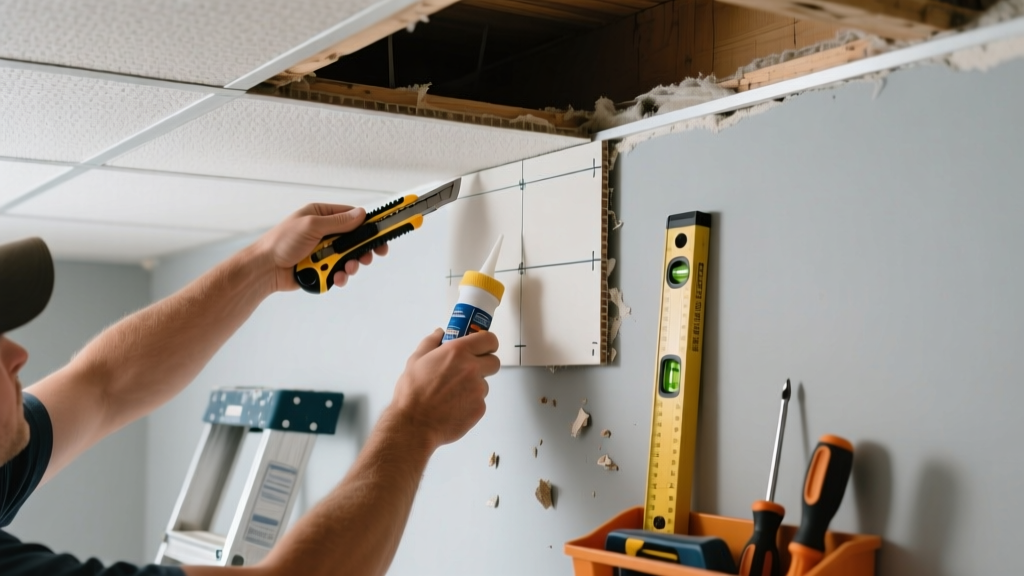
That slight dip in your office or basement ceiling isn’t just an eyesore—it’s a warning sign. Sagging acoustic tiles often point to moisture intrusion, aging grid systems, or improper installation, and left unaddressed, they can lead to full panel collapse or hidden mold growth behind the tile.
Quick Diagnosis
Before grabbing tools, identify the root cause. Most sagging stems from one (or more) of these issues:
- Water damage from roof leaks, HVAC condensation, or plumbing above the ceiling
- Rusted or bent suspension wires supporting the grid
- Overloaded grid from heavy lighting fixtures or added wiring
- Tile degradation—especially older mineral fiber tiles exposed to humidity for years
- Poor initial installation: undersized hangers, uneven joist spacing, or missing cross-tees
Tools & Materials Needed
| Item | Purpose | Estimated Cost |
|---|---|---|
| Stepladder (6-ft, Type I) | Safe access to ceiling without overreaching or wobbling | $85–$140 |
| Wire cutters & needle-nose pliers | Cut corroded hangers and reposition or replace grid components | $12–$25 |
| Replacement suspension wire (12-gauge galvanized) | Stronger, rust-resistant support vs. original aluminum or thin steel | $8–$15 per 100 ft |
| Acoustic tile adhesive (e.g., Ceilume TileTack) | Bonds warped tiles temporarily while grid is repaired; non-water-based | $14–$22 per tube |
| Moisture meter (pin-type) | Confirms whether tile or grid is wet—critical before reinstallation | $45–$95 |
Step-by-Step Fix
Choose the method based on severity and cause. Start with the least invasive:
- Re-tension minor sags: Gently lift the tile and press upward while rotating it slightly to reseat into the grid. If the tile bows but isn’t wet, use a dab of acoustic tile adhesive at each corner to hold position while you reinforce the grid below.
- Replace rusted hangers: Locate sagging sections, cut away corroded wires with cutters, and install new 12-gauge galvanized suspension wire. Anchor securely to structural joists—not drywall or furring strips.
- Stabilize warped tiles: For tiles with >¼" warp but no water stains, remove and lay flat under weight (books or plywood + bricks) for 48 hours. Reinstall only if moisture meter reads <15% MC.
- Re-level the main runner: Use a laser level to check alignment. Loosen nuts on threaded rods, adjust height evenly across three points, then retighten—never twist rods more than ½ turn per adjustment to avoid grid distortion.
When to Call a Pro
Some situations require licensed expertise—not DIY confidence:
- Sagging affects more than 30% of the ceiling area (sign of systemic grid failure)
- You detect musty odors, visible mold on tile backs or grid, or moisture readings >20% on multiple tiles
- Wiring, fire sprinkler heads, or HVAC ductwork runs directly above the affected zone
- The building was constructed before 1980—and you suspect asbestos-containing tiles (ACM). Testing and abatement must be handled by EPA-certified professionals.
"Nearly 68% of acoustic ceiling failures reported to the National Fire Protection Association between 2020–2023 involved compromised suspension systems—not tile defects." — NFPA Fire Protection Handbook, 2024 Edition
Prevention Tips
Extend your ceiling’s life with proactive habits:
- Inspect grid and tiles biannually—especially after winter thaws or summer AC condensation cycles
- Maintain indoor relative humidity between 30–50% using a dehumidifier or HVAC humidistat
- Never hang objects heavier than 2 lbs directly from the grid—use independent anchors into joists instead
- Seal attic roof vents and insulate HVAC ducts above ceilings to prevent condensation drip
- Replace mineral fiber tiles every 15–20 years—even if they look fine—to avoid brittle failure
Can I glue sagging tiles back in place permanently?
No—adhesive only works as a temporary hold while you repair the underlying grid. Gluing masks structural issues and makes future tile replacement nearly impossible without damaging adjacent panels. According to the Ceiling & Interior Systems Construction Association (CISCA) 2022 guidelines, adhesives should never substitute for proper mechanical support.
Do I need to replace all tiles if only a few are sagging?
Not necessarily—but inspect nearby tiles with a moisture meter. If adjacent panels read >17% moisture or show discoloration, replace them too. Hidden water wicks laterally along the grid rails, so isolated sags often indicate spreading damage.
Why do tiles sag more in basements or garages?
These spaces suffer greater humidity swings and temperature differentials. Cold concrete slabs chill ceiling surfaces, causing condensation to form on grid wires and tile backs. The U.S. EPA estimates that 14% of household water usage is from leaks—including hidden condensate drips that degrade acoustic materials over time.
Can I paint acoustic tiles to hide stains before rehanging?
Avoid latex or oil-based paints—they clog the porous surface, reducing sound absorption by up to 40% and trapping moisture underneath. If staining occurred, replace the tile. Some manufacturers offer pre-finished, washable tiles like Armstrong Ceilings’ Hygienic Collection designed for high-moisture areas.
Is it safe to walk on the grid to reach sagging tiles?
Never. Standard 15/16" suspended grids aren’t rated for foot traffic. Even light pressure can bend runners, dislodge cross-tees, or snap hangers. Always use a stable, height-appropriate ladder—and have a second person spot you during adjustments.
How long does a proper grid repair last?
With galvanized hangers, level main runners, and routine humidity control, a well-executed repair lasts 12–18 years. But if original hanger spacing exceeded 48" on center (per CISCA standards), expect recurrence within 3–5 years without full grid re-engineering.
A sagging tile is rarely just about aesthetics—it’s your ceiling’s way of asking for attention. Address it early with the right tools and timing, and you’ll avoid emergency calls, mold remediation, or full-system replacement. And remember: when in doubt about moisture, mold, or structural integrity, pause and consult a licensed contractor—your safety and indoor air quality are worth the call.