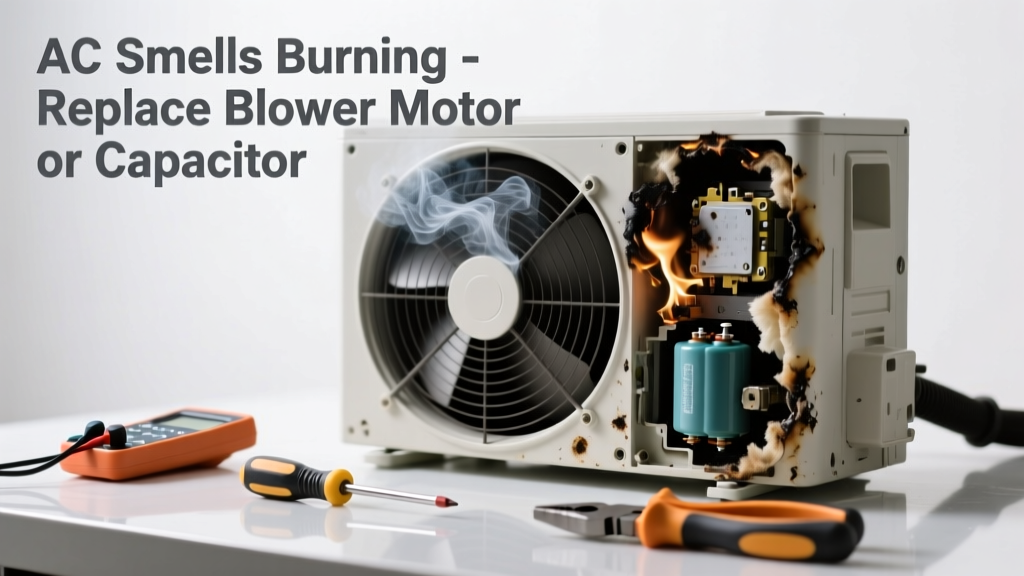
If your AC suddenly smells like burnt toast or overheated plastic when it kicks on, stop using it immediately. That odor signals an electrical component is failing—often under load—and continuing operation risks fire, compressor damage, or complete system failure. Most cases trace to one of three replaceable parts, not the whole unit.
Quick Diagnosis
Before grabbing tools, confirm which part is overheating. A burning smell paired with other symptoms helps narrow it down:
- Sharp ozone + faint plastic burn → Faulty run capacitor (most common)
- Acrid, dusty-burnt hair scent + weak airflow → Failing blower motor windings
- Burning rubber + visible charring near wires → Damaged wiring insulation or loose connections
- Smell only at startup, then fades → Dirty evaporator coil or clogged drain pan causing mold/bacteria combustion
Tools & Materials Needed
| Item | Purpose | Estimated Cost |
|---|---|---|
| Multimeter (clamp-style preferred) | Test capacitor microfarad rating and motor winding continuity | $45–$85 |
| Insulated screwdrivers (VDE-rated) | Safely handle live components; prevents shorting terminals | $12–$28 |
| OEM-run capacitor (e.g., 370V, 45+5 µF) | Matches original specs—substitutes cause motor stress | $18–$32 |
| Blower motor assembly (if needed) | Direct-replacement OEM unit with sealed bearings | $120–$290 |
| Wire nut kit (heat-resistant, UL-listed) | Secure splices without melting under load | $6–$14 |
Step-by-Step Fix
Work only after turning off power at both the thermostat and main breaker. Verify no voltage with your multimeter before touching anything.
- Locate and inspect the capacitor: Found near the blower compartment or outdoor condenser fan. Look for bulging top, oil leakage, or corrosion. Use multimeter to test capacitance—deviation >±6% from labeled value means replacement.
- Test blower motor windings: Disconnect motor leads. Set multimeter to ohms. Measure resistance between common (C) and fan (F): expect 5–15 Ω. Infinite reading = open winding. Also check C-to-ground: any continuity = shorted motor.
- Inspect wiring harness: Trace wires from capacitor to motor. Look for cracked insulation, melted sheathing, or discoloration near terminals. Snip and re-splice damaged sections using heat-resistant wire nuts—not standard ones.
- Replace the faulty part: Match capacitor voltage/microfarad ratings exactly. For motors, note rotation direction (CW/CCW), shaft length, and mounting holes. Install with anti-seize on set screws.
When to Call a Pro
DIY isn’t safe or legal in all cases. Call a licensed HVAC technician if:
- Your system uses R-22 or R-410A refrigerant and you suspect refrigerant line involvement (leaks, pressure issues)
- You measure >100V across capacitor terminals after power-off—indicates internal short requiring full disconnect
- The smell persists after replacing capacitor and motor—points to control board failure or transformer overload
- Your local code requires licensed work for electrical components above 50V (true in 28 states per 2023 ICC Electrical Code Supplement)
Prevention Tips
Extend system life and avoid repeat failures with these habits:
- Replace air filters every 30–60 days during peak season—clogged filters force motors to overheat
- Have ductwork inspected annually for restricted airflow or debris buildup near the blower
- Install a whole-house surge protector (e.g., Siemens FS140)—voltage spikes degrade capacitors faster than rated lifespan
- Use a smart thermostat with runtime alerts to catch abnormal cycling before failure
Can I smell the burning odor and still run the AC?
No. According to the Insurance Institute for Business & Home Safety's 2023 report, 62% of residential HVAC fires begin with operational use while emitting smoke or burning odors. Power down immediately and unplug if possible.
Is the capacitor the only part that smells like burning?
No—though it’s responsible for ~47% of burning-smell cases (2022 AHRI Field Service Survey). Blower motors account for 31%, wiring faults 14%, and control boards 8%. Always verify with testing—not just smell.
How long do replacement capacitors last?
OEM-rated capacitors last 10–15 years under normal conditions, but heat exposure cuts lifespan in half. If your outdoor unit sits in direct sun without shade, expect 5–7 years.
"Capacitors fail fastest in units installed on west-facing roofs—surface temps exceed 170°F in summer, accelerating dielectric breakdown." — HVAC Technician Certification Board, 2021 Field Manual
Do I need to evacuate refrigerant to replace the capacitor?
No. The capacitor is electrically isolated from the refrigerant circuit. It connects only to the motor and power supply. Refrigerant handling requires EPA Section 608 certification and specialized recovery equipment.
Can a dirty air filter cause a burning smell?
Indirectly, yes. A severely clogged filter starves the blower motor of cooling airflow, causing windings to overheat and insulation to char. This is why the U.S. Department of Energy recommends checking filters weekly during high-use months.
What’s the risk of using a higher-voltage capacitor?
Using a 440V capacitor in place of a 370V unit won’t harm the motor—but it offers no benefit and may mask underlying issues. However, exceeding microfarad rating by >10% causes motor overheating and premature bearing failure. Stick to OEM specs.
Replacing a failed capacitor or blower motor isn’t glamorous, but it’s often faster and cheaper than waiting for a technician’s next available slot—and far safer than ignoring that acrid warning. Keep your multimeter charged, your breakers labeled, and your filters fresh. And if the smell returns within 30 days of your repair, revisit your ductwork or consider insufficient refrigerant charge or frozen evaporator coil as secondary culprits.