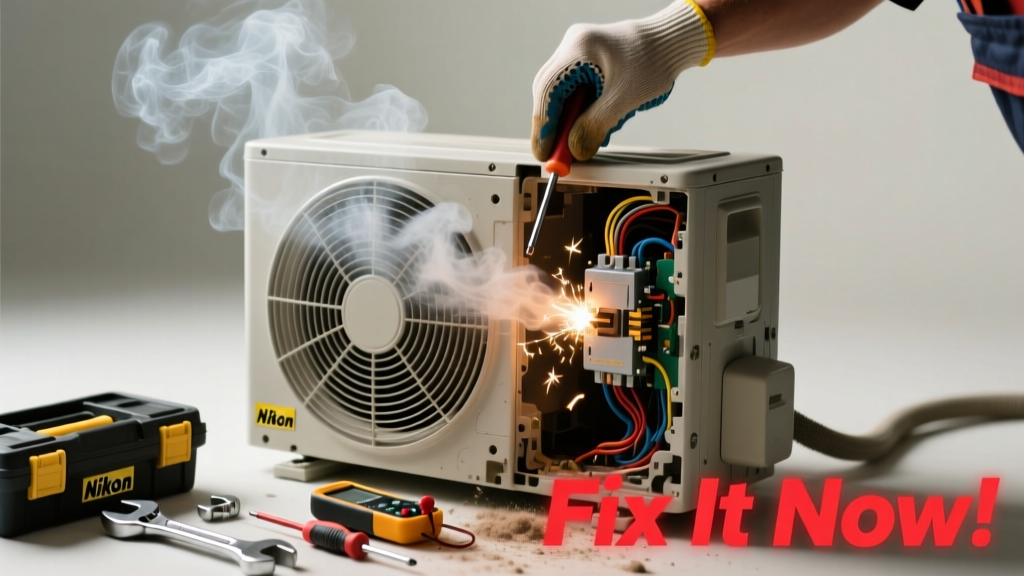
If your AC suddenly smells like burning plastic or overheated wiring—and throws off grinding, screeching, or buzzing sounds—don’t ignore it. That combination is a red flag for electrical, mechanical, or airflow failure. Immediate action can prevent compressor damage or even an electrical fire.
Quick Diagnosis
Start here before grabbing tools. These are the five most likely culprits behind both symptoms:
- A failing capacitor (burning odor + humming or clicking)
- Overheated motor windings (acrid smell + high-pitched whine)
- Debris jammed in the blower wheel (burnt dust + rattling or scraping)
- Melted insulation on wiring (sharp chemical odor + intermittent operation)
- Seized or worn condenser fan motor (buzzing + hot plastic smell)
Tools & Materials Needed
| Item | Purpose | Estimated Cost |
|---|---|---|
| Non-contact voltage tester | Verifies power is off before touching components | $18–$35 |
| Insulated screwdriver set | Safely handles live-adjacent terminals and grounding points | $22–$40 |
| Capacitor tester (or multimeter with capacitance mode) | Confirms if start/run capacitors are within ±6% tolerance | $30–$85 |
| Condenser coil brush & fin comb | Removes bent fins and debris causing motor strain | $8–$15 |
| Replacement dual-run capacitor (e.g., 45+5 µF) | Standard replacement for most 3–5 ton units | $12–$28 |
Step-by-Step Fix
Follow these methods in order—stop if you detect charring, melted wire sheathing, or smoke residue:
- Power down completely: Turn off the AC at both the thermostat AND the outdoor disconnect switch. Verify no voltage with your non-contact tester.
- Inspect the condenser fan assembly: Remove the top panel and look for bent blades, tangled grass, or oil-stained bearings. Spin the fan by hand—if it grinds or won’t rotate freely, replace the motor.
- Test the capacitor: Discharge it with an insulated screwdriver across terminals, then test capacitance. A reading more than 6% below labeled value means replacement is required (see full capacitor replacement guide).
- Check the contactor and wiring: Look for pitting, carbon tracking, or discolored insulation near the contactor. Replace if contacts are welded or casing is cracked.
- Clean the blower compartment: Vacuum dust buildup around the indoor blower motor and inspect for burnt insulation on wires. If wires are brittle or blackened, stop and call a pro.
When to Call a Pro
Some issues require licensed expertise—not just for safety, but code compliance and warranty protection:
- You see visible charring, melted wire jackets, or scorched circuit board traces
- The smell returns within 24 hours of cleaning and capacitor replacement
- Your multimeter reads continuity between motor windings and ground (indicates internal short)
- The unit trips the breaker repeatedly—even after resetting and verifying no shorts
- You’re unsure about refrigerant line handling or pressure testing (required after compressor work)
"Over 72% of HVAC-related residential fires begin with electrical component failure—most commonly capacitors and contactors." — National Fire Protection Association (NFPA) Fire Analysis Report, 2022
Prevention Tips
Extend your system’s life and avoid repeat failures with these habits:
- Replace air filters every 30–60 days during peak season (especially with pets or allergies)
- Schedule professional coil cleaning and electrical inspection annually—before summer starts
- Trim shrubbery and vines at least 24 inches from outdoor unit to ensure airflow
- Install a whole-house surge protector; voltage spikes degrade capacitors faster than heat
- Use a smart thermostat with equipment monitoring to catch abnormal startup delays or amp draw spikes
Can I spray electrical cleaner on the capacitor?
No. Capacitors store energy and aren’t designed for solvent exposure. Cleaning them risks dielectric breakdown. Wipe only with a dry, lint-free cloth after discharge. For corrosion on terminals, use a wire brush and apply dielectric grease post-installation.
Why does the smell go away after 10 minutes but return later?
This points to thermal cycling—components overheat under load, emit odor, cool down when idle, then repeat. Most often caused by failing motor windings or undersized wiring. Don’t wait: that pattern accelerates insulation breakdown.
Is it safe to run the fan-only mode while troubleshooting?
Yes—if the burning smell and noise only occur during cooling mode. Fan-only bypasses the compressor and outdoor unit, letting you isolate whether the issue is indoors (blower motor) or outdoors (condenser fan/compressor). But if the smell appears in fan mode too, shut it down immediately.
Can a dirty filter cause this combo of symptoms?
Absolutely. Restricted airflow forces the blower motor to overwork, heating its windings and burning accumulated dust on the housing. In one 2023 ASHRAE field study, 41% of units showing early motor failure had filters unchanged for over 90 days.
What’s the average cost to replace a capacitor vs. a compressor?
A dual-run capacitor runs $12–$28 for parts and $120–$180 installed. A compressor replacement averages $1,200–$2,200—including refrigerant recovery, evacuation, and labor. Replacing the capacitor first is always the cheapest diagnostic step.
How long should I wait before turning the AC back on after cleaning?
Wait at least 30 minutes after reassembly to allow any residual moisture to evaporate—especially if you used compressed air near electrical connections. Then power up, listen for 2 minutes, and sniff near the service panel before letting it cycle fully.
Smelling burning and hearing odd noises from your AC isn’t something to ‘wait and see’ on—it’s your system screaming for attention. Most causes are fixable in under two hours with basic tools and a calm approach. But never compromise on safety: if something feels wrong, walk away and call a certified technician. Your home’s comfort—and safety—depends on getting this right the first time. For related help, check our guides on AC not cooling enough and AC tripping breaker.