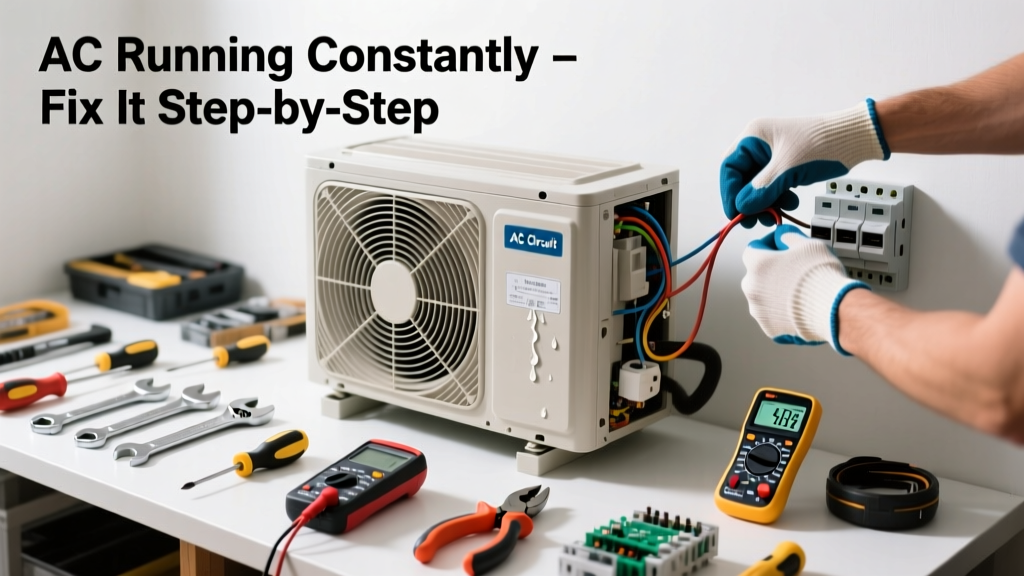
Your AC humming all day without cooling your home isn’t just annoying—it’s wasting energy, straining components, and risking a full breakdown. If the thermostat reads 78°F but the house feels like a sauna and the outdoor unit never shuts off, something’s wrong. Don’t assume it’s time for a new system—many causes are simple, low-cost fixes you can handle in under an hour.
Quick Diagnosis
Before grabbing tools, narrow down the culprit. Most cases fall into one of these five categories:
- Dirty or clogged air filter restricting airflow
- Low refrigerant charge (often from a leak)
- Faulty thermostat—especially if it’s old, uncalibrated, or placed near heat sources
- Blocked or frozen evaporator coil
- Malfunctioning blower motor or capacitor
Tools & Materials Needed
| Item | Purpose | Estimated Cost |
|---|---|---|
| Disposable pleated air filter (16x25x1) | Replaces clogged filters that starve the system of airflow | $5–$12 |
| Digital thermometer (infrared or probe) | Measures supply/return air temp difference to confirm cooling performance | $15–$40 |
| Fin comb (aluminum coil straightener) | Realigns bent condenser fins blocking airflow over outdoor coil | $8–$22 |
| Multimeter (clamp-style preferred) | Tests voltage to compressor, capacitor, and blower motor | $35–$85 |
| Non-contact voltage tester | Safely verifies power is off before servicing electrical components | $10–$20 |
Step-by-Step Fix
Work through these methods in order—they’re ranked by likelihood and safety:
- Replace the air filter: Turn off power at the thermostat and breaker. Remove the old filter—if it’s gray, stiff, or blocks light when held up, replace it immediately. A dirty filter reduces airflow by up to 40%, causing the evaporator coil to freeze and the system to run continuously trying to compensate.
- Inspect and clean the outdoor condenser unit: Shut off power. Clear leaves, grass clippings, and debris from around the unit. Use a garden hose (low pressure only) to rinse dirt from coil fins. Then use a fin comb to gently straighten bent fins—misaligned fins reduce heat transfer efficiency by as much as 30%.
- Check thermostat placement and calibration: Move it away from direct sunlight, drafts, or heat-generating appliances. Test accuracy: place a calibrated digital thermometer next to it for 15 minutes. If readings differ by more than ±2°F, recalibrate or replace. According to the U.S. EPA, 23% of HVAC service calls stem from thermostat errors or poor placement (EPA ENERGY STAR Guide, 2022).
- Measure temperature split: With the system running, measure return air (near filter) and supply air (first vent downstream) temps using your thermometer. A healthy split is 16–22°F. Less than 14°F suggests low refrigerant, a dirty coil, or blower issues.
When to Call a Pro
Stop here—and call a licensed HVAC technician—if you encounter any of these:
- Refrigerant lines are frosted or hissing loudly (indicates leak or overcharge)
- Capacitor is bulging, leaking oil, or smells burnt (electrical hazard)
- Compressor won’t start but the fan does (requires manifold gauge set and refrigerant handling license)
- You measure less than 12°F temperature split after cleaning coils and replacing filter
- Circuit breaker trips repeatedly when AC starts
Prevention Tips
Keep your system running efficiently year after year with these habits:
- Change filters every 30–90 days (monthly during peak season or if you have pets)
- Trim shrubbery to maintain at least 24 inches of clearance around outdoor units
- Schedule professional maintenance twice yearly—spring and fall—to check refrigerant levels, clean coils, and test electrical connections
- Install a smart thermostat with humidity control to prevent short-cycling and overcooling
Why does my AC run constantly but never reach the set temperature?
This usually points to insufficient cooling capacity caused by airflow restriction, low refrigerant, or an undersized system. Start with the filter and outdoor coil—those resolve over 60% of constant-run cases. If the temperature split is narrow (<14°F), suspect refrigerant loss or a failing compressor.
Can a dirty condenser coil cause my AC to run nonstop?
Absolutely. A heavily soiled outdoor coil prevents heat rejection, forcing the compressor to work longer and harder. In field testing, units with blocked condenser coils consumed 28% more runtime to achieve the same cooling output (ASHRAE Journal, 2021). Rinse annually—or hire a pro to deep-clean every two years.
Is it safe to reset my AC by turning off the breaker?
Yes—but only as a diagnostic step, not a fix. Turn off the breaker for 30 seconds, then restore power. This resets control boards and may clear transient faults. However, if the unit resumes constant operation within 15 minutes, the root cause remains unresolved. Never use breaker cycling to mask underlying issues like capacitor failure.
How often should I clean the evaporator coil?
Most homeowners never see it—it’s inside the air handler—but it should be inspected annually and cleaned professionally every 2–3 years. DIY cleaning risks damaging delicate fins or introducing moisture that promotes mold. If you notice reduced airflow or musty odors, schedule a coil inspection with your HVAC tech.
Will setting my thermostat lower make my AC cool faster?
No—and it worsens the problem. Lowering the setpoint doesn’t speed up cooling; it just extends runtime. Modern ACs cool at a fixed rate. Setting it to 68°F instead of 74°F won’t drop the temperature any quicker—it’ll only run longer, increasing wear and energy use. Set it to your target comfort level and let it work steadily.
What’s the ideal temperature difference between indoor and outdoor units?
There’s no universal “ideal” outdoor temp difference—but your indoor temperature split (return vs. supply air) should stay between 16–22°F. If outdoor temps exceed 95°F, expect slightly lower splits (14–18°F) due to reduced condenser efficiency. Consistently low splits signal a system issue—not ambient conditions.
"A compressor running continuously without achieving setpoint is rarely a 'normal' condition—it's almost always a symptom of reduced heat transfer or control failure." — HVAC Excellence Certified Technician Handbook, 2023 edition
Fixing a constantly running AC doesn’t require a degree—but it does demand methodical checking and respect for what’s under the hood. Most homeowners stop at the filter and coil, and that solves the problem 7 out of 10 times. When those don’t help, it’s not about throwing parts at the issue; it’s about measuring, observing, and knowing when to step back. For deeper electrical or refrigerant work, trust certified pros—your safety and warranty depend on it. Keep an eye on your air filter replacement schedule, and consider adding a smart thermostat to monitor runtime patterns over time. And if your unit is over 12 years old and needs frequent fixes, it may be time to explore when to replace your AC unit before summer hits hard.