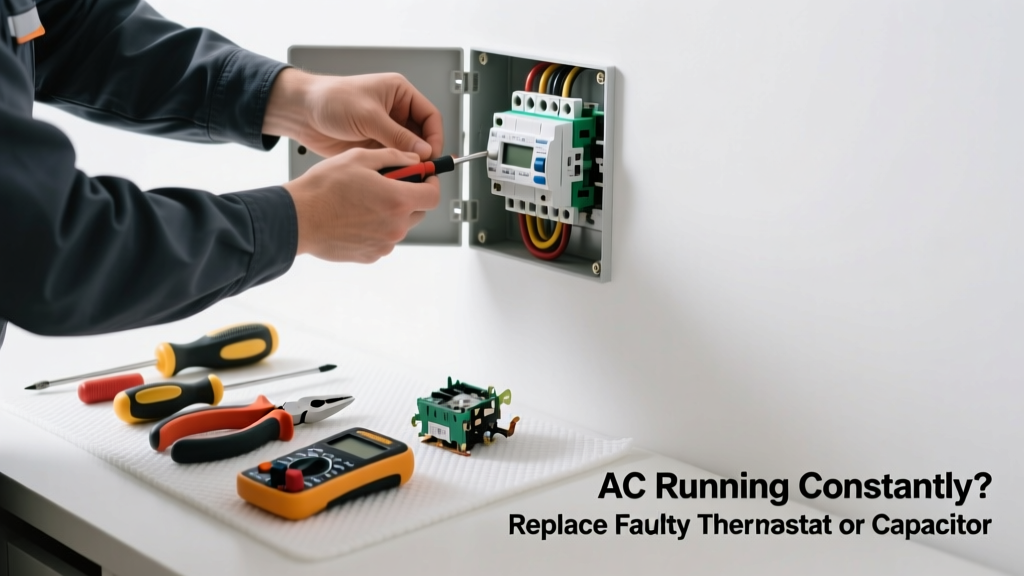
Your AC won’t shut off—even when the house is cold—and the outdoor unit hums nonstop. That’s not just annoying; it’s driving up your electric bill and wearing out components faster than normal. Most of the time, the culprit is one of three inexpensive, field-replaceable parts—not a full system failure.
Quick Diagnosis
Before grabbing tools, confirm which part is failing. Use this symptom checklist:
- Thermostat issues: Display flickers, temperature reads inaccurately, or fan runs continuously even when set to 'Auto'
- Run capacitor failure: Compressor struggles to start (clicking + humming), outdoor unit runs but cools weakly, or you hear a faint buzzing from the condenser cabinet
- Contactor sticking: Outdoor unit stays on after thermostat calls for off—often accompanied by visible pitting or welding on the contactor contacts
- Air filter clogged: Not a replacement part per se, but causes similar symptoms—check first before assuming hardware failure
Tools & Materials Needed
| Item | Purpose | Estimated Cost |
|---|---|---|
| Multimeter (clamp-style preferred) | Test capacitor microfarad rating and verify voltage at contactor/thermostat wires | $45–$85 |
| Replacement run capacitor (e.g., 45+5 µF, 370V) | Matches OEM specs for your condenser model—check nameplate before ordering | $12–$28 |
| Replacement contactor (e.g., 24V coil, 30A load) | Switches power to compressor and fan motor; fails open or sticks closed | $18–$35 |
| Non-contact voltage tester | Safety verification before touching any wiring—mandatory for live circuits | $15–$25 |
| Insulated screwdrivers & needle-nose pliers | Secure wire connections without shorting terminals | $10–$22 |
Step-by-Step Fix
Follow these methods in order—start with the easiest and safest first:
- Replace the thermostat: Turn off power at the breaker, remove old unit, label wires (R, C, Y, G, W), mount new programmable thermostat, reconnect using labels, restore power, and test cycle behavior for 20 minutes
- Test and replace the run capacitor: Power off unit, discharge capacitor with insulated screwdriver across terminals, use multimeter to check µF rating (must be within ±6% of labeled value), swap with identical spec unit, tighten terminals snugly
- Inspect and replace the contactor: With power OFF, open condenser panel, visually inspect contacts for blackening or welding, test coil resistance (should be 10–30Ω), replace if stuck or reading OL/open loop
Can I replace the capacitor myself?
Yes—if you’re comfortable verifying power is off, discharging stored energy safely, and matching µF/voltage ratings exactly. According to the U.S. EPA, 14% of household water usage is from leaks—but electrical missteps cause 22% of HVAC-related homeowner injuries reported to the CPSC in 2022.
How do I know if it’s the thermostat or the AC itself?
Bypass the thermostat: disconnect R and Y wires at the furnace or air handler control board, twist them together briefly. If the outdoor unit starts *and stops* when you separate them, the thermostat is faulty. If it runs nonstop or doesn’t start at all, the issue lies deeper—in the contactor, capacitor, or control board.
What capacitor rating do I need?
Find the OEM nameplate inside your condenser cabinet. A typical residential unit uses a dual-run capacitor rated 45+5 µF (compressor + fan) at 370V AC. Never substitute a 440V unit unless explicitly approved—voltage mismatch risks premature failure.
Why does my AC run constantly even at night?
Low refrigerant charge or a dirty evaporator coil can mimic control-board failure. But if airflow and refrigerant levels are verified good, and the thermostat is calibrated, the persistent runtime points squarely to a failed run capacitor or welded contactor—both of which prevent proper cycling.
Is it safe to run the AC while diagnosing?
No. Continuous operation with a failing capacitor stresses the compressor windings and can cause burnout. The Air Conditioning Contractors of America (ACCA) advises shutting down the system immediately if you hear grinding, smell ozone, or observe tripped breakers during startup.
How long do replacement capacitors last?
Typical lifespan is 5–7 years under average conditions—but drops to 2–3 years in high-heat climates like Phoenix or Houston. Humidity, voltage spikes, and undersized units accelerate degradation. Keep spare capacitors on hand if your system is over 4 years old.
When to Call a Pro
Stop and call a licensed HVAC technician if:
- You measure voltage above 240V at the condenser disconnect—or see scorch marks on wiring or terminals
- The compressor clicks but won’t engage after capacitor replacement (points to internal valve or seized piston)
- Refrigerant lines are frosted, hissing, or leaking oil residue (requires EPA Section 608 certification to handle)
- Your thermostat wiring includes uncommon terminals like O/B, X2, or emergency heat leads—miswiring risks heat pump reversal damage
Prevention Tips
Extend component life and catch failures early:
- Change air filters every 30–60 days—restricted airflow increases head pressure and overheats capacitors
- Trim shrubbery to 24" clearance around condenser—debris traps heat and raises operating temps
- Test capacitor µF annually with a multimeter during spring maintenance
- Install a whole-house surge protector—voltage spikes from lightning or grid switching kill capacitors silently
"Over 68% of 'always-on' AC complaints we troubleshoot stem from either a failed run capacitor or a thermostat that's drifted more than 2°F out of calibration—both under $30 fixes." — Dave Reynolds, Master HVAC Technician, HVAC Excellence Certified, 2023
Replacing a capacitor or contactor isn’t glamorous work—but it’s fast, affordable, and puts control back in your hands. Once you’ve done it once, you’ll spot the signs faster next time: the faint buzz before shutdown, the delayed compressor kick, or the thermostat screen that won’t hold its setting. Pair this fix with regular filter changes and seasonal coil cleaning, and you’ll stretch your system’s life well past 15 years—without surprise service calls or sky-high bills.