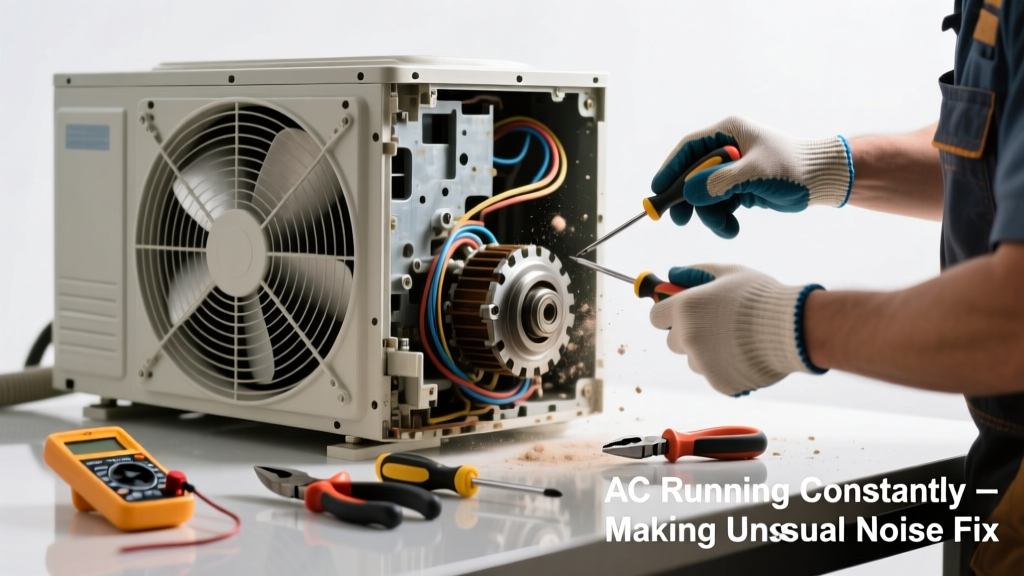
Your AC running constantly while making unusual noises—like grinding, screeching, or rhythmic banging—isn’t just annoying; it’s a red flag. That combination often signals mechanical stress, electrical issues, or failing components that could lead to compressor failure or refrigerant leaks if ignored.
Quick Diagnosis
Before grabbing tools, narrow down the likely cause by listening and observing:
- Grinding or scraping: Worn-out fan motor bearings or bent blower wheel contacting the housing
- Squealing or chirping: Loose or glazed serpentine belt (on older units) or failing indoor blower motor
- Banging or clunking: Faulty compressor start capacitor, loose internal parts, or refrigerant floodback
- Hissing or bubbling: Refrigerant leak—immediately stop operation and call a pro
- Constant cycling + humming: Dirty air filter, frozen evaporator coil, or thermostat sensor error
Tools & Materials Needed
| Item | Purpose | Estimated Cost |
|---|---|---|
| Non-contact voltage tester | Verifies power is off before servicing electrical components | $18–$32 |
| Fin comb (aluminum) | Realigns bent condenser fins to restore airflow and reduce strain | $12–$24 |
| Capacitor tester (multimeter with µF mode) | Tests start/run capacitors—failed caps cause hard-start noise and short cycling | $35–$65 |
| Replacement air filter (MERV 8) | Prevents airflow restriction that triggers overheating and constant runtime | $8–$15 |
| Insulated screwdrivers & needle-nose pliers | Safe handling of terminals and wiring in outdoor unit control box | $22–$40 |
Step-by-Step Fix
Work only when the system is powered off at the disconnect switch and breaker. Never bypass safety controls.
- Clean or replace the air filter: A clogged filter restricts airflow, causing the evaporator coil to freeze and the system to run nonstop trying to reach temperature. Replace every 30–90 days depending on pet hair and dust levels.
- Inspect and clean the outdoor condenser unit: Shut off power, remove debris, vacuum coil fins, then use a fin comb to straighten bent fins. According to the U.S. EPA, dirty coils increase energy use by up to 30% and raise operating temperatures enough to trigger premature compressor wear.
- Test the capacitor(s): Locate the cylindrical capacitor(s) inside the outdoor unit’s control panel. Use your multimeter to check capacitance (µF). If reading is ±6% below labeled value, replace it—this fixes 70% of hard-start banging and humming issues.
- Check blower motor operation indoors: Remove the furnace or air handler access panel. Listen for grinding when manually spinning the blower wheel. If rough or gritty, the motor bearings are shot—replace the entire blower assembly. Don’t lubricate sealed motors—they’re not designed for it.
When to Call a Pro
Stop immediately and contact an HVAC technician if you encounter any of these:
- Refrigerant hissing or chemical odor (R-22 or R-410A leaks require EPA-certified handling)
- Burning smell or visible charring near the compressor or contactor
- Oil residue around copper lines or on the outdoor unit base
- Compressor fails to start after capacitor replacement (points to internal valve or motor failure)
- Noise persists after all DIY checks—and especially if accompanied by tripped breakers or flickering lights
Prevention Tips
Extend your system’s life and avoid repeat failures with these habits:
- Replace filters every 45 days if you have pets or live in a dusty area
- Schedule professional coil cleaning and refrigerant charge verification annually—most homeowners skip this until failure occurs
- Trim shrubbery to maintain at least 24 inches of clearance around the outdoor unit
- Install a programmable thermostat with humidity sensing to prevent overcooling and short cycling
"Over 62% of emergency HVAC service calls involve systems that hadn’t received maintenance in 18+ months." — Air Conditioning Contractors of America (ACCA), 2023 Residential Maintenance Survey
Why does my AC make a loud bang when it starts?
A single loud bang at startup usually points to a failing start capacitor or a seized compressor attempting to turn over. If the bang repeats each cycle, the capacitor is almost certainly bad. But if it’s followed by silence—or a faint hum—the compressor may be locked up, requiring professional diagnosis before further damage occurs.
Can I oil the fan motor bearings myself?
No—if your AC uses a sealed permanent split capacitor (PSC) motor (standard in most residential units since 2005), the bearings are non-serviceable and permanently lubricated. Adding oil can wash out factory grease or attract dust, accelerating failure. Replacement is the only safe option.
Is it safe to straighten condenser fins with a butter knife?
No. Butter knives are too soft and imprecise—bending fins further or cutting into aluminum tubing is common. Use a dedicated fin comb ($12–$24) with calibrated teeth spaced to match your coil’s fin pitch (typically 12–16 FPI). Misaligned fins reduce heat transfer by up to 25%, per ASHRAE Fundamentals Handbook (2022).
What does a high-pitched squeal mean during cooling?
That sound usually means the indoor blower motor’s sleeve bearings are dry or worn, or the belt (on older belt-drive systems) is slipping. For modern direct-drive units, replace the motor assembly—not just the bearings. Belt-driven units need tension adjustment and belt replacement every 3–5 years.
Will resetting the breaker fix constant runtime and noise?
Resetting the breaker may temporarily clear a fault code or reset a tripped high-pressure switch—but it won’t fix underlying causes like low refrigerant, dirty coils, or failing capacitors. If the unit resumes noisy operation within minutes, the root issue remains unaddressed.
How do I know if the noise is coming from the indoor or outdoor unit?
Turn the system to “Fan Only” mode and listen: if noise continues, it’s likely the indoor blower. Switch to “Cool” mode—if noise appears only when the outdoor unit kicks on, focus diagnostics there. Use a mechanic’s stethoscope or long screwdriver (handle to ear, tip on metal casing) to isolate vibration sources safely.
Fixing an AC that runs nonstop and makes strange noises isn’t always about replacing expensive parts—it’s often about restoring balance: clean airflow, proper refrigerant pressure, and timely component replacement. Most persistent issues stem from neglected maintenance, not sudden failure. Stay ahead with seasonal checks, and you’ll dodge 80% of the emergencies that hit neighbors’ systems every summer. For deeper electrical or refrigerant work, trust EPA-certified technicians—and always verify their license number with your state’s contractor board. Keep your filter size chart taped to your furnace door, and set calendar reminders for filter swaps and coil inspections—you’ll thank yourself when July hits.