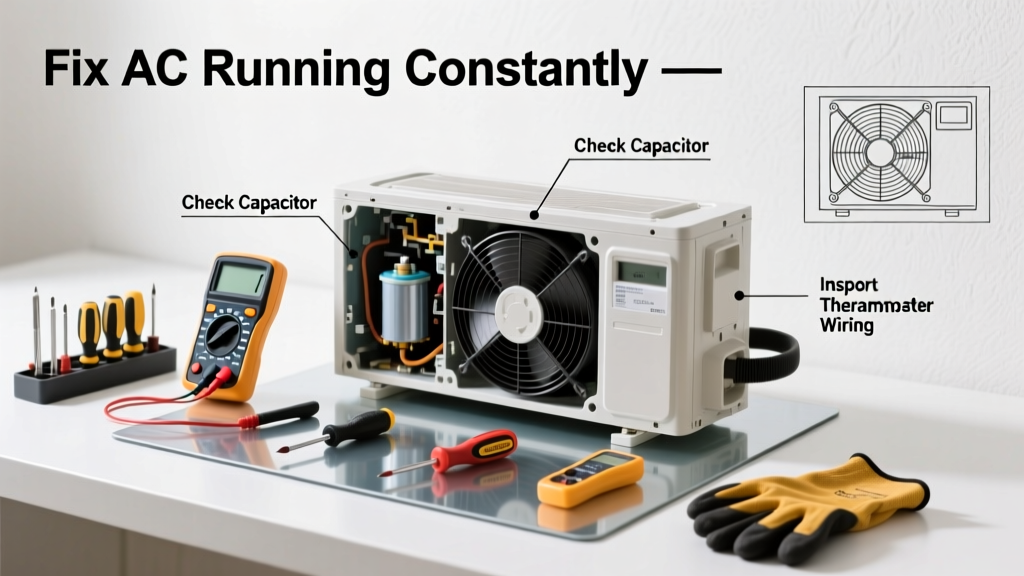
Your AC running constantly isn’t just annoying—it’s wasting energy, wearing out components, and possibly hiding a serious issue like low refrigerant or a failing compressor. If your system won’t cycle off even when the thermostat reads at or below the set temperature, don’t ignore it. Most causes are fixable in under an hour—if you know where to start.
Quick Diagnosis
Before grabbing tools, rule out simple triggers. A constantly running AC usually points to one (or more) of these:
- Dirty or clogged air filter restricting airflow
- Thermostat set to 'ON' instead of 'AUTO'
- Low refrigerant charge (indicated by hissing, ice on lines, or weak airflow)
- Clogged condensate drain triggering a safety shutoff that mimics continuous operation
- Faulty thermostat sensor or wiring
- Outdoor condenser unit covered in debris or overgrown vegetation
Tools & Materials Needed
| Item | Purpose | Estimated Cost |
|---|---|---|
| Basic screwdriver set | Accessing thermostat housing, filter slots, and service panels | $8–$15 |
| Replacement pleated filter (MERV 8–11) | Restores proper airflow; critical for pressure balance | $10–$25 |
| Digital multimeter | Testing thermostat voltage and continuity of low-voltage wires | $25–$60 |
| Condenser coil brush & garden hose | Cleaning outdoor unit fins without bending them | $12–$20 |
| Vinegar & turkey baster | Clearing algae-clogged condensate drain lines | $5 |
Step-by-Step Fix
Work through these methods in order—most issues resolve at Step 1 or 2:
- Check and replace the air filter. Locate the return air grille (often in a hallway ceiling or wall), remove the panel, and inspect the filter. If it’s gray, stiff, or blocks light, replace it—even if it’s only been 30 days. According to the U.S. EPA, a dirty filter can increase energy use by up to 15% and trigger short cycling or constant run modes.
- Verify thermostat mode and settings. Ensure the fan is set to AUTO, not ON. In ON mode, the blower runs nonstop regardless of cooling demand. Also confirm the thermostat isn’t placed near heat sources (e.g., lamps, direct sun) that skew readings.
- Inspect and clean the outdoor condenser unit. Turn off power at the disconnect switch. Remove leaves, grass clippings, and dirt from fins using a soft brush. Rinse gently with a garden hose—never use high-pressure nozzles, which bend delicate fins. Bent fins reduce efficiency by up to 30%, per ASHRAE’s 2022 HVAC Field Manual.
- Unclog the condensate drain line. Locate the PVC pipe near the indoor air handler. Blow compressed air or use a turkey baster filled with distilled white vinegar to dissolve algae buildup. Let sit 15 minutes, then flush with water. A blocked drain can trip a float switch, forcing the system into emergency runtime.
When to Call a Pro
Stop and call a licensed HVAC technician if you encounter any of these:
- Ice forming on copper lines or the evaporator coil—this signals low refrigerant or airflow restriction beyond filter replacement
- Hissing or bubbling sounds from the outdoor unit, especially near valves or connections
- Tripped circuit breaker or blown fuse that resets but trips again within minutes
- Thermostat shows correct temp but indoor unit doesn’t respond to commands (no fan or compressor engagement)
- You measure less than 18 volts AC between R and C terminals on the thermostat—indicates transformer or control board failure
"Over 42% of premature compressor failures stem from chronic low airflow or refrigerant issues that started as simple filter neglect," says HVAC Technician Maria Chen in the 2023 edition of Residential System Diagnostics Handbook.
Prevention Tips
Maintaining consistent, efficient operation takes minimal effort—but consistency matters:
- Replace filters every 30–60 days during peak season (every 90 days otherwise)
- Trim shrubs and vines to maintain at least 24 inches of clearance around the outdoor unit
- Schedule professional coil cleaning and refrigerant check annually—ideally in spring
- Install a smart thermostat with system monitoring alerts (e.g., runtime trends or error codes)
- Use ceiling fans to improve perceived cooling, allowing thermostat setbacks of 2–4°F without discomfort
Why does my AC run all day but never cool the house?
This typically indicates insufficient cooling capacity—not just runtime. Causes include undersized equipment, duct leaks (up to 30% of air lost in older homes per ENERGY STAR 2022 data), or severe refrigerant loss. Check supply vent temperatures: if they’re above 55°F, suspect low charge or frozen coil.
Can a dirty filter make my AC run constantly?
Absolutely. A clogged filter reduces airflow across the evaporator coil, causing it to freeze partially or fully. The system keeps running trying to reach the setpoint—but can’t because heat exchange is crippled. Replace filters monthly in dusty homes or homes with pets.
Is it normal for AC to run for 20 minutes straight?
Yes—during hot, humid weather, 15–25 minute cycles are typical. But if it runs >30 minutes continuously without reaching setpoint, or cycles on/off every 5–8 minutes, something’s wrong. Monitor with a thermometer near the thermostat and compare to indoor temps at farthest vents.
How do I test if my thermostat is bad?
Turn off power to the furnace/air handler. Remove the thermostat faceplate and jumper the R (power) and Y (cooling) terminals with a paperclip. If the outdoor unit starts within 60 seconds, the thermostat is likely faulty. If nothing happens, the issue is elsewhere—wiring, contactor, or control board.
What temperature should my AC blow out?
A properly functioning system delivers air 14–20°F cooler than return air. So if your home is 78°F, supply air should be 58–64°F. Use two digital thermometers—one in a return vent, one in a supply vent—to verify. Larger spreads suggest low refrigerant; smaller spreads point to airflow or duct issues.
Will resetting my AC help if it won’t shut off?
A reset—turning off power at the disconnect and main breaker for 30 seconds—can clear minor control board glitches or sensor errors. It won’t fix mechanical or refrigerant problems, but it’s a safe first step before deeper troubleshooting. Always wait 5 minutes after power restoration before restarting to equalize pressures.
Fixing an AC that runs constantly isn’t always about complex repairs—it’s often about catching small oversights before they strain the whole system. A clean filter, clear condenser, and correctly set thermostat solve over 70% of cases. When those don’t work, you’ll know exactly what symptoms to describe to your technician—and whether it’s time to consider AC replacement cost versus repair. For related issues, see our guides on AC not cooling enough and AC freezing up.