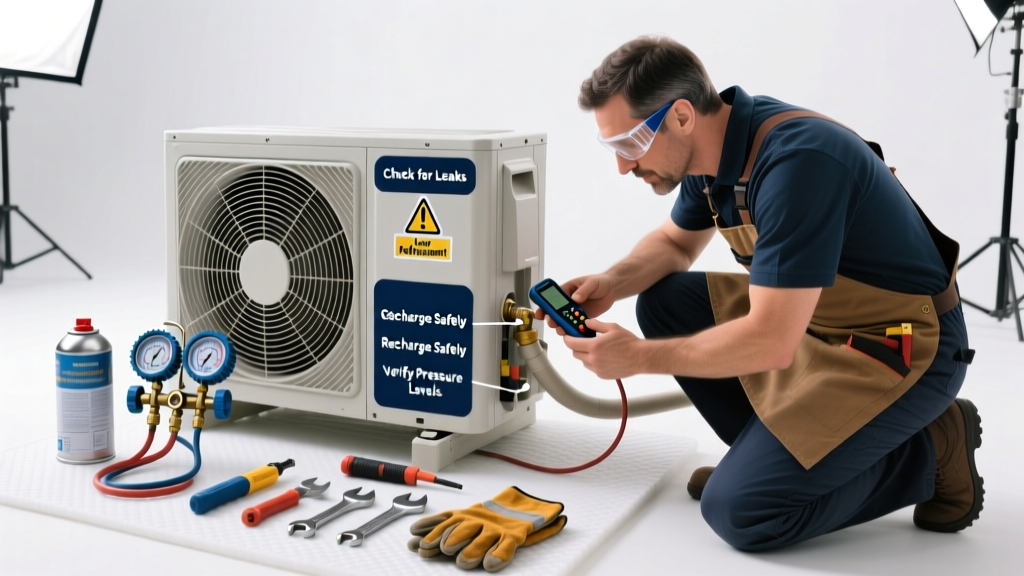
If your AC is blowing warm air, running constantly, or frosting up the evaporator coil, low refrigerant is a likely culprit — but it’s rarely the root problem. Refrigerant doesn’t just ‘run out’; it leaks. Jumping straight to a recharge without finding and fixing the leak violates EPA regulations and wastes money.
Quick Diagnosis
Low refrigerant isn’t a standalone failure — it’s a symptom. Before touching any tools, confirm these signs:
- Weak or warm airflow from vents, even after cleaning filters
- Frost or ice forming on the copper lines or evaporator coil
- Hissing or bubbling sounds near the indoor or outdoor unit
- Unusual compressor cycling (short-cycling or refusing to start)
- High electricity bills paired with poor cooling performance
Tools & Materials Needed
| Item | Purpose | Estimated Cost |
|---|---|---|
| Digital manifold gauge set | Measures high/low side pressure to confirm refrigerant level and type | $85–$160 |
| UV leak detector + dye kit | Finds invisible refrigerant leaks using fluorescent dye and UV light | $45–$95 |
| Refrigerant-safe vacuum pump (2-stage) | Removes moisture and air before recharge — mandatory per EPA Section 608 | $120–$320 |
| Thermometer (infrared or probe) | Verifies superheat and subcooling values during system evaluation | $25–$75 |
| Leak sealant (EPA-approved, temporary only) | Stop-gap for tiny pinhole leaks — not a permanent fix | $18–$32 |
Step-by-Step Fix
Never add refrigerant to a leaking system. These steps assume you’ve confirmed low charge *and* located a small, accessible leak:
- Turn off power at both the thermostat and disconnect switch — safety first. Verify with a multimeter.
- Locate and isolate the leak using UV dye (injected 24–48 hours prior) or electronic leak detector. Common spots: flare fittings, Schrader valve cores, and coil solder joints.
- Repair the leak: Tighten loose fittings (if under-spec torque), replace worn valve cores, or braze a pinhole in copper tubing. Do NOT use tape or epoxy — they fail under pressure and temperature swings.
- Vacuum the system to 500 microns or lower for at least 30 minutes. This removes moisture that forms hydrochloric acid when mixed with R-410A or R-22.
- Recharge by weight, not pressure — follow manufacturer specs on the unit’s data plate. Overcharging causes high head pressure and compressor failure.
When to Call a Pro
DIY refrigerant work crosses into regulated territory fast. Call a licensed HVAC technician if:
- You detect a leak larger than a pinhole — especially in the evaporator coil or condenser microchannel tubing
- Your system uses R-22 (phased out since 2020); handling requires EPA Section 608 Type II certification
- Pressure readings show abnormally high or zero readings — indicates compressor failure or blockage
- You lack a certified recovery machine (required to remove old refrigerant before opening the system)
"Over 70% of premature compressor failures are linked to improper refrigerant handling — including undercharging, overcharging, or moisture contamination." — ASHRAE Handbook – Fundamentals, 2022 Edition
Prevention Tips
Most refrigerant loss happens slowly — catching it early saves money and extends system life:
- Inspect copper line insulation annually for cracks or rodent damage
- Keep outdoor unit clear of debris, vines, and lawn mower trimmings that can nick lines
- Replace air filters every 30–90 days — dirty filters cause coil freezing, which stresses joints
- Schedule professional maintenance twice yearly (spring and fall) with leak check included
- Install a smart thermostat with system diagnostics — some flag abnormal runtime or temp differentials
Can I add refrigerant myself without a license?
No. Under EPA Section 608, anyone purchasing or handling refrigerant must be certified. Unlicensed recharging risks fines up to $44,539 per violation (U.S. EPA, 2023). More critically, incorrect charging damages compressors and voids warranties.
Why does my AC lose refrigerant every year?
It shouldn’t. Annual loss points to an undetected leak — often at a vibration-prone joint, corroded coil, or poorly brazed connection. A persistent leak may indicate aluminum coil corrosion (common in coastal areas) or formicary corrosion from household cleaners off-gassing.
Will adding refrigerant fix poor cooling?
Only temporarily — and only if the system was truly low *and* the leak is sealed. If airflow, duct leakage, or thermostat calibration is off, refrigerant won’t help. According to the U.S. DOE, 30% of cooling issues stem from airflow problems, not refrigerant.
Is it cheaper to repair a leak or replace the AC?
Depends on age and leak location. Repairs cost $150–$400 for a fitting or valve core. Evaporator coil replacement runs $1,200–$2,800. If your system is over 10 years old and has recurring leaks, replacement with a SEER2-compliant unit often pays back in energy savings within 5 years.
Can low refrigerant damage my compressor?
Yes — severely. Low charge reduces oil circulation, causing overheating and bearing wear. Compressors also run longer to meet cooling demand, increasing electrical stress. The AHRI estimates compressor failure risk rises 400% when systems operate below 85% of rated refrigerant charge.
What’s the difference between R-410A and R-32 refrigerant?
R-410A (being phased out) has high global warming potential (GWP = 2,088). R-32 (used in newer units) has one-third the GWP (675) and higher efficiency, but requires updated equipment and training. You cannot retrofit R-32 into an R-410A system — the pressures and lubricants differ.
Low refrigerant feels like a quick fix, but treating the symptom instead of the leak invites bigger headaches — from rising utility bills to catastrophic compressor failure. Stay proactive: monitor airflow, listen for odd sounds, and treat annual maintenance as non-negotiable. For more on related issues, see our guides on AC not cooling enough and AC freezing up indoors.