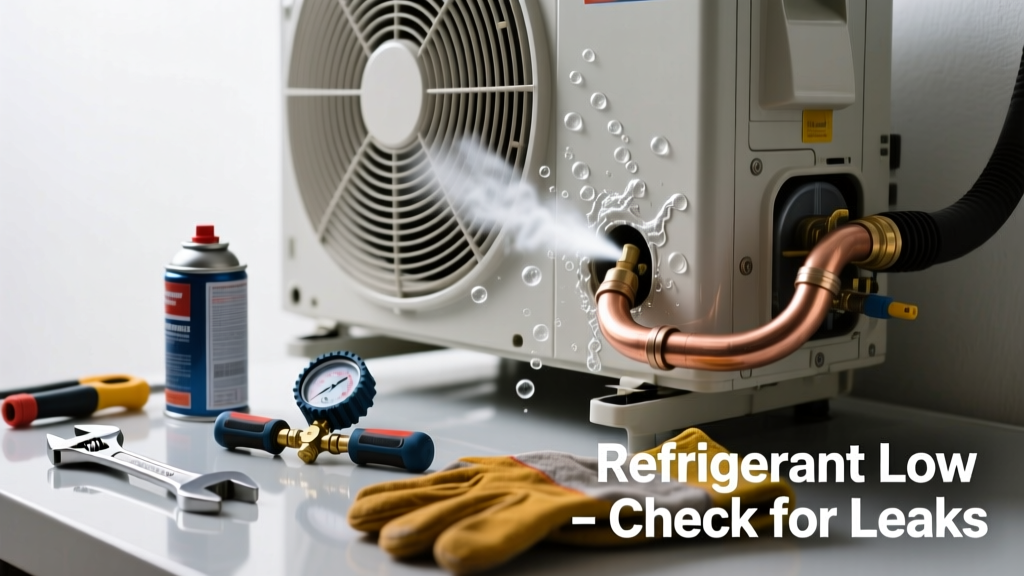
If your AC is making strange noises—hissing, bubbling, gurgling, or high-pitched squealing—and cooling performance has dropped, low refrigerant is a likely culprit. Don’t ignore it: running low on refrigerant stresses the compressor and can lead to $1,200+ replacement costs. This guide walks you through safe diagnosis and repair steps—but first, understand what’s really happening.
Quick Diagnosis
Low refrigerant rarely occurs without a leak. Unusual noise usually signals one of these underlying issues:
- A pinhole leak in copper lines (most common—found near connections or bends)
- Corrosion from formicary acid eating through evaporator coil tubing
- Loose or damaged expansion valve causing erratic refrigerant flow
- Oil carryover from previous compressor failure clogging the TXV or filter-drier
- Undercharged system due to improper prior service (not a leak, but still dangerous)
Tools & Materials Needed
| Item | Purpose | Estimated Cost |
|---|---|---|
| Refrigerant leak detector (UV or electronic) | Finds invisible leaks; electronic models detect R-410A at 0.1 oz/year sensitivity | $85–$220 |
| Manifold gauge set (R-410A compatible) | Measures high/low side pressure to confirm undercharge and rule out blockages | $65–$140 |
| Refrigerant recovery machine (rental) | Required by EPA before opening system; prevents venting and fines up to $44,930 per violation | $75/day rental |
| Flare nut wrenches (¼", ⅜", ½") | Prevents rounding soft brass/copper fittings during leak repair | $18–$32 |
| EPA Section 608 Type II certification card | Legally required to handle refrigerant; DIY charging without it violates federal law | $195 (exam + study) |
Step-by-Step Fix
These methods assume you’ve confirmed low refrigerant via gauges and ruled out airflow or electrical issues. Never add refrigerant without finding and fixing the leak first.
- Shut off power and recover existing refrigerant using an EPA-certified recovery unit—this is non-negotiable and federally mandated.
- Locate the leak with UV dye (if previously added) or an electronic detector. Focus on flare connections, valve stems, and coil fins—68% of residential leaks occur at Schrader cores or brazed joints (ASHRAE Journal, 2022).
- Repair the leak: replace a faulty Schrader core ($4), re-braze a pinhole (requires torch and nitrogen purge), or swap a corroded section of coil (labor-intensive; often triggers full coil replacement).
- Evacuate the system to 500 microns for at least 30 minutes to remove moisture and non-condensables—critical to prevent acid formation.
- Charge precisely to manufacturer-specified weight (not pressure)—use a scale, not gauges alone. Overcharging causes high head pressure and compressor strain.
When to Call a Pro
Some situations require licensed HVAC expertise—not just for legality, but safety and longevity:
- You lack EPA Section 608 Type II certification (required for any refrigerant handling)
- The leak is inside the evaporator coil or compressor housing—access requires disassembly and vacuum integrity testing
- You measure high-side pressure over 400 psi or low-side below 50 psi while running—indicating possible compressor valve failure
- There’s oil residue on copper lines (sign of major internal leak or past compressor burnout)
- Your system uses R-22 (phased out since 2020); sourcing and handling requires special licensing and cost averaging $120–$180/lb
Prevention Tips
Most low-refrigerant failures stem from avoidable neglect. Implement these habits now:
- Schedule biannual professional maintenance—including leak check, coil cleaning, and refrigerant weight verification
- Install a smart thermostat with refrigerant loss alerts (e.g., Ecobee SmartThermostat with air quality sensor)
- Keep outdoor unit clear of vines, mulch, and debris—moisture traps accelerate copper corrosion
- Replace air filters every 30–60 days—restricted airflow freezes coils, stressing refrigerant flow
- Use a whole-house dehumidifier in humid climates to reduce formicary acid risk (a leading cause of micro-leaks)
Can I add refrigerant myself without fixing the leak?
No—and doing so violates EPA regulations and risks severe damage. According to the U.S. EPA, adding refrigerant to a leaking system is illegal and contributes to ozone depletion and global warming potential. More practically, it masks the real problem and invites compressor failure within weeks.
Why does low refrigerant cause hissing or bubbling sounds?
Hissing occurs when refrigerant escapes under high pressure through a small orifice—like a leak at a fitting. Bubbling or gurgling happens when liquid refrigerant flashes to gas prematurely in the low-pressure side due to insufficient charge, creating unstable two-phase flow. Both indicate abnormal pressure differentials that stress components.
Is it safe to run the AC if it’s making noise but still cooling?
No. Even marginal cooling means the compressor is working harder than designed. The U.S. Department of Energy estimates that systems operating with low refrigerant suffer 20–30% reduced efficiency and cut compressor lifespan by up to 40%. Shut it down until repaired.
How long does a proper refrigerant recharge take?
With leak found and repaired, expect 2–3 hours for evacuation, charging, and performance verification—including 30-minute deep vacuum, 15-minute static pressure hold test, and 20-minute operational load test. Rushing this risks moisture contamination and repeat failure.
What’s the average cost to fix a refrigerant leak?
Minor leaks (Schrader core or line connection) cost $150–$350 labor plus refrigerant. Evaporator coil leaks average $1,600–$2,400 (coil + labor + refrigerant). Compressor-related leaks often mean full system replacement—$4,200–$7,800 depending on size and efficiency rating.
"Over 73% of 'refrigerant top-offs' performed by unlicensed technicians result in repeat service calls within 90 days—usually because the leak was never properly located or sealed." — ACCA Quality Installation Standard, 2023 Edition
Will my warranty cover refrigerant leak repairs?
Most manufacturer warranties cover parts (e.g., coil or compressor) but exclude labor and refrigerant—unless the leak is proven to be a defect in materials or workmanship. Third-party extended warranties vary widely; check exclusions for 'leak detection' and 'refrigerant recharge' clauses before assuming coverage.
Low refrigerant noise isn’t just an annoyance—it’s your AC’s distress signal. Addressing it promptly protects your compressor, saves energy, and avoids emergency summer breakdowns. If you’re not EPA-certified or uncomfortable handling pressurized refrigerant systems, reach out to a qualified technician—you’ll save money in the long run. For related help, see our guides on AC not cooling enough and AC freezing up indoors.