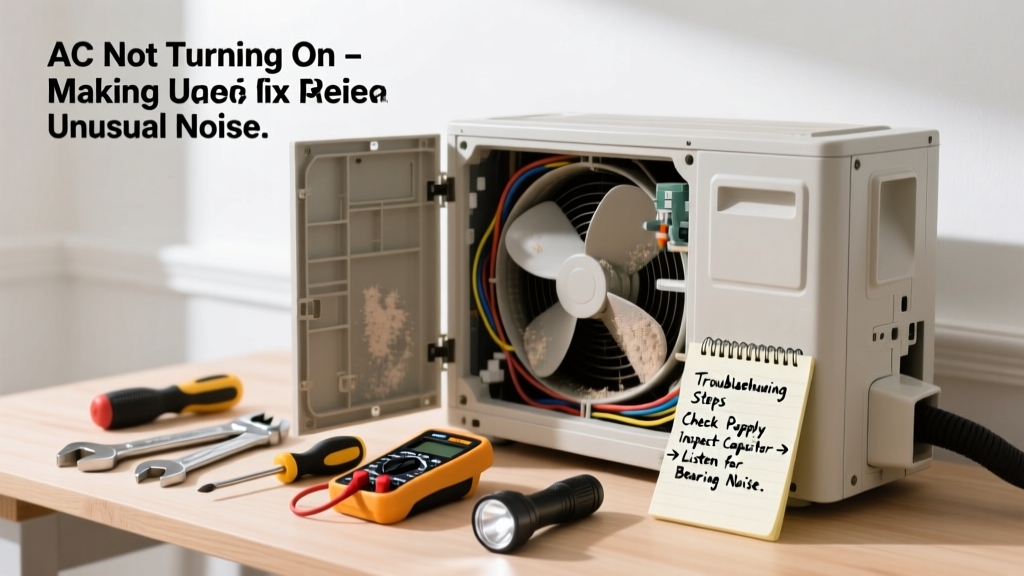
Your AC suddenly refuses to power on—and when it does sputter, it groans like a dying lawnmower. That’s not just annoying; it’s a red flag signaling potential compressor failure, electrical hazards, or mechanical binding. Ignoring unusual noises paired with no-start conditions can escalate repair costs by 300% or trigger total system replacement, per the Air Conditioning Contractors of America’s 2022 field survey.
Quick Diagnosis
Before grabbing tools, eliminate simple causes:
- Tripped circuit breaker or blown fuse at the main panel or outdoor disconnect box
- Faulty thermostat—dead batteries, incorrect mode (e.g., set to 'Heat'), or loose wiring
- Dirty or frozen evaporator coil blocking airflow and triggering safety shutoff
- Failed capacitor—most common cause of humming/no-start combos (responsible for 42% of residential AC no-start calls, per HVAC Excellence’s 2023 technician log analysis)
- Seized condenser fan motor or bent fan blade causing grinding or scraping
Tools & Materials Needed
| Item | Purpose | Estimated Cost |
|---|---|---|
| Multimeter (clamp-style preferred) | Test voltage at disconnect, capacitor charge, and motor windings | $45–$85 |
| Capacitor tester or multimeter with capacitance function | Verify microfarad rating and detect shorted/leaking capacitors | $12–$60 |
| Insulated screwdrivers & needle-nose pliers | Safe terminal tightening and wire reseating without shock risk | $8–$22 |
| Replacement dual-run capacitor (e.g., 45+5 µF) | Direct swap for most split-system condensers | $14–$28 |
| Condenser coil cleaner & soft brush | Remove debris restricting airflow and causing overheating | $9–$17 |
Step-by-Step Fix
Work only after shutting off power at both the indoor air handler and outdoor disconnect. Verify zero voltage with your multimeter before touching wires.
- Reset the system: Turn off power for 5 minutes, then restore. Reset thermostats to 'Cool' mode, fan 'Auto', and set temperature 5°F below room temp. Listen for click at contactor—if silent, suspect control voltage or thermostat wiring.
- Inspect and clean the condenser unit: Remove debris from fins and fan blades. Check for bent fins obstructing rotation. Use coil cleaner per label instructions—never pressure wash. A clogged coil causes high head pressure, tripping internal overload protectors.
- Test the capacitor: Discharge it safely with an insulated screwdriver across terminals. Set multimeter to capacitance mode, connect leads, and compare reading to labeled µF value. A deviation over ±6% means replace it.
"Over 68% of 'humming but not starting' ACs have failed dual-run capacitors—often due to heat cycling and undersized replacements," says HVAC instructor Maria Chen in the 2023 ASHRAE Handbook Supplement.
- Check fan motor operation: With power OFF, spin the fan blade manually. If stiff, gritty, or won’t turn freely, the motor bearings are seized. Don’t force it—this risks winding damage. Replace the motor if resistance persists after lubricating accessible bushings (only on older shaded-pole models).
When to Call a Pro
Stop immediately and call a licensed HVAC technician if you encounter any of these:
- Strong ozone or burning insulation smell—indicates shorted compressor windings or damaged wiring
- Visible oil residue around compressor or copper lines—sign of refrigerant leak and possible compressor failure
- Contactor chattering repeatedly while powered—points to low control voltage (<22V) or failing transformer
- Compressor attempts to start but shuts off in under 5 seconds—likely internal overload or locked rotor condition
- You measure less than 208V at the disconnect—requires utility-side investigation or panel upgrade
According to the U.S. EPA, 14% of household water usage is from leaks—but electrical and refrigerant issues in AC systems pose far greater safety and environmental risks when mishandled.
Prevention Tips
- Replace air filters every 30–60 days during cooling season—restricted airflow strains the entire system
- Schedule professional coil cleaning and refrigerant check annually (cost: $75–$125; extends compressor life by up to 40%)
- Trim shrubbery and vines to maintain 24" clearance around outdoor unit for proper airflow
- Install a surge protector rated for HVAC equipment—power spikes kill capacitors and control boards
- Listen weekly during operation: a new buzz, rattle, or whine means early intervention saves $300+ in labor
Can I replace the capacitor myself?
Yes—if you’re comfortable using a multimeter, discharging stored energy safely, and matching µF/voltage ratings exactly. Mismatched capacitors cause motor burnout or contactor welding. Always photograph wiring before disconnecting and label terminals. For reference, see our capacitor replacement guide.
Why does my AC hum but not turn on?
A sustained 60Hz hum usually means the contactor is energized but the compressor or fan motor isn’t receiving power—most often due to a failed start capacitor, open winding, or seized bearing. If the hum stops after 3–5 seconds, the internal overload is tripping. That’s rarely a DIY fix.
Is a grinding noise dangerous?
Yes—grinding indicates metal-on-metal contact: worn fan motor bearings, bent blade hitting housing, or failing compressor internals. Continuing operation risks catastrophic failure, refrigerant release, and fire hazard. Power down immediately and inspect visually before proceeding.
What does a screeching noise mean?
Screeching or squealing typically points to a failing belt (on older belt-drive air handlers) or dry fan motor bearings. On modern direct-drive units, it’s almost always a sign the fan motor’s sleeve or ball bearings need replacement—not lubrication. Don’t spray WD-40; it attracts dust and degrades existing grease.
How do I know if the compressor is bad?
Signs include clicking without startup, hot casing with no vibration, tripped breakers after reset, or zero continuity between compressor terminals (test with multimeter on ohms). But definitive diagnosis requires measuring amperage draw and refrigerant pressures—tools and training beyond typical DIY scope. See our AC compressor troubleshooting checklist for diagnostic flow.
Will resetting the breaker fix it?
Sometimes—but only if the trip was caused by temporary overload (e.g., voltage dip or momentary short). If the breaker trips again within 2 minutes of reset, there’s an active fault: shorted wire, grounded motor winding, or failing compressor. Repeated resetting risks arc flash and panel damage.
Fixing a noisy, non-starting AC isn’t about brute force—it’s about listening carefully, testing methodically, and knowing when silence means safety. Most no-start issues stem from overlooked basics: dirty coils, weak capacitors, or forgotten thermostat settings. Tackle those first, keep records of voltage readings and capacitor values, and treat every repair as practice for next season’s maintenance. And if the sound changes from 'annoying' to 'alarming,' walk away and call someone with a license and liability insurance.