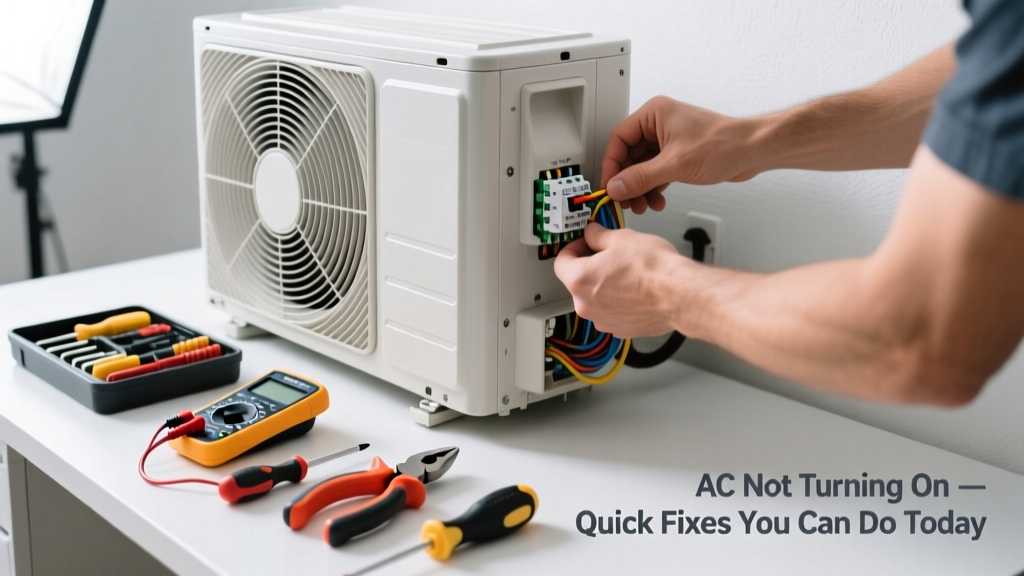
Your AC refuses to power up on a 95°F afternoon — no fan hum, no compressor kick, just silence. Before you panic or dial an emergency HVAC technician, try these proven checks. Most 'AC not turning on' issues stem from simple oversights, not costly component failures.
Quick Diagnosis
Start here before grabbing tools. These are the five most common culprits behind a completely dead AC unit:
- No power at the outdoor condenser (tripped breaker or disconnected disconnect switch)
- Thermostat set incorrectly (e.g., in 'Off' mode or battery dead)
- Blown low-voltage fuse on the furnace control board
- Clogged air filter causing high-limit safety shutoff
- Failed capacitor on the outdoor unit (no humming or clicking sound)
Tools & Materials Needed
| Item | Purpose | Estimated Cost |
|---|---|---|
| Non-contact voltage tester | Verifies power at disconnect box and indoor unit without touching wires | $12–$25 |
| Digital multimeter | Tests capacitor health, transformer output (24V), and continuity of safety switches | $25–$60 |
| Replacement 3-amp automotive-style fuse | Replaces blown low-voltage fuse on furnace control board (common cause) | $2–$5 |
| 1/4-inch hex screwdriver | Accesses thermostat wiring and furnace panel covers | $4–$8 |
| Replacement run capacitor (e.g., 35+5 µF, 370V) | Swaps out failed capacitor — match microfarad (µF) and voltage rating exactly | $12–$22 |
Step-by-Step Fix
- Check the thermostat: Ensure it’s set to 'Cool', temperature is at least 5°F below room temp, and display is lit. Replace batteries if dim or blank. If wired, verify terminals R and C have 24V using your multimeter.
- Inspect the circuit breaker and disconnect switch: Locate the double-pole 220V breaker for the AC in your main panel — flip it fully OFF then ON. Then check the outdoor disconnect box (a gray metal box near the condenser) — ensure the pull-out switch is fully seated and not tripped.
- Test the furnace control board fuse: Turn off power to the furnace. Open the control board access panel. Find the 3-amp automotive-style fuse (often red or blue). Use your multimeter’s continuity setting — no beep means it’s blown. Replace only with same amperage and type.
- Listen and smell at the outdoor unit: With thermostat calling for cooling, stand near the condenser. A faint *click* followed by a *hum* means the contactor is engaging — but if it’s silent or makes a single click then nothing, suspect a bad capacitor or contactor. Burnt odor? Stop immediately — that’s a sign of internal winding failure.
When to Call a Pro
DIY stops where safety and code compliance begin. Call a licensed HVAC technician if:
- You measure less than 20V between R and C at the thermostat — points to transformer or wiring fault
- The outdoor unit’s contactor doesn’t pull in (no audible click) even after verifying 24V at its coil terminals
- You detect refrigerant lines frozen solid or oil residue near copper fittings (possible leak)
- You’re uncomfortable handling 220V circuits or removing the condenser’s electrical cover
According to the U.S. EPA, 14% of household water usage is from leaks — but with HVAC, it’s electricity and refrigerant safety that demand expertise. As HVAC contractor Mark Delaney told Contractor Magazine in 2022: 'If you’re second-guessing whether a wire is live or why the compressor won’t engage, that’s the exact moment to shut it down and call your local NATE-certified tech.'
Prevention Tips
- Replace your air filter every 30–60 days during cooling season — a clogged filter can trigger high-limit shutdowns that mimic a 'no power' condition
- Trim shrubbery to maintain at least 24 inches of clearance around the outdoor unit for airflow and service access
- Test your thermostat batteries every spring — weak voltage can prevent signal transmission to the outdoor unit
- Schedule professional maintenance every April — techs clean coils, check refrigerant charge, and test capacitor ESR (equivalent series resistance)
Why does my AC turn on for 5 seconds then shut off?
This short-cycling often points to a failing run capacitor, overheating compressor due to dirty coils, or a malfunctioning high-pressure switch. Check for ice on the suction line — if present, turn system off and let it thaw before investigating further.
Can I reset my AC by turning off the breaker?
Yes — but only as a diagnostic step, not a permanent fix. Turn the 220V breaker OFF for at least 30 seconds, then back ON. This resets the control board and clears transient faults. If it works once but fails again within hours, the root cause remains unaddressed.
Is it safe to bypass the thermostat to test the AC?
No — directly jumping R to Y at the furnace or air handler risks damaging the control board or contactor. Instead, use a multimeter to verify 24V at the thermostat wires (R and Y) while it’s calling for cooling. If voltage is present but outdoor unit stays silent, the issue lies downstream — likely contactor or capacitor.
How do I know if my capacitor is bad?
A bulging or leaking capacitor case is a dead giveaway. But many fail internally without visual signs. Use your multimeter’s capacitance setting: disconnect both leads, discharge with an insulated screwdriver, then test. A reading more than ±6% from the labeled µF value means replacement is needed. See our full capacitor testing guide.
What’s the average cost to replace a condenser fan motor?
Parts alone range $85–$190 depending on brand and HP rating; labor adds $220–$400. However, if the motor burned out due to capacitor failure or poor airflow, replacing just the motor without addressing root causes invites repeat failure. Full fan motor replacement steps here.
Can a dirty evaporator coil cause no power to the outdoor unit?
Not directly — but yes, indirectly. A severely dirty coil triggers the indoor blower’s high-limit switch, cutting power to the entire system including the outdoor unit’s control circuit. That’s why cleaning the filter and checking for ice on the indoor coil should be first-line diagnostics. How to safely clean an evaporator coil.
Most AC units that won’t turn on aren’t broken — they’re just waiting for a forgotten breaker flip or a fresh set of thermostat batteries. Take it slow, verify power at each stage, and don’t skip the low-voltage fuse check — it’s the #1 overlooked fix we see in service calls. When in doubt, document what you hear, smell, and measure before picking up the phone. That info saves your technician 20 minutes — and cuts your bill accordingly.