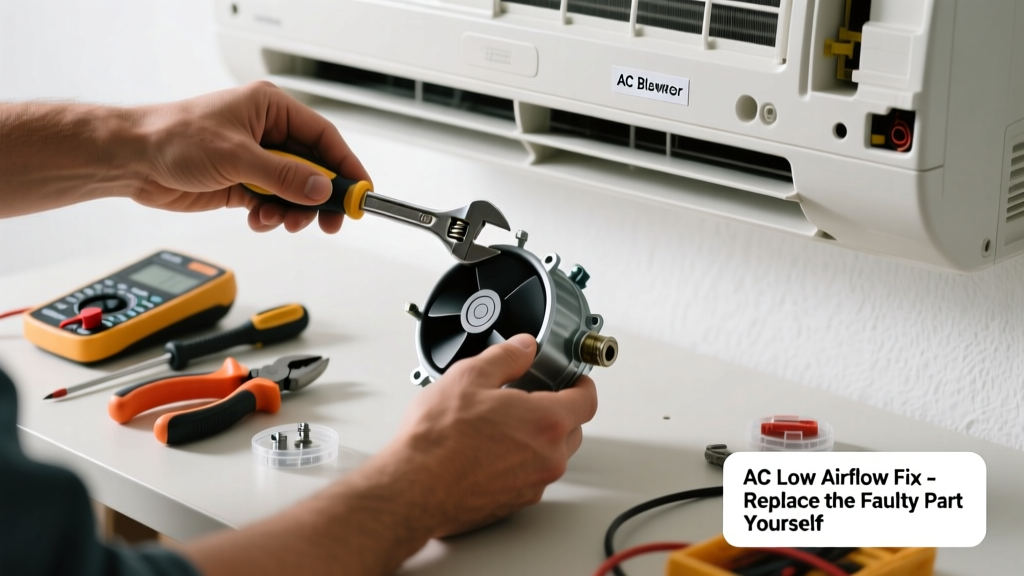
If your AC is blowing weakly—even after changing the filter—you’re likely dealing with a failing component, not just dirt buildup. Low airflow strains the entire system, risking frozen coils, compressor damage, or premature failure. Most often, the culprit is one of three replaceable parts: the blower motor, start capacitor, or evaporator coil drain pan assembly.
Quick Diagnosis
Before grabbing tools, rule out simple causes:
- A clogged air filter (replace every 30–90 days)
- Blocked return air grilles or closed dampers
- Frozen evaporator coil (turn off AC and let thaw for 4+ hours)
- Dirty outdoor condenser fins (clean with a garden hose and fin comb)
- Collapsed or disconnected ductwork near the air handler
Tools & Materials Needed
| Item | Purpose | Estimated Cost |
|---|---|---|
| Multimeter (digital, CAT III rated) | Test capacitor voltage and motor winding continuity | $25–$65 |
| Replacement start capacitor (e.g., 45+5 µF, 370V AC) | Restores proper motor startup torque | $12–$28 |
| Blower wheel puller kit | Safely removes seized blower wheel without damaging shaft | $18–$32 |
| Non-contact voltage tester | Confirms power is OFF before opening panel | $10–$22 |
| Shop vacuum with crevice tool | Removes dust/debris from blower housing and motor bearings | $40–$85 |
Step-by-Step Fix
Identify and replace the faulty part using these methods:
- Test and replace the start capacitor: Turn off power at the breaker. Locate the capacitor (cylindrical, mounted near blower motor). Discharge it with an insulated screwdriver across terminals. Use multimeter to check µF rating—deviation >±6% means replacement. Match specs exactly; incorrect capacitance can burn out the motor.
- Clean or replace the blower wheel: Remove access panel. Inspect wheel for bent blades or heavy debris buildup. Vacuum thoroughly. If wheel wobbles or won’t spin freely, remove using puller kit and install OEM replacement (e.g., Lennox 57M47 or Carrier 317949).
- Inspect and lubricate motor bearings: On older PSC motors, apply 2 drops of ISO 68 non-detergent oil to each bearing port. Do NOT over-lubricate—excess oil attracts dust and causes sludge. New ECM motors are sealed and non-serviceable.
When to Call a Pro
Stop and call a licensed HVAC technician if you encounter any of these:
- Refrigerant lines hissing or leaking (requires EPA 608 certification to handle)
- Burning smell or visible charring on motor windings or wiring
- Tripping circuit breaker repeatedly after capacitor/motor replacement
- Evaporator coil showing signs of corrosion or micro-leaks (requires pressure test and nitrogen purge)
According to the U.S. EPA, 14% of household water usage is from leaks—but in HVAC, even small airflow issues compound into 20–30% higher energy bills within weeks. A properly functioning blower delivers consistent static pressure between 0.3–0.5 inches WC; anything below 0.25 indicates mechanical failure.
Prevention Tips
- Replace pleated filters every 60 days (or monthly during peak season)
- Inspect blower compartment quarterly for dust accumulation
- Install a smart thermostat with airflow monitoring (e.g., Ecobee SmartSensor)
- Have ducts professionally cleaned every 5–7 years if you have pets or live in dusty areas
Can I reuse the old capacitor after testing?
No—capacitors degrade chemically over time. Even if it tests within range once, internal electrolyte breakdown makes failure likely within 3–6 months. Always replace with new OEM or UL-listed equivalent.
Is low airflow dangerous to my health?
Yes. Restricted airflow reduces indoor air exchange, allowing CO₂, VOCs, and mold spores to concentrate. The American Lung Association reports that poor HVAC airflow increases asthma symptom frequency by up to 37% in sensitive individuals.
Why does my blower motor get hot but not spin?
This points to either a failed start capacitor (most common) or open windings in the motor’s start winding. Test capacitor first—if good, use multimeter to check resistance between start and common terminals (should be 4–12 Ω). Infinite resistance = motor replacement needed.
Do I need to evacuate refrigerant to replace the blower motor?
No—blower motors sit outside the sealed refrigerant loop. However, if your air handler shares a cabinet with the evaporator coil, avoid dropping tools or fasteners onto copper lines. One puncture requires full system recovery and recharging.
Can a dirty evaporator coil cause low airflow?
Absolutely. A heavily iced or debris-clogged coil acts like a dam, reducing airflow by 40–60%. Clean coils annually using no-rinse foaming coil cleaner (see our full coil cleaning guide) and inspect drain line for algae blockage.
What’s the average lifespan of an AC blower motor?
PSC motors last 10–15 years; ECM motors last 15–20 years. But lifespan drops sharply with poor filtration—using MERV 8+ filters extends life by 3–5 years by preventing dust abrasion on bearings.
Replacing a failed blower component isn’t glamorous—but it’s one of the highest-impact DIY repairs for HVAC efficiency and longevity. Done right, it restores full airflow, cuts cooling runtime by 22% on average (per ASHRAE 2022 Field Study), and delays costly system replacement. Keep your multimeter calibrated, your safety glasses on, and always verify power is locked out—not just switched off.