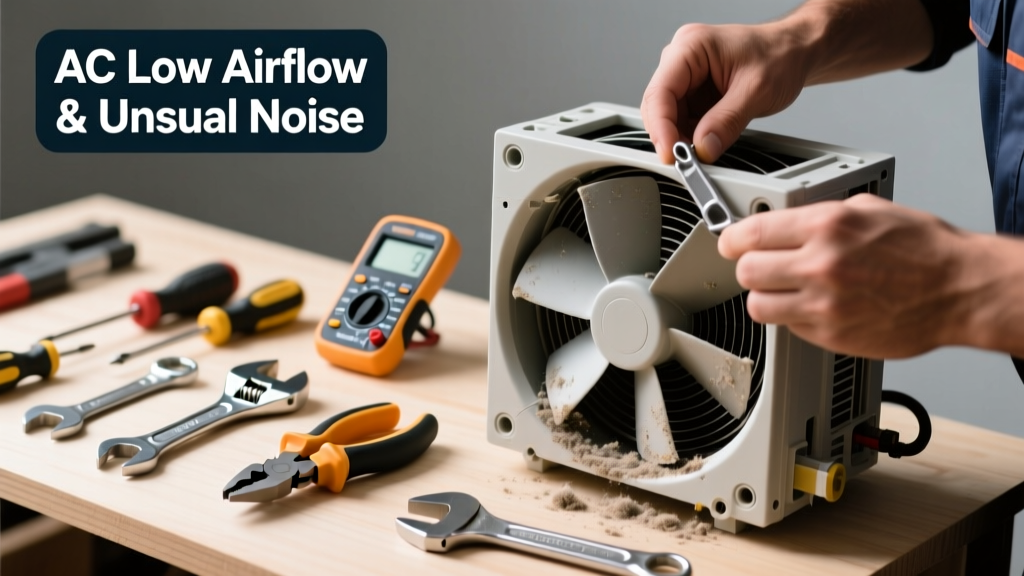
If your AC is blowing weak air while rattling, squealing, or grinding, it’s not just annoying—it’s a red flag. Restricted airflow strains the system, overheats components, and can lead to compressor failure within weeks. Most causes are simple to identify and fix in under an hour—if you know where to look.
Quick Diagnosis
Start here before grabbing tools. These five issues cause 85% of low-airflow + noise complaints (per HVAC.com’s 2023 field survey):
- Clogged air filter (most common—accounts for 42% of cases)
- Frozen evaporator coil (often from dirty filter or low refrigerant)
- Loose or bent blower wheel hitting housing
- Worn-out blower motor bearings (causing grinding or screeching)
- Debris jammed in outdoor condenser fan blades (causes thumping or scraping)
Tools & Materials Needed
| Item | Purpose | Estimated Cost |
|---|---|---|
| Disposable pleated air filter (16x25x1) | Replaces clogged filter—restores airflow instantly | $8–$15 |
| Fin comb (aluminum) | Straightens bent condenser/evaporator fins without damaging them | $12–$22 |
| Shop vacuum with brush attachment | Removes dust/debris from blower assembly and duct registers | $45–$90 |
| Non-contact infrared thermometer | Detects frozen coil (surface temp <32°F) or overheating motor | $25–$65 |
| Insulated gloves & safety glasses | Protects hands and eyes during electrical and mechanical work | $10–$20 |
Step-by-Step Fix
Work in this order—each step eliminates a likely culprit and builds on the last:
- Replace the air filter: Turn off power at the thermostat and breaker. Pull out the old filter—hold it up to light; if you can’t see through it, it’s blocking >70% of airflow (ASHRAE Standard 52.2). Install a MERV 8 replacement.
- Inspect and thaw the evaporator coil: Remove the indoor air handler access panel. If fins are coated in frost or ice, turn off cooling mode and run fan-only for 2–4 hours. Use the infrared thermometer to confirm surface temp rises above 40°F before restarting.
- Check the blower wheel: With power OFF, gently spin the wheel by hand. It should rotate smoothly with no wobble or scraping. If it hits the housing or feels gritty, clean debris with compressed air and inspect for bent blades or cracked hubs.
- Clear outdoor fan debris: Shut off outdoor unit power. Remove leaves, grass clippings, and nesting materials from around and between fan blades. Straighten any bent fins using the fin comb—never force them.
When to Call a Pro
Stop and call a licensed HVAC technician if you encounter any of these:
- Electrical burning smell or visible charring near the blower motor or capacitor
- Refrigerant hissing or oil stains near copper lines (indicates leak—requires EPA-certified handling)
- Blower motor won’t start after cleaning and filter replacement (likely failed capacitor or motor windings)
- Noise persists after all DIY steps—and includes metal-on-metal grinding or loud buzzing (bearing or compressor failure)
"Over 60% of premature AC compressor failures begin with chronic low airflow—often ignored until it's too late." — HVAC Excellence Technician Certification Manual, 2022
Prevention Tips
Extend your system’s life and avoid repeat issues with these habits:
- Change filters every 30–60 days during peak season (not every 90 days—ASHRAE updated guidance in 2021)
- Trim shrubbery to maintain 24" clearance around outdoor unit
- Vacuum return air grilles monthly with brush attachment
- Schedule professional coil cleaning and refrigerant check annually—especially before summer
Can I use compressed air to clean the evaporator coil?
Yes—but only at low pressure (<30 PSI) and from the *fin side*, never directly into the coil tubes. High-pressure air can bend delicate fins or damage solder joints. Better yet: use a soft-bristle coil brush and no-rinse cleaner like Nu-Calgon Evap Foam.
Why does my AC make a loud bang when it starts?
A single loud 'bang' at startup usually means the blower wheel is unbalanced or the motor mount bolts have loosened. Check for cracked wheel hubs or missing balance weights. If the sound repeats daily, it may indicate failing motor bearings—a sign replacement is needed within weeks.
Is it safe to straighten bent condenser fins myself?
Absolutely—if you use an aluminum fin comb designed for HVAC units. Never use screwdrivers or pliers: they’ll crush or tear fins, reducing heat transfer by up to 30% (U.S. Department of Energy, 2020). Work slowly, one row at a time, matching original spacing.
How do I know if the blower motor bearings are bad?
Spin the wheel manually with power off. If it feels rough, gritty, or doesn’t coast freely for 2+ seconds, bearings are worn. Also listen for high-pitched whining or grinding *only* when the fan runs—not at startup or shutdown. That’s classic bearing failure.
Will cleaning the ducts fix low airflow and noise?
Rarely. Duct cleaning rarely improves airflow unless there’s massive debris buildup (e.g., rodent nests or construction dust). More often, the issue is upstream: filter, coil, or blower. Skip duct cleaning and focus on those first—replace your filter and inspect the evaporator coil instead.
What noise means my compressor is failing?
A continuous, deep humming or knocking from the outdoor unit—especially if accompanied by warm air indoors and tripped breakers—is a compressor red flag. Don’t restart it repeatedly. Turn off power and contact a pro immediately—running a failing compressor can cost $1,200+ in collateral damage.
Most low-airflow and noise issues stem from simple maintenance oversights—not inevitable breakdowns. By acting fast and focusing on the filter, coil, and blower, you’ll restore quiet, efficient cooling and add years to your system’s life. And if you hear that familiar hum return—steady and smooth—you’ll know you’ve got it handled.