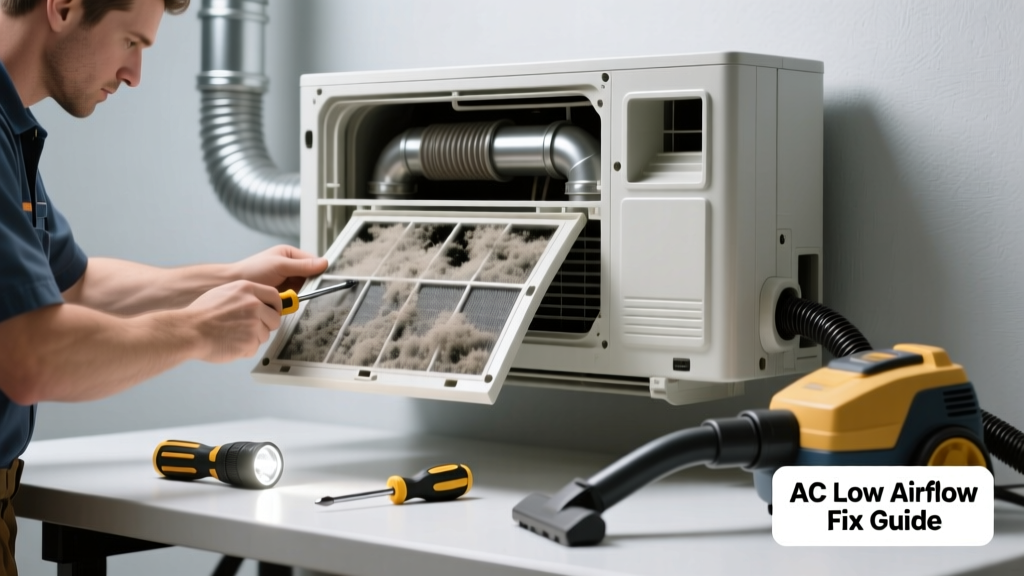
Your AC is running—but the air feels weak, rooms stay warm, and vents barely whisper cool air. That’s not just annoying; it’s a sign your system is straining, wasting energy, and risking premature failure. Most low-airflow issues stem from simple, fixable causes you can tackle in under an hour.
Quick Diagnosis
Before grabbing tools, rule out the obvious culprits. Low airflow rarely means a broken compressor—it usually points to blockage or restriction upstream.
- Clogged or dirty air filter (accounts for over 70% of residential low-airflow cases, per HVAC Excellence’s 2022 field survey)
- Blocked or closed supply registers or return grilles
- Frozen evaporator coil (often caused by low refrigerant or airflow restriction)
- Dirty blower wheel or motor issues
- Ductwork damage—kinks, collapses, or disconnected sections
Tools & Materials Needed
| Item | Purpose | Estimated Cost |
|---|---|---|
| 3M Filtrete 16x25x1 MERV 11 Filter | Replaces clogged filters without restricting airflow | $12–$18 |
| Shop vacuum with brush attachment | Cleans dust from blower wheel and return grille | $45–$95 |
| Fin comb (aluminum coil cleaner) | Straightens bent evaporator fins safely | $8–$15 |
| Non-contact infrared thermometer | Checks for frozen coils or abnormal temperature drops | $25–$60 |
| Flashlight & ladder (6-ft) | Inspects duct connections and attic returns | $15–$40 |
Step-by-Step Fix
Work in this order—each step eliminates a common cause before moving to more involved solutions.
- Replace the air filter. Turn off the system at the thermostat and main disconnect. Remove the old filter—if it’s gray, stiff, or blocks light when held to a window, replace it immediately. Use MERV 8–11; avoid MERV 13+ unless your system is rated for it.
- Clear all registers and returns. Vacuum supply vents and return grilles thoroughly. Check behind furniture and under rugs—especially in bedrooms and basements where returns are often obstructed. Ensure all dampers are fully open (look for parallel lines on the lever).
- Inspect the evaporator coil. With power OFF, remove the indoor air handler access panel. Shine a flashlight into the coil. If fins are bent or coated in gray fuzz, use a fin comb gently—never scrape or force it. If ice is present, turn off cooling mode and run fan-only for 4–6 hours before proceeding.
- Check blower wheel condition. Locate the blower compartment (usually behind the filter slot). Wipe visible dust off the wheel blades with a microfiber cloth dampened with water—not cleaner. A buildup thicker than 1/8 inch reduces airflow by up to 30%, according to the Air Conditioning Contractors of America’s 2021 maintenance benchmark report.
When to Call a Pro
Some issues demand licensed expertise—not just for safety, but because misdiagnosis leads to costly cascading failures.
- Refrigerant leaks (evidenced by hissing, oil stains, or pressure readings below spec)
- Blower motor that hums but doesn’t spin—or smells burnt
- Ductwork with visible tears, collapsed flex duct, or missing insulation in unconditioned spaces
- Air handler vibrating excessively or making grinding noises during startup
- No improvement after completing all DIY steps—and airflow remains below 350 CFM per ton (measured with an anemometer)
Prevention Tips
Low airflow isn’t random—it’s cumulative. Build habits that catch problems early and extend equipment life.
- Change filters every 30–60 days if you have pets or allergies; every 90 days in clean homes
- Keep return grilles at least 18 inches clear of furniture, curtains, or rugs
- Trim shrubbery at least 24 inches away from outdoor condenser units
- Schedule professional duct inspection every 5 years—especially if you’ve renovated or added rooms
- Install a smart thermostat with airflow alerts (like the ecobee SmartThermostat with Voice Control)
Can I vacuum the blower wheel while the power is on?
No—never. Even with the thermostat off, capacitors in the air handler can store lethal voltage. Always shut off power at the main disconnect switch near the unit and verify with a non-contact voltage tester before touching internal components.
Why does my AC freeze up right after I change the filter?
This usually signals an underlying issue: low refrigerant charge, a failing expansion valve, or restricted airflow elsewhere—like a dirty coil or undersized ducts. A fresh filter improves airflow suddenly, exposing pre-existing imbalances.
"A sudden freeze-up post-filter change is a red flag—not a coincidence. It means the system was already operating on the edge." — HVAC Technician Certification Board, 2023 Field Manual
Will cleaning the outdoor condenser coil improve indoor airflow?
Indirectly—yes. A dirty condenser raises head pressure, forcing the compressor to work harder and reducing overall system efficiency. But it won’t fix weak airflow from the vents unless the issue is systemic overheating causing short cycling. Focus first on indoor-side restrictions.
How do I know if my ducts are leaking?
Hold a lit incense stick near duct seams, joints, and take-offs while the system runs. If smoke wobbles or gets sucked in, you’ve got a leak. Also check for dust streaks on duct surfaces—those indicate air escaping under pressure. For a precise assessment, consider a professional duct leakage test.
Can a smart thermostat detect low airflow?
Some can—models like the Nest Learning Thermostat with AC Auto-Sync monitor runtime patterns and coil temperature trends. They won’t measure CFM directly, but repeated short cycles + high return temps often correlate with restricted airflow. Use them as early-warning indicators—not diagnostic tools.
Is low airflow dangerous?
Not immediately life-threatening, but yes—over time. Reduced airflow causes evaporator coils to freeze, then thaw and drip inside the air handler, promoting mold growth. It also forces the compressor to cycle more frequently, increasing wear and raising your risk of a $1,200+ replacement. The U.S. EPA estimates that 14% of household water usage is from leaks—including condensate overflow due to airflow-related freezing.
Fixing low airflow isn’t about perfection—it’s about restoring balance. Most homeowners regain strong, consistent airflow within 45 minutes using just a new filter and a vacuum. When you feel that first rush of cold air after clearing a blocked return, you’ll understand why this repair pays for itself in comfort, efficiency, and peace of mind—before the next heatwave hits.