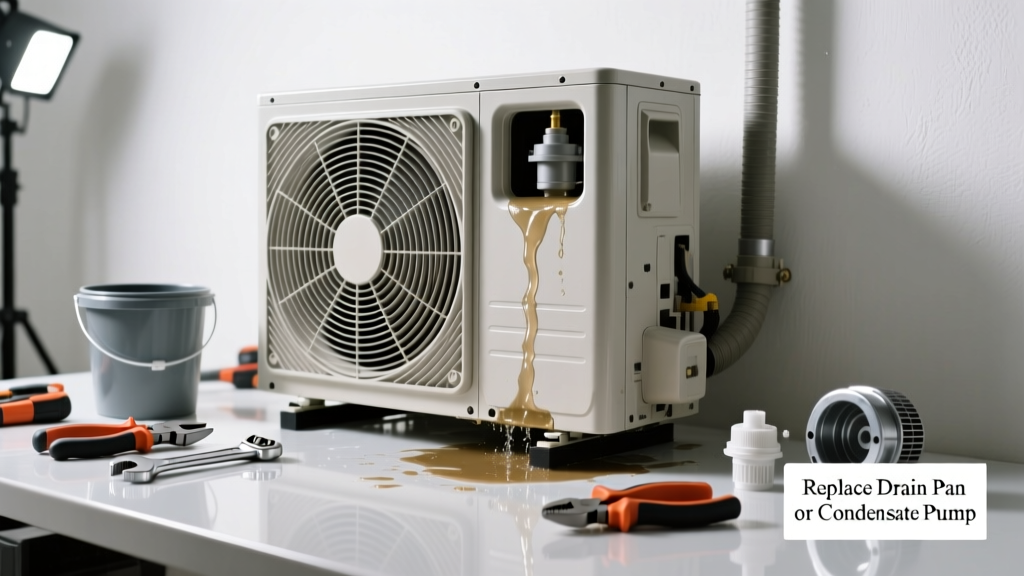
That puddle under your indoor AC unit isn’t just annoying—it’s a red flag that moisture isn’t draining properly, risking mold, rust, or even electrical damage. Most leaks stem from one of three replaceable parts: a cracked drain pan, a clogged or failed condensate pump, or a stuck float switch. Replacing the right component takes under an hour and costs less than $75—if you diagnose correctly first.
Quick Diagnosis
Before grabbing tools, rule out simple causes:
- Check if the condensate line is clogged (blow compressed air or use a wet/dry vac)
- Look for algae buildup in the drain pan or PVC line (common in humid climates)
- Inspect the float switch inside the drain pan—it should click when lifted manually
- Listen for humming from the condensate pump but no water movement (indicates motor failure)
- Examine the drain pan for hairline cracks or corrosion (especially in units over 8 years old)
Tools & Materials Needed
| Item | Purpose | Estimated Cost |
|---|---|---|
| Phillips and flathead screwdrivers | Remove access panels and mounting hardware | $8–$15 |
| Shop vacuum with wet/dry capability | Clear standing water and test pump function | $45–$90 |
| Replacement condensate pump (e.g., Little Giant VCMA-20UL) | Direct swap for failed pumps; includes built-in float switch | $65–$85 |
| Plastic drain pan (OEM or universal fit) | Replaces rusted or cracked pans; verify dimensions match your air handler | $22–$48 |
| Vinegar and soft-bristle brush | Cleans algae biofilm without damaging PVC or copper lines | $5–$10 |
Step-by-Step Fix
Follow these methods based on your diagnosis:
- Replace the condensate pump: Turn off power at the breaker. Disconnect the pump’s power cord and drain lines. Unscrew mounting bracket, lift out old unit, and install new pump using existing tubing and wiring. Test by pouring ½ cup water into the reservoir—pump should activate within 30 seconds.
- Swap the drain pan: After powering down and draining residual water, remove the air handler’s front access panel. Unbolt the old pan (usually secured with 3–4 screws), disconnect the overflow tube, and slide in the replacement—ensure the slope directs water toward the outlet port.
- Install a new float switch (if standalone): Locate the switch mounted near the pan’s edge. Disconnect wires (note color coding), unscrew the old switch, and mount the replacement so the arm moves freely without binding. Test by gently lifting the arm—it should kill power to the AC immediately.
When to Call a Pro
Don’t risk it if any of these apply:
- Your AC uses a high-efficiency two-stage system with integrated smart controls (e.g., Lennox XC25 or Carrier Infinity)
- You find refrigerant oil residue around the leak—this points to an evaporator coil issue, not drainage
- The drain line runs through a concrete slab or inaccessible wall cavity
- You measure over 14% relative humidity in the attic space where the air handler sits (per U.S. EPA’s 2023 Indoor Air Quality Guide, this increases mold risk during repairs)
Prevention Tips
Extend the life of your new parts with consistent maintenance:
- Pour ¼ cup distilled white vinegar into the drain line every 3 months to prevent algae
- Install a $12 condensate line alarm (e.g., Zircon Leak Alert) that beeps before overflow occurs
- Replace the pump every 5–7 years—even if working—since internal impellers degrade silently
- Keep attic access clear and inspect the pan visually during biannual filter changes
Can I use bleach to clean the drain line?
No—bleach corrodes copper tubing and degrades PVC over time. The U.S. Department of Energy explicitly warns against chlorine-based cleaners in HVAC condensate systems (2022 Residential HVAC Maintenance Guidelines). Stick with vinegar or enzyme-based drain treatments like Rectorseal Air-Con.
How do I know if my drain pan is cracked or just dirty?
Wipe the pan dry, then pour ½ cup water directly onto its center. Watch closely: if water appears beneath the unit within 90 seconds—and you’ve confirmed the line isn’t clogged—it’s likely cracked. Surface stains or white mineral deposits don’t indicate failure; hairline fractures near mounting holes do.
Is it safe to bypass the float switch temporarily?
"Bypassing a float switch is like disabling an airbag—it might seem convenient, but one overflow can flood your ceiling and trigger $5,000 in mold remediation," says HVAC technician Marcus Lee, lead trainer at North American Technician Excellence (NATE), 2023.Never bypass it. Instead, replace the switch ($12–$24) or upgrade to a pump with integrated safety shutoff.
What size condensate pump do I need for my 3-ton AC?
Most residential units (up to 5 tons) work with a 20–25 GPH pump like the Little Giant VCMA-20UL. Check your current pump’s label for GPH rating—or calculate: 3 tons × 0.75 gallons/hour per ton = ~2.25 gallons/hour peak output. A 20 GPH pump provides ample headroom.
Why does my new pump make a clicking noise but not move water?
That’s usually trapped air in the discharge line. Loosen the compression fitting at the pump’s outlet, let air escape while water flows, then re-tighten. If clicking persists, the impeller is jammed—disassemble and clear debris with needle-nose pliers. Don’t force it; plastic impellers snap easily.
Can I replace just the float switch without replacing the whole pump?
Yes—if your pump model supports it (e.g., Superior Pumps SP1A has a removable switch). But most modern units (like Zoeller M53 or Simer 2020) integrate the switch into the housing. In those cases, full pump replacement is faster and more reliable.
A small leak today can become warped drywall, ruined insulation, or a failed blower motor tomorrow. Replacing the correct part—not just the most obvious one—stops the drip and protects your home’s air quality. Keep a spare float switch and a bottle of vinegar in your garage, and you’ll handle 80% of AC water issues before they escalate. For deeper issues like refrigerant leaks or duct condensation, see our guide on AC condensation on cold lines or AC not draining properly.