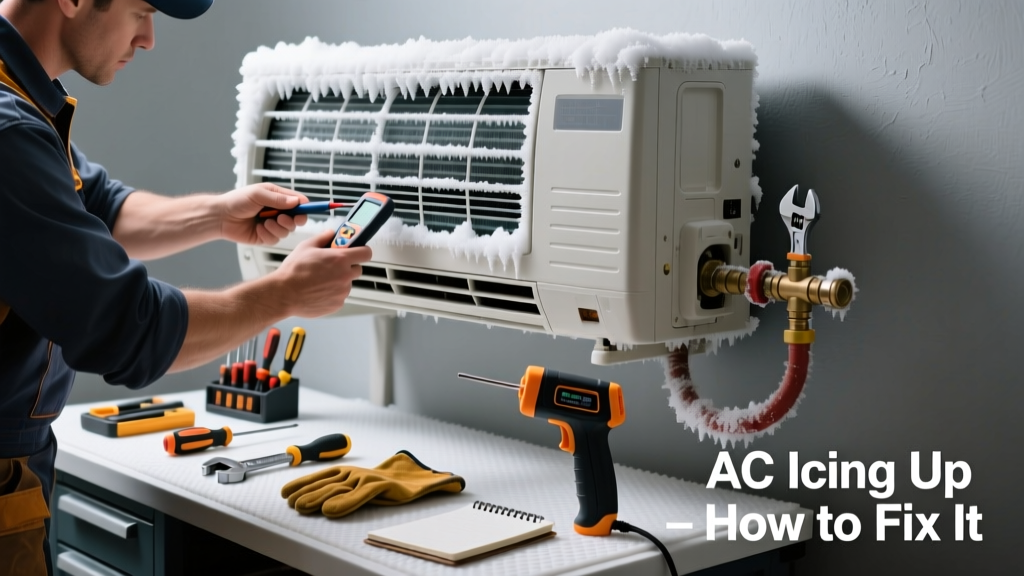
If your air conditioner is blowing warm air while ice coats the evaporator coils or refrigerant lines, you’re dealing with a classic freeze-up — a symptom, not the disease. It’s frustrating, inefficient, and if ignored, can damage your compressor. The good news? Most causes are simple to identify and fix yourself in under an hour.
Quick Diagnosis
Before grabbing tools, confirm it’s actually icing (not condensation) and check these five most common culprits:
- Dirty or clogged air filter restricting airflow
- Blocked or closed supply vents reducing return air volume
- Low refrigerant charge (often from a leak)
- Faulty blower motor or capacitor causing weak airflow
- Thermostat set too low in high-humidity conditions
Tools & Materials Needed
| Item | Purpose | Estimated Cost |
|---|---|---|
| Digital thermometer (infrared or probe) | Measure coil and line temperatures to confirm freezing vs. normal operation | $15–$40 |
| Replacement pleated air filter (MERV 8) | Restores proper airflow; prevents repeat icing | $8–$15 |
| Fin comb (aluminum coil straightener) | Realigns bent evaporator fins blocking airflow | $12–$22 |
| Multimeter | Test blower motor voltage and capacitor function | $25–$65 |
| Soft brush & vacuum with crevice tool | Clean debris from indoor coil without damaging fins | $0–$18 |
Step-by-Step Fix
Follow this sequence — skipping steps risks recurrence or further damage:
- Turn off the AC at the thermostat AND breaker. Let the ice melt completely (4–12 hours). Never chip ice — you’ll puncture copper tubing.
- Replace the air filter and inspect all supply vents — open every one, especially in unused rooms. Confirm return grilles aren’t blocked by furniture or rugs.
- Inspect the evaporator coil (inside air handler). If visibly dirty, gently vacuum loose dust, then use a soft brush and fin comb to straighten bent fins. Avoid harsh cleaners — they corrode aluminum.
- Test blower operation: Turn power back on, set thermostat to “Fan Only.” Listen for consistent airflow and check for unusual noise or vibration. If fan runs weakly or intermittently, test the capacitor with a multimeter.
- Check refrigerant lines: After 15 minutes of cooling, feel the larger insulated suction line — it should be cool and slightly damp, not frozen solid. If still icy after full defrost and cleaning, refrigerant is likely low.
When to Call a Pro
Stop here and call a licensed HVAC technician if:
- The suction line remains frosty after 30+ minutes of operation post-defrost
- You hear hissing, bubbling, or rattling noises near the outdoor unit
- The circuit breaker trips repeatedly when the AC starts
- You suspect a refrigerant leak — handling refrigerants requires EPA Section 608 certification
- Your unit is under 5 years old and still under manufacturer warranty (DIY repairs may void coverage)
According to the U.S. EPA, improper refrigerant handling contributes to 14% of residential HVAC-related environmental violations reported in 2022 — always leave refrigerant work to certified pros.
Prevention Tips
Freezing isn’t random — it’s predictable. Keep your system running smoothly with these habits:
- Change your air filter every 30–60 days during peak season (more often with pets or allergies)
- Keep outdoor condenser unit clear of grass clippings, leaves, and shrubbery within 2 feet
- Set thermostat no lower than 72°F in summer — each degree below increases freeze risk by ~12% in humid climates (ASHRAE Journal, 2021)
- Schedule professional coil cleaning and refrigerant pressure check every 2 years
Why does my AC only ice up at night?
Nighttime icing usually points to low airflow combined with high humidity and cooler ambient temps. As outdoor temps drop, the evaporator coil gets colder faster — any restriction (dirty filter, weak blower) becomes more pronounced. Check your filter first, then verify blower speed settings match your duct size.
Can I pour hot water on a frozen AC coil?
No — thermal shock can crack solder joints or warp aluminum fins. Use room-temperature water in a spray bottle or let it thaw naturally. Speed it up safely by setting the thermostat to “Fan Only” with heat turned off — moving air accelerates melting without stressing components.
Will resetting the breaker fix icing?
Resetting the breaker only restarts the system — it doesn’t address root causes like airflow blockage or low refrigerant. In fact, cycling power without defrosting first can worsen ice buildup and strain the compressor. Always fully thaw before restoring power.
How long should I wait before turning the AC back on after defrosting?
Wait until all ice is gone — including hidden frost inside the coil fins and along the suction line near the air handler. That typically takes 4–8 hours. Turning it back on prematurely guarantees immediate re-freeze and potential liquid refrigerant return to the compressor.
Is it safe to run the AC with a partially melted coil?
No. Even thin layers of ice restrict refrigerant flow and cause uneven pressure drops. Running under those conditions stresses the compressor and reduces efficiency by up to 30%, per the Air Conditioning Contractors of America’s 2023 Field Service Benchmark Report. Wait until surfaces are completely dry and at ambient temperature.
Can a dirty outdoor unit cause indoor icing?
Indirectly, yes. A clogged condenser coil reduces heat rejection, raising head pressure. This forces the expansion valve to over-meter refrigerant into the evaporator, lowering its temperature excessively — especially in high humidity. Clean both coils annually for balanced performance.
A frozen AC isn’t a death sentence — it’s a warning light flashing in slow motion. Most icing issues stem from preventable maintenance lapses, not catastrophic failure. Catch it early, act methodically, and you’ll restore cooling without a service call. For deeper system checks, see our guide on AC not cooling enough or AC blowing warm air.