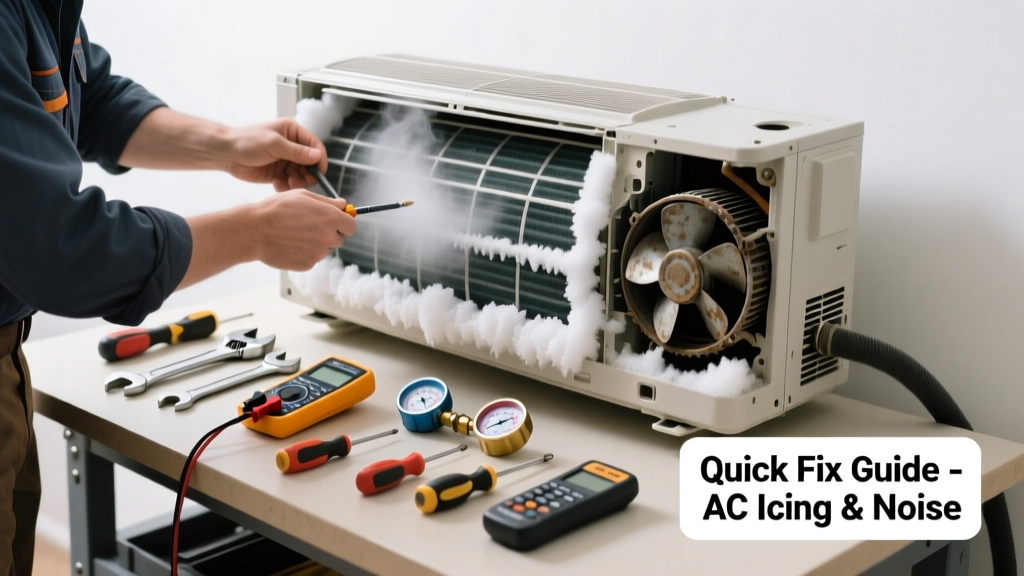
If your air conditioner is frosting over while emitting grinding, hissing, or buzzing sounds, it’s not just inconvenient—it’s a red flag. Ice buildup restricts airflow, strains components, and can lead to compressor failure in as little as 48 hours of continuous operation. Don’t ignore it: this combo often points to a solvable issue, but timing matters.
Quick Diagnosis
Start here—these are the five most common culprits behind simultaneous icing and noise:
- Dirty or clogged air filter (causes low airflow → evaporator coil freezes)
- Low refrigerant charge (often from a leak; triggers pressure drop and ice + hissing)
- Frozen or damaged blower motor (grinding/screeching + reduced airflow)
- Blocked condensate drain line (water backs up, freezes on coil, adds gurgling)
- Failed expansion valve or TXV (causes erratic refrigerant flow → ice + clicking or rattling)
Tools & Materials Needed
| Item | Purpose | Estimated Cost |
|---|---|---|
| Digital thermometer (infrared or probe) | Measure evaporator coil surface temp to confirm freezing vs. normal operation | $15–$45 |
| Fin comb (aluminum coil straightener) | Realign bent fins blocking airflow across frozen coil | $8–$22 |
| Refrigerant manifold gauge set | Check system pressure—critical before adding or recovering refrigerant | $65–$180 |
| Condensate line cleaning kit (with pump & tablets) | Clear algae-clogged drain lines that cause water backup and freezing | $12–$35 |
| Non-corrosive coil cleaner (EPA-approved) | Safely dissolve grime without damaging aluminum fins or copper tubing | $10–$28 |
Step-by-Step Fix
Follow these methods in order—most issues resolve at Step 1 or 2. Always power off the unit at the disconnect switch and thermostat before starting.
- Shut down and thaw completely: Turn off the AC at the thermostat AND the outdoor disconnect. Let ice melt naturally—never chip or use heat guns. This takes 4–12 hours depending on severity. Check for standing water in the drain pan.
- Replace or clean the air filter: Use only the MERV rating specified by your unit (usually MERV 8–11). A filter rated too high restricts airflow and mimics low-refrigerant symptoms. Replace every 30–90 days in summer.
- Inspect and clean the evaporator coil: After thawing, remove the indoor air handler access panel. Use a soft brush and non-corrosive coil cleaner (not bleach or vinegar—both corrode aluminum). Rinse gently with low-pressure water. Straighten bent fins with a fin comb.
- Clear the condensate drain line: Insert a wet/dry vac hose into the drain line’s access port and suction for 60 seconds. Follow with 1/4 cup white vinegar or a commercial tablet. Flush with 1 cup warm water.
- Test blower motor operation: With power restored, listen for smooth startup. If you hear grinding, screeching, or delayed spin-up, the motor bearings may be failing—see 'When to Call a Pro' below.
When to Call a Pro
Some issues require EPA-certified refrigerant handling, electrical licensing, or specialized diagnostics. Call a licensed HVAC technician if you observe any of these:
- Refrigerant pressure readings below 65 psi on the low side (R-410A) or above 275 psi on the high side—indicates leak or overcharge
- Oil residue near copper line connections or valves (a telltale sign of refrigerant leak)
- Tripped circuit breaker or burning odor when powering on
- Compressor humming but not starting (may indicate seized piston or failed start capacitor)
- Ice returns within 24 hours after full cleaning and filter replacement
"Over 62% of premature compressor failures begin with undiagnosed airflow restrictions—like dirty filters or blocked coils—that trigger repeated freeze-thaw cycles." — ACCA Technical Bulletin TB-12-2022
Prevention Tips
Stop icing before it starts with these habits:
- Change filters every 45 days during peak cooling season—not just when they look dirty
- Keep supply vents fully open and unobstructed (no furniture, rugs, or curtains blocking airflow)
- Trim shrubbery and debris at least 24 inches from outdoor condenser unit
- Have refrigerant levels and coil cleanliness checked annually by a certified technician
- Install a smart thermostat with freeze protection alerts (e.g., Honeywell T9 or Ecobee SmartThermostat)
Can I use a hair dryer to speed up thawing?
No—applying direct heat risks warping aluminum coil fins, melting wire insulation, or triggering thermal cutoffs. Patience is safer: let ice melt naturally with power off. If you’re in a rush, increase indoor fan-only mode for gentle airflow—but never run cooling during thaw.
Why does my AC only ice up at night?
Nighttime cooling loads drop, causing the system to cycle longer at lower outdoor temps. If refrigerant is slightly low or airflow is marginal, this extended runtime creates ideal conditions for coil freezing. It’s rarely ‘just humidity’—it’s usually an early symptom of an underlying imbalance.
Will resetting the breaker fix the noise and ice?
Resetting the breaker may restart the system temporarily, but it won’t address root causes like low refrigerant, dirty coils, or failing bearings. In fact, cycling power repeatedly while ice is present can overload the compressor. Always diagnose first—check for insufficient cooling output before resetting.
How do I know if it’s the capacitor or the motor making the noise?
A failing capacitor usually causes a loud *hum* followed by no fan movement—or intermittent spinning. A bad motor bearing produces a rhythmic grinding, whining, or scraping sound that changes pitch with fan speed. If you hear buzzing *and* see the outdoor fan not turning, test the capacitor with a multimeter first—capacitor testing guide here.
Is it safe to run the AC in fan-only mode while it’s thawing?
Yes—if the indoor blower motor is functional and the coil isn’t physically obstructed by ice. Fan-only mode helps circulate dry air and speeds natural thawing without stressing the compressor. Just ensure the thermostat is set to 'Fan Only', not 'Cool'. Never run cooling until all ice is gone and airflow is confirmed.
Can a dirty outdoor condenser cause indoor coil icing?
Indirectly—yes. A clogged condenser reduces heat rejection, raising head pressure and disrupting refrigerant flow dynamics. This can cause the expansion device to misfeed, leading to low evaporator pressure and freezing—even with clean filters and coils. Keep the outdoor unit free of leaves, grass clippings, and dust year-round.
Fixing an iced-up, noisy AC isn’t about brute force—it’s about restoring balance: airflow, refrigerant, and electrical integrity. Most homeowners resolve this in under two hours using just a filter, coil cleaner, and patience. But if the problem recurs within three weeks, treat it as a diagnostic clue—not a fluke. That’s when refrigerant leaks, undersized ductwork, or aging components need professional attention before bigger failures happen.