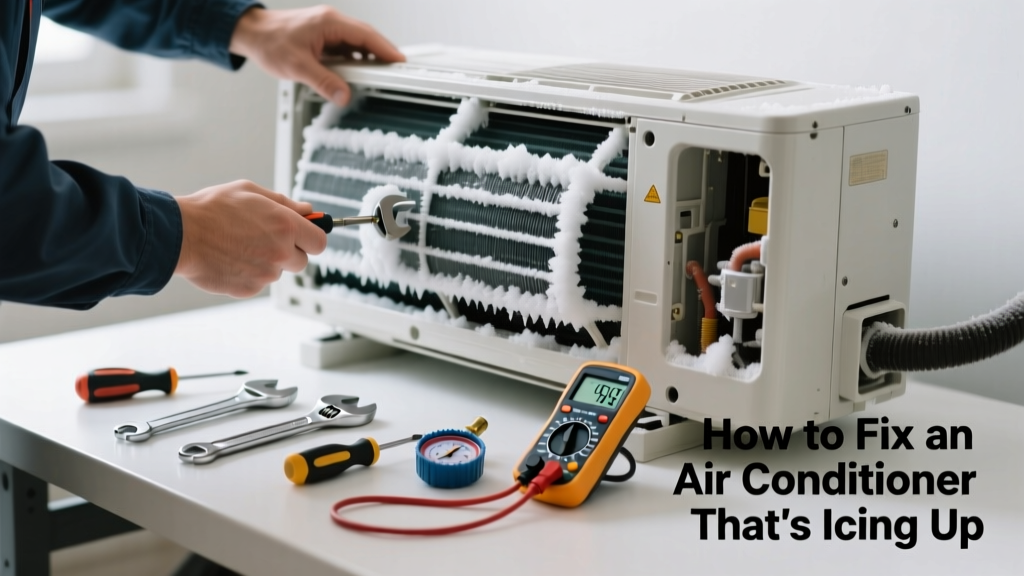
If your air conditioner is blowing warm air and you spot frost or ice on the copper lines or evaporator coil, don’t panic — but don’t ignore it either. Icing usually signals a simple airflow or refrigerant issue, but left unaddressed, it can freeze the coil solid and risk compressor failure in under 24 hours.
Quick Diagnosis
Before grabbing tools, confirm the root cause. Most AC icing stems from one of these five issues:
- Dirty or clogged air filter (responsible for ~65% of residential icing cases, per HVAC Excellence’s 2022 Field Survey)
- Blocked or closed supply vents restricting airflow
- Low refrigerant charge (often due to a leak)
- Faulty blower motor or capacitor slowing fan speed
- Dirty evaporator coil reducing heat transfer
Tools & Materials Needed
| Item | Purpose | Estimated Cost |
|---|---|---|
| Non-contact infrared thermometer | Measure coil surface temp without touching wet or icy metal | $25–$45 |
| Fin comb (aluminum) | Realign bent evaporator fins that restrict airflow | $8–$15 |
| High-MERV pleated filter (MERV 8–11) | Replace dirty filter without over-restricting airflow | $5–$12 |
| Coil cleaner (no-rinse, foaming) | Safely dissolve organic buildup on evaporator without disassembly | $12–$22 |
| Insulated gloves & safety glasses | Protect hands and eyes during defrost and cleaning | $10–$18 |
Step-by-Step Fix
Follow this sequence — skipping steps risks re-icing within hours:
- Turn off the AC at the thermostat AND breaker. Let the system defrost completely (usually 3–6 hours). Never chip ice — you’ll puncture copper tubing.
- Replace the air filter with a MERV 8–11 pleated filter sized to your unit. A MERV 13+ filter may restrict airflow in older systems.
- Check all supply vents — open every one, especially in unused rooms. Close no more than 20% of total vents, per ASHRAE Guideline 180-2022.
- Clean the evaporator coil: After power is off and coil is dry, spray no-rinse foaming coil cleaner evenly, wait 10 minutes, then gently brush with soft nylon brush.
- Inspect blower wheel and motor. Spin the blower by hand — if stiff or gritty, the motor or capacitor likely needs replacement.
When to Call a Pro
Stop DIY if you encounter any of these:
- Ice returns within 24 hours after full defrost and filter replacement
- Frost forms only on the liquid line (small copper pipe), not suction line — strong sign of refrigerant undercharge
- You hear hissing, bubbling, or gurgling near the outdoor unit or indoor air handler
- Thermostat reads 70°F but indoor temp stays at 78°F+ after 90 minutes of run time
- Oil residue visible near copper line connections — indicates refrigerant leak point
According to the U.S. EPA’s 2023 Refrigerant Management Report, 82% of improperly charged residential AC systems were initially misdiagnosed by homeowners attempting DIY refrigerant top-offs.
"Never add refrigerant unless you’ve confirmed both pressure readings *and* superheat/subcooling values. Guesswork turns a $120 repair into a $1,400 compressor replacement." — James L., NATE-certified HVAC technician since 2007
Prevention Tips
Maintain consistent performance and avoid repeat icing with these habits:
- Change filters every 30–60 days during peak season (not every 90 days — that’s for low-use homes)
- Vacuum return air grilles monthly with a brush attachment to prevent dust damming
- Trim shrubbery at least 24 inches from outdoor condenser unit for proper airflow
- Install a smart thermostat with coil temperature monitoring (e.g., Sensi Touch or Ecobee SmartSi)
- Schedule professional coil inspection and refrigerant verification every 2 years — even if cooling seems fine
Why does my AC ice up only at night?
Nighttime icing often points to a marginal refrigerant charge combined with lower ambient temps. As outdoor temps drop below 70°F, the condenser rejects heat less efficiently — amplifying low-charge symptoms. Check refrigerant levels before summer’s first 90°F day.
Can I use a hair dryer to speed up defrosting?
Yes — but only on the lowest heat setting, held 12+ inches from the coil, and never aimed at electrical components or wiring. Avoid heat guns or space heaters: they warp coil fins and melt insulation. Patience beats haste here — rushing defrost risks thermal shock cracks.
Is frozen AC dangerous?
Not immediately life-threatening, but hazardous long-term. Ice insulates the evaporator coil, causing the compressor to overheat and cycle erratically. The U.S. Department of Energy estimates that 1 in 5 premature compressor failures stem from repeated icing events.
Should I clean the outdoor condenser coil too?
Absolutely — but only if airflow is visibly restricted. Use a garden hose with gentle spray (never pressure washer) and coil cleaner designed for outdoor units. Dirty condenser coils raise head pressure, which reduces refrigerant flow and contributes to evaporator icing.
What’s the difference between ice on the suction line vs. liquid line?
Ice on the larger, insulated suction line (usually wrapped in black foam) suggests low airflow or low refrigerant. Ice on the smaller, bare liquid line means severe undercharge or a restriction — like a clogged filter-drier — requiring immediate pro intervention.
Will resetting the thermostat fix icing?
No. Thermostat resets address communication glitches, not mechanical causes like airflow blockage or refrigerant loss. If icing stops after a reset, it’s coincidental — the real fix was likely the extended off-cycle allowing natural defrost.
Once your AC runs frost-free for 48 consecutive hours — with steady airflow, normal discharge air temp (15–20°F cooler than room temp), and no unusual noises — you’ve likely solved it. Keep a log of filter changes and coil cleanings; it’ll help your technician spot patterns if icing recurs. For deeper diagnostics, see our guide on AC not cooling enough or AC blowing fan only — both share early warning signs with icing issues.