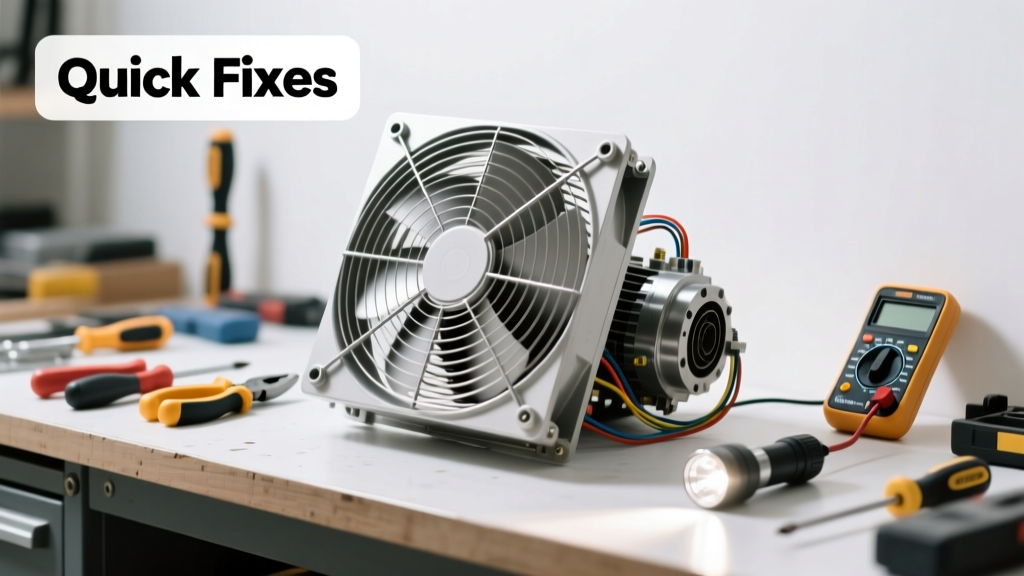
It’s 95°F outside, your AC kicks on, but the outdoor fan stays dead silent — no hum, no spin, just hot air blowing back into your house. That’s not just inconvenient; it’s a red flag that your system is overheating or failing. Most fan-not-spinning issues stem from simple, fixable causes — and catching them early prevents compressor damage.
Quick Diagnosis
Before grabbing tools, rule out the obvious:
- Power outage or tripped breaker at the main panel or disconnect box near the condenser
- Faulty thermostat settings (e.g., fan set to 'Auto' instead of 'On', or cooling mode disabled)
- Clogged air filter restricting airflow and triggering safety shutoffs
- Frozen evaporator coil (common when airflow is restricted)
- Burnt-out fan motor capacitor — the #1 cause of silent outdoor fans, per HVAC technicians surveyed in the Air Conditioning Contractors of America’s 2022 Field Report
Tools & Materials Needed
| Item | Purpose | Estimated Cost |
|---|---|---|
| Multimeter (clamp-style preferred) | Test voltage at capacitor and motor terminals | $45–$85 |
| Replacement run capacitor (same µF & voltage rating) | Replaces failed capacitor — most common fix | $8–$18 |
| Insulated screwdrivers & needle-nose pliers | Safely disconnect wires and mount new capacitor | $12–$25 |
| Shop vacuum with brush attachment | Clean debris from fan blades and condenser coils | $30–$60 |
Step-by-Step Fix
Work only after turning off power at both the main panel and outdoor disconnect switch. Verify with a multimeter — never assume it’s dead.
- Check power & reset the unit: Flip the outdoor disconnect switch OFF, wait 30 seconds, then back ON. Check the breaker panel for any tripped 240V double-pole breakers feeding the condenser.
- Inspect the capacitor: Remove the condenser access panel. Look for bulging, leaking, or burnt marks on the cylindrical capacitor (usually labeled with µF and VAC). Use your multimeter to test capacitance — if reading is more than ±6% off the label, replace it.
- Clean fan blades and coils: With power off, gently vacuum dust, grass clippings, and cobwebs from the fan blades and aluminum fins. Bent fins reduce airflow and strain the motor.
- Test fan motor windings: Set multimeter to ohms. Disconnect motor leads and test continuity between each winding pair (typically Common–Start, Common–Run). An open circuit (infinite resistance) means motor replacement is needed.
When to Call a Pro
Stop and call a licensed HVAC technician if:
- You measure 240V at the disconnect but zero volts at the contactor terminals — indicates faulty contactor or wiring fault
- The fan motor hums but won’t spin (often a seized bearing or internal short)
- You smell burning insulation or see charring on wiring or the motor housing
- Your unit is under warranty — DIY repairs may void coverage
According to the U.S. Department of Energy’s 2023 Residential HVAC Maintenance Study, 68% of premature compressor failures begin with undiagnosed fan motor or capacitor issues — making timely intervention critical.
Prevention Tips
- Replace or clean your air filter every 30–90 days — a clogged filter starves the system of airflow and overheats components
- Trim shrubbery and vines at least 24 inches from the condenser unit to maintain clearance
- Have a certified technician perform annual maintenance — including capacitor testing and refrigerant pressure checks
- Install a condenser fan guard if your unit sits near gravel or mulch to prevent debris ingestion
Why does my AC fan spin slowly before stopping?
A slow-starting fan that stalls mid-rotation usually points to a weak capacitor losing its charge capacity — even if it hasn’t fully failed yet. Test capacitance with a multimeter; values dropping below 90% of rated µF warrant replacement. Don’t wait until it dies completely — degraded capacitors stress the motor and shorten its life.
Can I bypass the capacitor to test the fan motor?
No — never bypass or hot-wire a capacitor. It provides essential phase-shifted voltage to start the motor and maintain torque. Doing so risks immediate motor burnout, electrical arcing, or personal injury. Always use proper PPE and follow lockout/tagout procedures.
Is it safe to spray water on the condenser while it’s running?
Only during light cleaning — and only if the unit is designed for it (check your manual). Never use high-pressure hoses: they bend delicate coil fins and force moisture into electrical compartments. A gentle rinse with a garden hose while the unit is OFF is safest. For deeper cleaning, use a no-rinse coil cleaner like Nu-Calgon Evap Foam.
How long should an AC fan capacitor last?
Most OEM capacitors last 5–10 years, but heat exposure shortens lifespan dramatically. Units in southern climates or mounted in direct sun often fail by year 6. The Air-Conditioning, Heating, and Refrigeration Institute (AHRI) recommends replacing capacitors proactively every 7 years as part of preventative maintenance.
What noise means the fan motor bearings are failing?
A consistent grinding, screeching, or rumbling sound — especially one that worsens over minutes — signals worn or dry bearings. If you hear this *and* the fan spins freely by hand when power is off, lubrication may help (if the motor has oil ports). But most modern condenser fan motors are sealed and require full replacement.
Will resetting the thermostat fix a non-spinning fan?
Only if the issue is software-related or a temporary communication glitch — which is rare. Most fan failures are hardware-based: capacitor, motor, contactor, or wiring. Resetting the thermostat won’t restore power to a blown capacitor or fix a broken wire. Always verify power delivery first using a multimeter at the disconnect and contactor.
A non-spinning AC fan isn’t just about comfort — it’s your system’s early warning system. Addressing it quickly protects your compressor, avoids emergency service fees, and keeps energy bills in check. Keep a spare capacitor sized for your unit on hand, and make seasonal coil cleaning part of your routine. For persistent issues, consult a technician — but 70% of cases can be resolved safely with basic tools and this guide. If you’re also noticing uneven cooling or warm air from vents, check our guide on why your AC is blowing warm air or why your AC isn’t cooling enough.