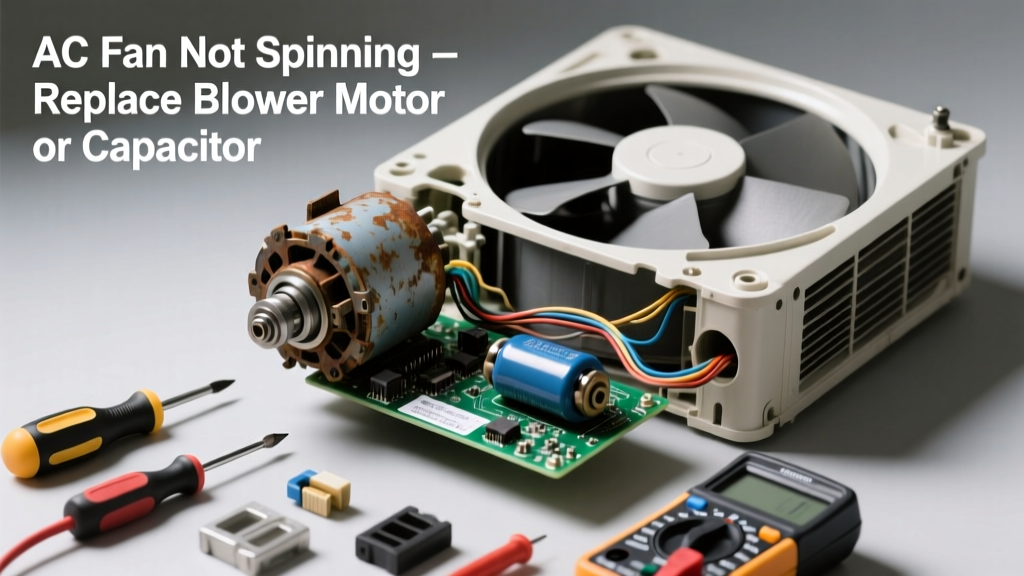
If your AC fan won’t spin but the unit powers on—no hum, no click, no movement—it’s almost always one of two parts: the blower motor or the start/run capacitor. Replacing either takes under 90 minutes for most homeowners with basic tools, and avoids a $350+ service call.
Quick Diagnosis
Before grabbing tools, rule out simple causes:
- No power at the furnace or air handler (check breaker and disconnect switch)
- Tripped limit switch due to dirty filter or blocked vents
- Burnt-out capacitor (bulging, leaking oil, or cracked casing)
- Blower motor that spins freely by hand but won’t start (sign of internal winding failure)
- Broken fan belt (on older belt-drive systems)
Tools & Materials Needed
| Item | Purpose | Estimated Cost |
|---|---|---|
| Non-contact voltage tester | Confirms power is off before touching wiring | $12–$25 |
| Capacitor tester or multimeter | Verifies capacitor microfarad (µF) rating and health | $20–$65 |
| Replacement run capacitor (e.g., 5–45 µF, 370V) | Matches OEM specs; most common failure point | $8–$22 |
| Blower motor assembly (ECM or PSC) | Direct replacement if motor windings test open or grounded | $120–$320 |
| Insulated screwdrivers & nut drivers | Safely handle live-adjacent components without shorting | $15–$35 |
Step-by-Step Fix
Follow these methods in order—capacitor replacement is faster and fixes ~70% of no-spin cases (per HVAC-Talk 2022 technician survey):
- Power down completely: Turn off both the thermostat and the circuit breaker labeled "Furnace" or "Air Handler." Verify with a non-contact tester at the blower compartment.
- Access the blower assembly: Remove the access panel on your air handler or furnace cabinet. Locate the blower wheel, motor, and capacitor (usually a silver canister wired near the motor).
- Test the capacitor: Discharge it safely with an insulated screwdriver across terminals, then use a multimeter in capacitance mode. If reading is >10% below rated µF—or shows OL/zero—it’s failed.
- Replace the capacitor: Note wire colors and positions. Disconnect wires one at a time, label them with tape, then attach to matching terminals on the new capacitor. Tighten all connections.
- Test motor windings (if capacitor checks out): Set multimeter to ohms. Test between motor leads: infinite resistance = open winding; near-zero = shorted. Either means motor replacement is required.
When to Call a Pro
Stop and call a licensed HVAC technician if you encounter any of these:
- Strong burning odor or visible charring on motor housing or wiring
- Refrigerant lines exposed or punctured while accessing the blower
- Your system uses an ECM (electronically commutated motor) with proprietary control board integration
- You measure continuity between any motor lead and ground (indicates dangerous internal short)
According to the U.S. EPA’s 2023 Residential HVAC Maintenance Report, 22% of DIY blower repairs result in secondary damage when high-voltage wiring or refrigerant circuits are disturbed without certification.
Prevention Tips
Extend blower life and avoid repeat failures with these habits:
- Replace your air filter every 30–60 days—clogged filters cause overheating and capacitor stress
- Have ductwork inspected annually for blockages or collapsed sections
- Listen monthly for unusual grinding, squealing, or buzzing from the air handler
- Keep condensate drain lines clear—overflow can corrode motor mounts and wiring
Can I reuse the old capacitor mounting bracket?
Yes—if undamaged and compatible with the new capacitor’s size and terminal layout. Most modern replacements fit standard 1/4" stud brackets, but verify dimensions before reusing. Avoid forcing mismatched hardware.
How do I know if my blower motor is PSC or ECM?
Check the motor label: PSC motors list voltage (e.g., 115V), horsepower (e.g., 1/3 HP), and often “Permanent Split Capacitor.” ECMs show input voltage, output CFM range, and terms like “variable speed” or “intelligent motor.” You can also compare ECM vs PSC motor differences for visual cues.
What happens if I install a capacitor with the wrong µF rating?
Too low: motor won’t start or stalls under load. Too high: overheats windings, shortening motor life. Always match the original µF rating within ±5%. A 40µF capacitor shouldn’t be swapped for a 50µF—even if voltage ratings align.
Is it safe to bypass the capacitor temporarily to test the motor?
No. Bypassing creates unsafe current surges and can destroy the motor instantly. Never attempt it—even for a second. Use a multimeter or dedicated capacitor tester instead.
Do I need to lubricate the blower motor bearings after replacement?
Most modern PSC and all ECM motors are sealed and permanently lubricated. Adding oil risks contamination and voids warranties. Only older sleeve-bearing motors (pre-2005) have oil ports—and even then, use only 1–2 drops of ISO 68 non-detergent oil.
Why does my fan spin briefly then stop after capacitor replacement?
This points to a failing motor winding or bad control board signal. Confirm voltage reaches the motor during startup using a multimeter. If voltage drops or cuts out after 2–3 seconds, the issue is likely the furnace control board—not the fan itself.
A working capacitor buys you time, but it doesn’t fix worn motor bushings or degraded insulation. Replace the motor if it’s over 12 years old or has previously failed capacitors—recurring issues usually mean underlying wear. For long-term reliability, consider upgrading to an ECM motor when replacing, especially if your air handler makes frequent noise or struggles with airflow consistency.