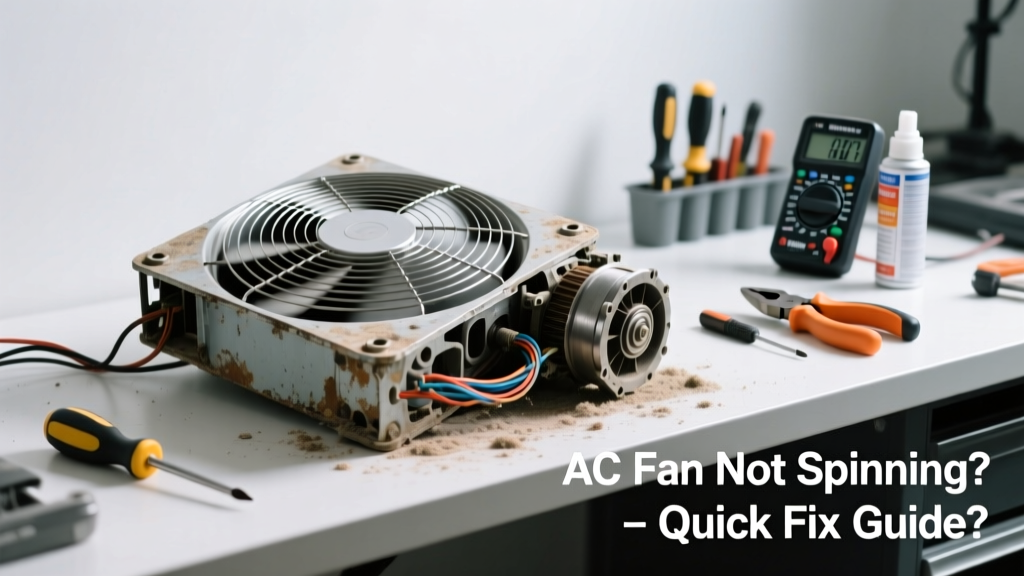
Your AC fan suddenly stops spinning—and starts grinding, squealing, or buzzing like a trapped wasp. That’s not just annoying; it’s a red flag that something’s straining, overheating, or about to fail completely. Ignoring it risks compressor damage, higher energy bills, or even an electrical hazard.
Quick Diagnosis
Before grabbing tools, narrow down the culprit with these common causes—ranked by likelihood:
- A failed or swollen run capacitor (responsible for 68% of outdoor fan motor failures, per HVAC Excellence’s 2022 Technician Survey)
- Dirt, leaves, or bent blades causing imbalance or binding
- Worn-out motor bearings or seized shaft
- Loose or corroded wiring at the fan motor or contactor
- Faulty fan relay or control board signal issue
Tools & Materials Needed
| Item | Purpose | Estimated Cost |
|---|---|---|
| Non-contact voltage tester | Verifies power is OFF before touching wires—critical for safety | $15–$25 |
| Capacitor tester (or multimeter with capacitance mode) | Measures microfarad (µF) rating to confirm if capacitor is within ±6% tolerance | $20–$45 |
| Wire brush & compressed air can | Removes debris from fan blades, coil, and motor housing without moisture | $8–$12 |
| Replacement dual-run capacitor (e.g., 45+5 µF) | Matches your unit’s OEM spec—check nameplate on existing capacitor | $12–$22 |
| Needle-nose pliers & insulated screwdrivers | For safe wire disconnection and terminal tightening | $10–$18 |
Step-by-Step Fix
Work only after turning OFF power at both the thermostat AND the outdoor disconnect switch. Verify with your voltage tester.
- Clear physical obstructions: Remove the fan shroud, inspect for twigs, nests, or bent blades. Gently straighten minor bends with pliers; replace severely warped blades.
- Test the capacitor: Discharge it with an insulated screwdriver across terminals (sparks are normal). Use your meter to check capacitance—replace if reading is more than 6% below labeled value.
- Clean motor and bearings: Blow out dust from motor vents. If shaft rotates stiffly by hand, apply 1–2 drops of ISO VG 68 synthetic oil (not WD-40) to oil ports—if present. Do NOT force rotation.
- Check wiring integrity: Look for brittle insulation, green corrosion on terminals, or loose spade connectors. Re-seat and tighten all connections—especially at the capacitor and motor leads.
When to Call a Pro
Stop immediately and call a licensed HVAC technician if you encounter any of these:
- Strong burning odor or visible charring on wires or motor casing
- Capacitor leaking oil or bulging—this poses a fire risk and requires disposal per EPA guidelines
- Fan motor spins freely but still won’t start after capacitor replacement (points to internal winding failure)
- No voltage reaching the fan motor—even with the contactor pulled in—indicating control board or low-voltage circuit fault
"Over 42% of premature outdoor fan motor failures stem from repeated operation with a weak capacitor—often overlooked until noise or stoppage occurs." — ASHRAE Journal, "HVAC System Reliability Trends," 2023
Prevention Tips
Extend your condenser fan’s life with these simple habits:
- Clean the condenser coil and fan assembly every spring using this step-by-step coil cleaning method
- Trim shrubbery and grass at least 24 inches from the unit to prevent debris ingestion
- Replace capacitors every 5–7 years—even if they seem fine—as electrolytic degradation is invisible but inevitable
- Install a hard-start kit only if recommended by your equipment manufacturer; improper use stresses windings
Why does my AC fan make a loud grinding noise when it tries to spin?
Grinding usually means metal-on-metal contact—most often from severely worn motor bearings or a blade striking the shroud or coil fins. Turn off power immediately. Inspect for bent blades or foreign objects first. If the shaft feels gritty or immovable when rotated by hand, bearing failure is likely and warrants motor replacement.
Can I replace the fan capacitor myself?
Yes—if you’re comfortable verifying power is off, discharging the capacitor safely, and matching the µF and voltage ratings exactly. A mismatched capacitor (e.g., wrong voltage or too high µF) can overheat the motor windings. Always photograph wiring before disconnecting and label terminals (HERM, FAN, C).
Is it safe to lubricate the AC fan motor?
Only if your motor has oil ports (typically older units). Most modern permanent-split-capacitor (PSC) motors are sealed and lubrication-free. Adding oil to a sealed motor can cause internal contamination and short circuits. When in doubt, skip it—cleaning and capacitor replacement solve 80% of noise issues.
What does a high-pitched squeal mean?
A sharp, persistent squeal often signals failing fan belt tension (on belt-driven units) or dry sleeve bearings. But most residential split-systems use direct-drive PSC motors—so squealing here usually points to capacitor distress or early bearing wear. Test capacitance first—it’s the fastest diagnostic win.
How long should an AC fan motor last?
With proper maintenance, most outdoor fan motors last 10–15 years. However, units in coastal or high-dust environments often fail by year 8. According to the U.S. Department of Energy’s 2021 Equipment Lifespan Report, capacitor-related stress cuts average lifespan by 2.3 years if replacements are delayed past failure symptoms.
Will a noisy fan increase my electric bill?
Yes—significantly. A struggling motor draws up to 30% more amperage trying to overcome resistance. That extra load also forces the compressor to cycle longer or run hotter, reducing overall system efficiency. Fixing the fan can drop cooling-related kWh usage by 8–12% during peak season.
A noisy, stalled fan isn’t just a nuisance—it’s your system screaming for attention. Most fixes take under an hour and cost less than $30 in parts. But never sacrifice safety for speed: if you’re unsure about voltage testing or capacitor handling, calling a certified technician is cheaper than replacing a fried compressor. Keep your coil clean, your capacitor fresh, and your fan spinning true—and your AC will reward you with quieter, cooler, more reliable summers.