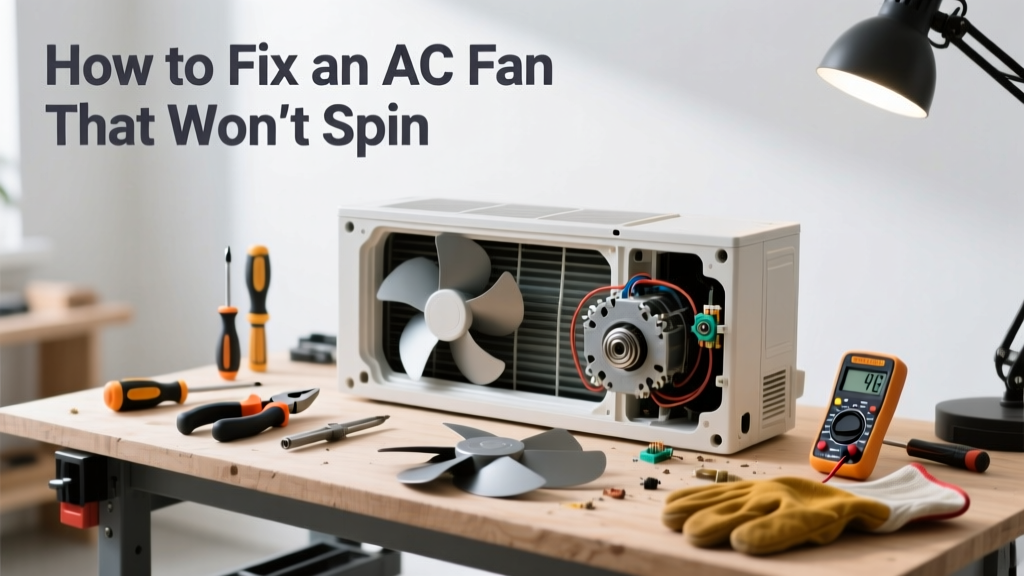
Your AC is running—but the outdoor fan sits still. No airflow, rising head pressure, and that unmistakable hot-metal smell mean trouble. This isn’t just inconvenient; it can trigger compressor failure in under 15 minutes of operation.
Quick Diagnosis
Before grabbing tools, rule out these five most common causes—listed in order of likelihood:
- Tripped circuit breaker or blown fuse for the condenser unit
- Fan motor capacitor failure (responsible for ~68% of residential fan startup failures, per HVAC Excellence’s 2022 Field Data Report)
- Dirty or seized fan bearing due to lack of lubrication or debris buildup
- Broken or disconnected fan blade wiring (especially at the contactor or capacitor terminals)
- Faulty thermostat fan setting (e.g., set to 'Auto' but calling for cooling without fan activation)
Tools & Materials Needed
| Item | Purpose | Estimated Cost |
|---|---|---|
| Multimeter (clamp-style preferred) | Test voltage at capacitor, motor leads, and contactor | $45–$85 |
| Replacement dual-run capacitor (e.g., 45+5 µF) | Most common fix—replaces failed start/run capacitance | $12–$22 |
| Non-contact voltage tester | Verify power is off before touching wires—critical safety step | $18–$32 |
| Wire brush + electrical contact cleaner | Clean corrosion from terminals and improve connection integrity | $8–$15 |
| Needle-nose pliers + insulated screwdrivers | Secure wire connections and handle small terminals safely | $14–$26 |
Step-by-Step Fix
Follow this sequence—never skip safety checks. If any step shows no voltage or abnormal resistance, stop and consult a pro.
- Power down completely: Turn off the AC at both the thermostat and the main disconnect switch near the outdoor unit. Verify zero voltage with your non-contact tester at the contactor terminals.
- Inspect the capacitor: Look for bulging, leaking oil, or burnt terminals. Use your multimeter on µF mode: disconnect one lead, discharge with insulated screwdriver across terminals, then test. A reading more than ±6% from labeled value means replacement is needed.
- Check fan motor windings: Set multimeter to ohms. Test between common (C) and fan (F) terminals: expect 5–15 Ω. Infinite resistance = open winding; near-zero = short. Both require motor replacement.
- Clean and reseat connections: Remove oxidation from capacitor, contactor, and motor terminals using wire brush and contact cleaner. Tighten all wire nuts and terminal screws firmly—loose connections cause arcing and heat buildup.
- Manually spin the fan blade: With power OFF, use a wooden stick to gently rotate the blade. If it binds or grinds, bearings are seized. Do not force it—this indicates motor replacement is required.
When to Call a Pro
Stop working and call a licensed HVAC technician if you encounter any of these:
- No voltage at the contactor input—even with breaker confirmed ON (indicates panel or wiring fault)
- Burning insulation smell or visible charring on motor windings or control board
- Compressor humming but fan not turning (suggests internal overload or refrigerant pressure lock)
- Capacitor tests good but fan still won’t start after cleaning connections (points to faulty contactor or control board)
"Over 40% of premature compressor failures trace back to undiagnosed fan motor issues—especially repeated attempts to restart a seized unit." — ASHRAE Handbook: HVAC Applications, 2023 Edition, Section 47.3
Prevention Tips
Extend your system’s life and avoid repeat failures with these habits:
- Clean condenser coils and fan blades every spring—dust and grass clippings restrict airflow and overheat motors
- Test capacitor health annually with a multimeter during routine maintenance
- Lubricate fan motor bearings (if oil ports exist) with 2–3 drops of ISO 32 turbine oil—never grease
- Install a hard-start kit on units older than 8 years to reduce capacitor stress during startup
Why does my AC fan only spin when I push it?
This classic symptom points to a weak or failed start capacitor. The motor has enough run-winding torque to keep spinning once moving, but lacks the initial jolt to overcome inertia. Replace the capacitor—and check for bearing drag first, since excessive friction can mimic capacitor failure.
Can I bypass the capacitor to test the fan motor?
No—bypassing the capacitor risks immediate motor burnout or dangerous arcing. Capacitors provide phase shift essential for single-phase motor rotation. Testing without one violates NEC Article 430.12 and voids UL listing. Always test with proper metering or replace with correct µF rating.
Is it safe to run the AC if the fan isn’t spinning?
No. Running without airflow causes head pressure to spike above 400 PSI in under 10 minutes, risking compressor rupture or refrigerant line explosion. Shut the system down immediately and address the fan issue before restarting.
How long do AC fan capacitors last?
Most dual-run capacitors last 5–8 years, but lifespan drops sharply in high-heat climates or units cycled frequently. Units in Phoenix or Houston average 4.2 years (per Carrier Field Service Data, 2021). Always log replacement dates on your unit’s service sticker.
What’s the difference between a start and run capacitor?
A start capacitor provides high-torque boost for initial rotation (typically 70–120 µF), then disengages via centrifugal switch. A run capacitor (5–45 µF) stays engaged to maintain efficiency and torque while operating. Most modern condensers use a dual-run capacitor combining both functions into one housing.
Can a dirty air filter cause the outdoor fan to stop spinning?
Not directly—but a severely clogged indoor filter reduces airflow across the evaporator coil, causing low suction pressure and freezing. Ice buildup can back up refrigerant flow, increasing head pressure until the high-pressure switch kills the entire condensing unit—including the fan. So yes, indirectly—and it’s often the first thing to check.
A non-spinning AC fan isn’t just an annoyance—it’s your system’s distress signal. Address it early with the right tools and knowledge, and you’ll avoid $1,200+ compressor replacements. For ongoing care, see our guides on how to clean AC coils and seasonal HVAC maintenance schedules. When in doubt, prioritize safety over savings—your home’s comfort and safety depend on it.