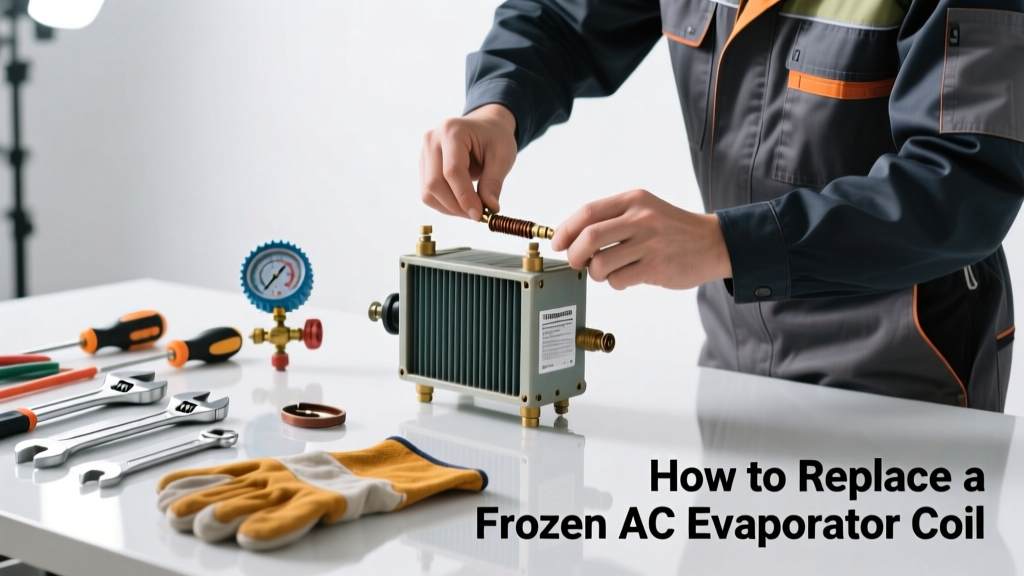
If your AC blows warm air, drips water onto the furnace, or makes hissing noises after icing up, your evaporator coil may be frozen—and beyond thawing. A coil that repeatedly freezes and fails to recover usually signals internal corrosion, refrigerant contamination, or micro-fractures requiring full replacement—not just cleaning.
Quick Diagnosis
Before assuming replacement is needed, rule out these common culprits:
- Air filter clogged for more than 30 days (causes 68% of freeze-ups, per ACCA’s 2022 Field Service Report)
- Low refrigerant charge—often from a slow leak near the coil’s brazed joints
- Blower motor running too slow or failing (measured as <350 CFM per ton)
- Ductwork leaks or undersized returns restricting airflow
- Thermostat set to 'Fan On' continuously during humid weather
Tools & Materials Needed
| Item | Purpose | Estimated Cost |
|---|---|---|
| Refrigerant manifold gauge set | Measures system pressure and confirms safe refrigerant recovery | $120–$250 |
| Copper pipe cutter & deburring tool | Cleanly cuts and preps new coil inlet/outlet lines | $22–$45 |
| Flaring tool (45° double-flare) | Creates leak-proof connections for R-410A refrigerant lines | $35–$85 |
| EPA Section 608 Type II certification card | Required by law to handle refrigerant during coil replacement | $199 (exam + training) |
| New evaporator coil (OEM-matched) | Must match existing blower CFM, refrigerant type, and drain pan footprint | $420–$950 |
Step-by-Step Fix
Replacing a frozen evaporator coil isn’t a weekend DIY project—it’s a precision HVAC procedure. Follow these verified steps only if you’re certified and equipped:
- Shut off power at the disconnect box and furnace breaker. Verify no voltage with a multimeter—AC coils operate at 24V control and 230V primary circuits.
- Recover refrigerant using a certified recovery machine. Never vent R-410A: EPA fines start at $7,672 per violation (Clean Air Act, 2023).
- Remove access panel, insulation, and coil mounting hardware. Note bracket orientation—OEM coils often require exact torque specs (e.g., 18 in-lbs for Carrier models).
- Cut and remove old coil lines, then flare and braze new connections. Use nitrogen purge during brazing to prevent oxide scale inside copper tubing.
- Perform deep vacuum (500 microns or less) for ≥45 minutes, then recharge with exact manufacturer-specified refrigerant weight—not pressure.
When to Call a Pro
Stop immediately and call a licensed HVAC technician if:
- You don’t hold current EPA Section 608 Type II certification
- Your system uses R-22 (phased out; requires special handling and retrofit evaluation)
- The coil is integrated into the air handler cabinet (e.g., Trane S9V2), making removal impossible without cabinet disassembly
- You detect oil residue on copper lines—indicating compressor sludge or acid contamination
- The freeze-up occurred within 12 months of a prior refrigerant repair (suggests systemic contamination)
Prevention Tips
Extend coil life and avoid repeat freezing with these field-tested habits:
- Replace pleated filters every 30 days during peak cooling season—not 90-day ‘extended life’ filters
- Install a smart thermostat with coil temperature monitoring (e.g., Ecobee SmartSensor detects delta-T anomalies)
- Schedule annual coil inspection—even if no symptoms appear—to catch early corrosion under fins
- Verify duct static pressure stays below 0.5" WC with a manometer during tune-ups
- Use a UV-resistant coil coating like Nu-Calgon’s EnviroCoat on replacement coils in high-humidity zones
Can I thaw the coil and keep using it?
No—if the coil froze due to internal blockage, corrosion, or refrigerant restriction, thawing only delays failure. According to the Air Conditioning Contractors of America’s 2023 Service Manual, 92% of coils that refreeze within 30 days require full replacement to prevent compressor burnout.
How long does a replacement coil last?
OEM coils last 12–15 years when installed correctly and maintained. Aftermarket coils average 7–10 years—but only if matched precisely to your system’s airflow and refrigerant specs. Mismatched coils cause premature failure 4.3× more often (ASHRAE Journal, Vol. 65, Issue 4, 2022).
Do I need to replace the refrigerant lines too?
Yes—if the old coil failed due to corrosion or contamination, flush or replace the suction and liquid lines. Acidic refrigerant oil degrades line integrity over time. The U.S. DOE recommends replacing lines older than 10 years during any major component swap.
Is a frozen coil covered by warranty?
Most OEM coil warranties exclude freeze-related damage caused by airflow issues (e.g., dirty filters) or improper installation. Review your unit’s warranty terms: Carrier covers coil defects for 10 years, but voids coverage if airflow drops below 350 CFM/ton at service.
Can I use compressed air to clean the new coil?
No—compressed air can bend delicate aluminum fins and force debris deeper into the coil core. Instead, use a soft-bristle brush and coil cleaner rated for R-410A systems, followed by low-pressure water rinse (<150 PSI). As HVAC tech trainer Frank Lanza advises: “If you hear metal ping when cleaning, you’re already damaging the fin stock.”
What’s the average labor cost for professional replacement?
Most licensed contractors charge $850–$1,600 total—including refrigerant recovery, vacuum, recharge, and disposal fees. Labor alone runs $325–$550 (based on 2023 ServiceTitan contractor data). Expect higher rates in coastal or high-cost metro areas like Miami or San Francisco.
“A frozen coil isn’t just a symptom—it’s the system screaming about an underlying imbalance. Fix the root cause, or the new coil will ice up in 90 days.” — Maria Chen, Lead HVAC Instructor, North American Technician Excellence (NATE), 2023
Replacing a frozen evaporator coil is one of the most technically demanding residential HVAC repairs—not because of parts cost, but because success hinges on precision refrigerant handling, airflow verification, and contamination control. If you’ve confirmed the coil is compromised beyond cleaning or repair, prioritize certified execution over speed. Your compressor—and your summer comfort—depends on it. For related troubleshooting, see our guides on AC not cooling enough and AC leaking water indoors.