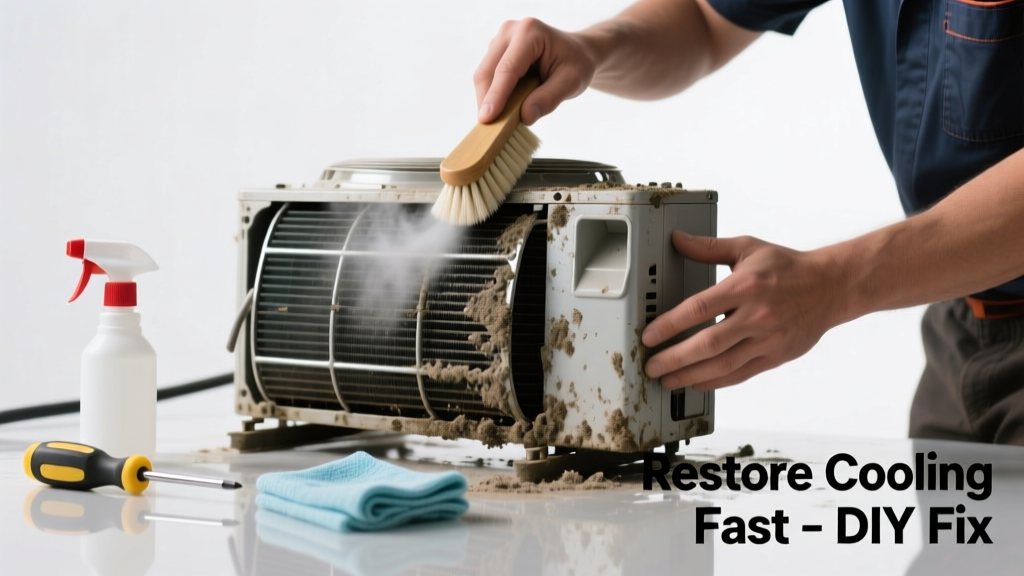
Your AC runs but blows warm air—or shuts off early—and you hear that faint, strained hum from the outdoor unit. That’s often a red flag: your condenser coil is caked with dirt, grass clippings, or pollen, choking airflow and crippling efficiency.
Quick Diagnosis
Before grabbing tools, confirm it’s the coil—not another system failure. Check for these telltale signs:
- Reduced cooling output despite normal indoor thermostat settings
- Outdoor unit running constantly but not lowering indoor temps
- Frost or ice forming on refrigerant lines (especially near the condenser)
- Higher-than-normal electric bills over the last 2–3 months
- Visible debris—dust, leaves, cottonwood fluff—packed between coil fins
Tools & Materials Needed
| Item | Purpose | Estimated Cost |
|---|---|---|
| Garden hose with adjustable nozzle | Rinses loose debris without bending fins; low-pressure setting prevents damage | $12–$25 |
| Soft-bristle coil brush (nylon, angled) | Cleans between fins without snapping them; essential for stubborn grime | $8–$16 |
| Non-acidic coil cleaner (e.g., Nu-Calgon Evap Foam) | Dissolves organic buildup safely; avoids corrosion of aluminum fins | $14–$22 |
| Fin comb (aluminum-compatible) | Realigns bent fins to restore airflow—critical for performance recovery | $10–$18 |
| Work gloves & safety glasses | Protects against sharp edges, chemical splashes, and flying debris | $7–$15 |
Step-by-Step Fix
Turn off power at the disconnect box and main breaker before starting—this isn’t optional. Then follow these steps in order:
- Clear surface debris: Use a dry leaf blower or soft brush to remove leaves, twigs, and grass clippings from the top and sides of the unit.
- Rinse gently: Set hose to “shower” or “flat” spray. Start at the top and work downward—never spray upward into the coil, which forces debris deeper.
- Apply coil cleaner: Spray cleaner evenly across the coil face per label instructions. Let dwell 5–10 minutes—don’t let it dry. Agitate lightly with the coil brush if residue remains.
- Rinse thoroughly: Flush all cleaner and loosened gunk from front to back. Repeat if runoff looks cloudy.
- Comb and inspect: Gently run the fin comb vertically through each row. If fins are severely matted or corroded, note it for professional evaluation.
When to Call a Pro
Stop and call an HVAC technician if you encounter any of these:
- Refrigerant leaks (oil stains, hissing sound, or frozen suction line)
- Coil fins bent more than 30% across >25% of the surface area
- No improvement after cleaning—and you’ve verified proper airflow, fan operation, and electrical supply
- Unit trips breaker repeatedly during startup or operation
- You detect a burnt odor or see discolored wiring inside the cabinet
According to the U.S. EPA, 14% of household water usage is from leaks—but when it comes to AC systems,
"A dirty condenser coil can reduce system efficiency by up to 30%, turning a $120 summer electric bill into $155+ monthly" — Air Conditioning Contractors of America (ACCA), 2022 Field Performance Study.
Prevention Tips
Extend your coil’s clean life with simple habits:
- Trim shrubs and grass within 2 feet of the unit—airflow needs space, not shade
- Install a seasonal mesh guard (not solid cover) to block leaves—but never run the unit covered
- Clean the coil every spring before peak season—and again mid-July if you’re in a high-pollen or dusty area like Phoenix or Dallas
- Check the condensate drain line quarterly—clogs raise humidity and stress the entire system
Can I use bleach on my condenser coil?
No. Bleach corrodes aluminum fins and degrades rubber gaskets and wiring insulation. It also reacts dangerously with copper tubing. Stick to non-acidic, no-rinse or low-rinse coil cleaners approved for residential HVAC units—like those listed on the AHRI Directory.
How often should I clean the condenser coil?
At minimum once per year—ideally in early spring. Homes near construction sites, hay fields, or cottonwood trees need cleaning every 4–6 months. A study by the National Renewable Energy Laboratory (NREL, 2021) found biannual cleaning improved seasonal energy efficiency ratio (SEER) retention by 12% over single annual cleaning.
Why does my coil get dirty so fast?
Three common culprits: landscaping too close (within 18”), using a leaf blower pointed directly at the unit (which pushes debris in), and installing the unit on gravel or dirt instead of a concrete pad—which creates dust clouds every time wind hits it. Consider relocating or adding a low-profile gravel barrier.
Is it safe to pressure wash the condenser coil?
No. Even “low-pressure” settings on most consumer-grade pressure washers exceed 1,200 PSI—enough to permanently bend aluminum fins and compromise heat transfer. The ACCA explicitly warns against pressure washing in its Residential System Installation Standards Manual (2023 ed.).
What’s the difference between condenser and evaporator coil cleaning?
The condenser coil lives outdoors and rejects heat; the evaporator coil is indoors (usually above your furnace) and absorbs heat. They require different access, cleaners, and safety protocols. Never use evaporator coil cleaner on the condenser—it’s often acidic and unsafe for outdoor exposure.
Will cleaning the coil fix a frozen AC line?
Sometimes—but only if the freeze was caused solely by restricted airflow. If refrigerant levels are low, the expansion valve is faulty, or the indoor blower isn’t moving enough air, cleaning alone won’t resolve it. Always check for frost on both the suction line *and* the evaporator coil before assuming it’s coil-related.
A clean condenser coil doesn’t guarantee perfect cooling—but it’s the most cost-effective first step you can take. Most homeowners recover full capacity within 24 hours of proper cleaning, especially when paired with a fresh air filter and cleared drain line. If your unit still struggles after this, it’s time to dig deeper—or call in someone with gauges, a manifold set, and a license to handle refrigerant.