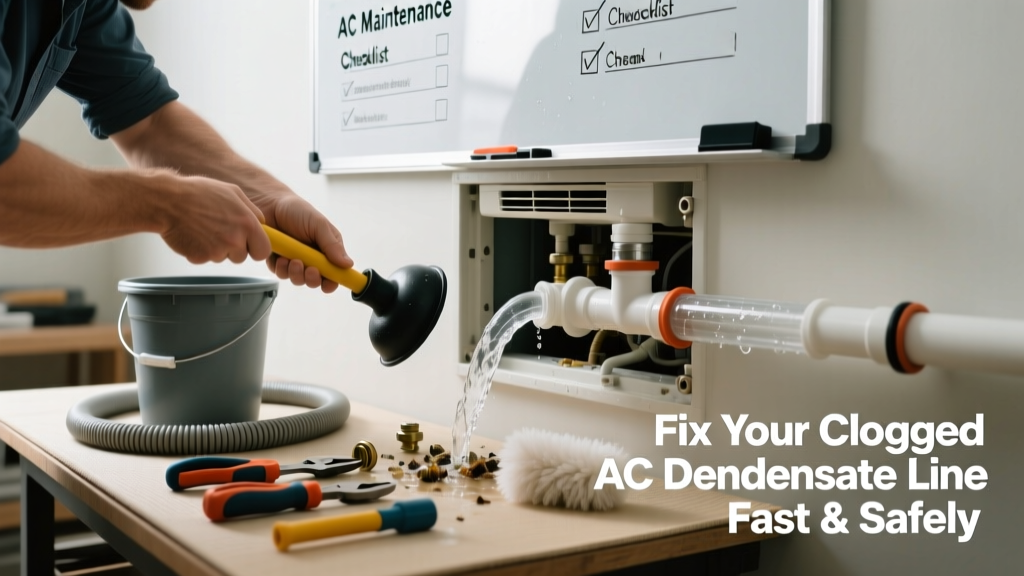
Your AC suddenly stops cooling—or worse, you spot water pooling near the indoor unit. That’s often your condensate line screaming for attention. A clogged drain line is one of the most common—and easiest to fix—AC failures, yet it causes 32% of emergency HVAC service calls in humid climates (ASHRAE Technical Bulletin, 2022). Don’t wait for mold growth or compressor lockout.
Quick Diagnosis
Before grabbing tools, confirm it’s the condensate line—not the coil, refrigerant, or thermostat. Look for these telltale signs:
- Water dripping from the air handler’s bottom or ceiling below it
- AC shuts off after 10–15 minutes with no error code
- Musty odor near the furnace or air handler
- Full or overflowing condensate pan visible through access panel
- Humming sound but no airflow—often due to float switch tripping
Tools & Materials Needed
| Item | Purpose | Estimated Cost |
|---|---|---|
| Shop vacuum (wet/dry) | Creates strong suction to dislodge biofilm and sludge | $45–$85 |
| Flexible bottle brush (1/4" diameter) | Scrubbing interior walls of PVC or vinyl drain tubing | $6–$12 |
| White vinegar (1 quart) | Natural biocide that dissolves algae and mineral deposits | $3–$5 |
| Condensate line tablet (e.g., Nu-Calgon Algae Guard) | Slow-release treatment to inhibit microbial growth for up to 90 days | $12–$18 |
| 10' length of 1/4" vinyl tubing | Replacement section if original line is cracked or brittle | $4–$7 |
Step-by-Step Fix
Try these methods in order—start gentle, escalate only if needed:
- Vinegar flush: Pour 1 cup undiluted white vinegar into the drain line access port (usually a T-fitting near the air handler). Let sit 30 minutes, then flush with 2 cups warm water. Repeat weekly during cooling season.
- Blow-out method: Disconnect the line at the air handler outlet. Seal the open end with your thumb or a rubber stopper, then blow hard into the other end (wear safety glasses). If you hear gurgling, debris is moving.
- Vacuum suction: Attach wet/dry vac hose to the line’s exterior end (near condensate pump or drain exit). Run for 60 seconds—then reverse direction: seal the outdoor end and suck from the air handler side.
- Brush + vinegar combo: Insert flexible brush into line while rotating gently. Follow with 1/2 cup vinegar. Wait 20 minutes, then flush with pressurized water using a turkey baster.
When to Call a Pro
DIY ends where safety or complexity begins. Call an HVAC technician immediately if:
- You suspect a clog deeper than 10 feet inside wall cavity or attic run
- The condensate pump fails to activate or makes grinding noises
- You see black mold on insulation or within the air handler cabinet
- After clearing the line, water still backs up within 48 hours
- Your system uses a secondary drain line that’s also blocked—this indicates chronic oversaturation or improper pitch
Prevention Tips
Most clogs form over months—not overnight. Prevention cuts repeat work by 70% (National Comfort Institute, 2023). Install these habits:
- Add a condensate line tablet every 90 days—or use a vinegar drip system with a 12-oz bottle and gravity feed tube
- Inspect the drain pan and line quarterly—especially before peak summer months
- Ensure the line slopes downward at least 1/4" per foot; use a level and pencil mark to verify pitch
- Install a $25 condensate overflow switch like the Fieldpiece CLS-1—it shuts off the AC before spillage occurs
Can I use bleach on this?
No. Bleach corrodes copper drain pans and degrades vinyl/PVC lines over time. It also reacts dangerously with ammonia-based cleaners sometimes used in ductwork. Stick to white vinegar or EPA-registered enzymatic drain treatments like Rectorseal Air-Con Clear.
Why does my line clog every 2–3 months?
Frequent clogging points to either high humidity (over 60% RH), poor airflow across the evaporator coil (dirty filter or bent fins), or insufficient line pitch. According to the U.S. EPA, homes in Gulf Coast and Southeast regions average 2.3 clogs per cooling season—nearly double the national rate.
Is it safe to blow compressed air into the line?
Only if pressure stays under 35 PSI. Most shop compressors exceed 90 PSI—enough to burst vinyl lines or crack PVC fittings. Use a bicycle pump or low-pressure air nozzle instead. As HVAC tech Marcus Delgado advises:
“If you hear a ‘pop’ or see fogging at a joint, stop. That’s not a clog breaking loose—it’s your line failing.”
Do all AC units have a condensate line?
Yes—if your system removes humidity from indoor air (which all central ACs and heat pumps do), it produces condensate. Window and portable units collect water internally or drain via gravity hose, but split systems and ducted heat pumps rely on a dedicated PVC or vinyl line. Check our guide on how to find your AC condensate drain line if you’re unsure.
What’s the difference between primary and secondary drain lines?
The primary line carries normal condensate flow. The secondary (or auxiliary) line is a backup path that activates only when the primary is blocked—triggering a safety shutoff. If both are clogged, water spills directly into the pan. Always test both lines annually. See our AC secondary drain line leaking troubleshooting page for inspection tips.
Can a clogged condensate line cause frozen coils?
Indirectly, yes. When water backs up, it can saturate the drain pan and insulate the evaporator coil. This reduces heat transfer, causing coil surface temps to drop below freezing—especially with low airflow or low refrigerant. That’s why 41% of frozen coil cases involve prior condensate issues (ACCA Manual J Update, 2021).
A clogged condensate line isn’t just an annoyance—it’s a red flag for larger airflow or humidity control issues. Fix it promptly, document your maintenance dates, and pair it with regular filter changes and annual coil cleaning. For long-term reliability, consider upgrading to a stainless steel drain pan and installing a smart leak detector like the Zircon Leak Alert—it sends phone alerts before a single drop hits your drywall. And if you’ve tried three methods and still see backup, don’t risk it: call a certified technician. Your air handler’s warranty likely voids if water damage results from neglected maintenance. You’ll find more help in our AC not cooling enough troubleshooting hub.