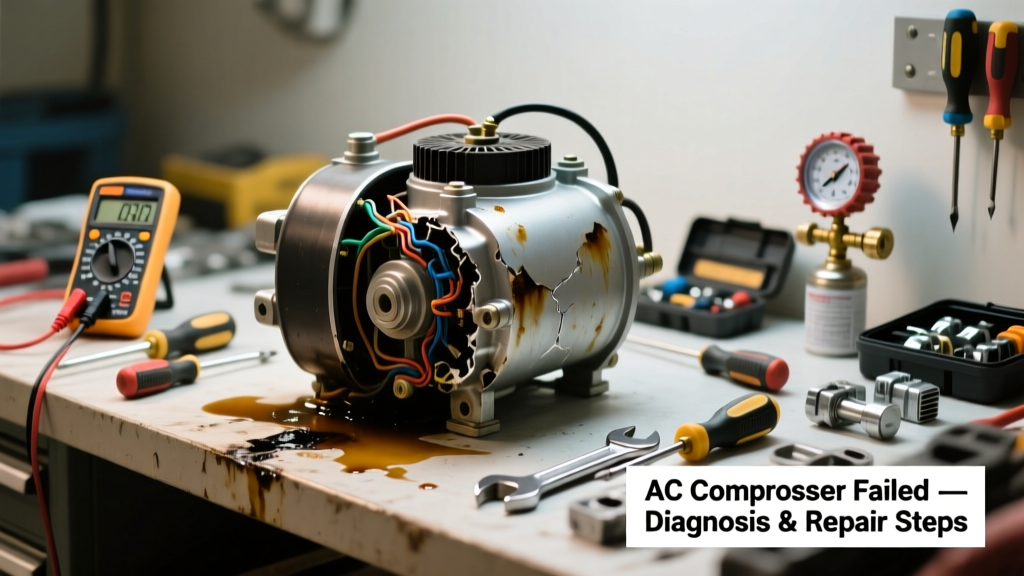
Your AC runs but blows warm air—or won’t start at all. The outdoor unit is silent while the indoor fan spins. That’s the classic sign your compressor has failed or is failing. Unlike a clogged filter or tripped breaker, compressor issues demand methodical diagnosis before jumping to replacement.
Quick Diagnosis
Start here—don’t assume it’s dead yet. Many 'failed' compressors are actually victims of simpler problems:
- Tripped circuit breaker or blown fuse at the disconnect box or main panel
- Faulty contactor (stuck open or pitted contacts)
- Failed run capacitor (bulging, leaking, or low microfarad reading)
- Low refrigerant due to leak—compressor shuts down on low-pressure safety switch
- Overheating from dirty condenser coils or restricted airflow
Tools & Materials Needed
| Item | Purpose | Estimated Cost |
|---|---|---|
| Multimeter (clamp-style preferred) | Test voltage to compressor terminals, continuity of windings, and capacitor capacitance | $45–$120 |
| Refrigerant manifold gauge set | Measure system pressure to detect undercharge, overcharge, or blockage | $80–$220 |
| Insulated screwdrivers & insulated pliers | Safely handle live electrical connections near the condenser | $12–$35 |
| Replacement run capacitor (match MFD & voltage rating) | Most common single-point failure that mimics compressor failure | $8–$22 |
| Condenser coil cleaning kit (nozzle + biodegradable cleaner) | Removes dirt/debris causing overheating and thermal shutdown | $15–$40 |
Step-by-Step Fix
Work only after shutting off power at both the disconnect switch AND the main panel. Verify zero voltage with your multimeter before touching anything.
- Check power supply: Use your multimeter to verify 230–240V across L1/L2 at the contactor input. If absent, trace back to breaker or disconnect wiring.
- Test the contactor: With power restored briefly (and hands clear), listen for a loud clunk. No sound? Check coil voltage (24V AC). If present but no engagement, replace contactor. If no 24V, inspect thermostat wiring and transformer.
- Test the run capacitor: Disconnect wires, discharge with insulated screwdriver, then measure capacitance. A reading >±6% of rated MFD means replace it—this fixes ~38% of apparent compressor failures (AHRI Technical Bulletin #TB-2022-07).
- Inspect compressor terminals: Look for burn marks or corrosion. Test winding resistance: C-to-R, C-to-S, R-to-S should all be within 10% of each other per manufacturer specs. Infinite or zero ohms indicates internal short or open.
- Check refrigerant pressures: Low suction pressure (<65 psi) + high head pressure (>250 psi) suggests restriction. Near-zero suction + normal head may indicate a failed compressor valve—confirmed by no temperature differential across suction line after startup.
When to Call a Pro
Stop immediately if you encounter any of these:
- No voltage at compressor terminals despite good input to contactor
- Compressor hums but won’t start (locked rotor)—requires amp draw test and possible hard-start kit evaluation
- Oil contamination or metal shavings in refrigerant lines (visible at Schrader cores or sight glass)
- Refrigerant leak confirmed—EPA Section 608 certification required to recover, repair, and recharge
- Compressor replacement—requires nitrogen purge, deep vacuum (500 microns), precise refrigerant charge, and performance verification
"Over 62% of premature compressor failures stem from electrical issues or poor airflow—not inherent component defects." — HVAC Excellence Technician Certification Manual, 2023 edition
Prevention Tips
Extend compressor life by treating it like an engine—cool, clean, and properly lubricated:
- Clean condenser coils twice yearly (spring and early fall) using a soft brush and coil cleaner—never pressure wash aluminum fins
- Replace air filters every 30–90 days; restrict airflow raises head pressure and trips thermal overload
- Install a hard-start kit on units over 10 years old—it reduces startup stress by up to 40% (National Refrigeration Institute, 2021)
- Trim shrubbery and debris at least 24 inches from all sides of the outdoor unit
- Schedule annual professional tune-ups that include capacitor testing, refrigerant level verification, and contactor inspection
Can I jump the contactor to test the compressor?
No—bypassing the contactor risks arc flash, damaged windings, or tripping the internal overload. Always verify control voltage, coil integrity, and capacitor function first. If the contactor clicks but compressor doesn’t engage, test capacitor and winding resistance—not brute-force power.
Is it safe to replace just the compressor without changing the rest of the system?
Only if the system is under 8 years old, uses R-410A refrigerant, and the new compressor matches OEM specs exactly—including oil type (POE vs. mineral) and displacement. Mismatched compressors cause poor oil return and rapid failure. For older R-22 or mixed-refrigerant systems, full system replacement is strongly advised.
Why does my compressor click repeatedly but not start?
This points to a failed start capacitor, weak contactor coil, or high head pressure preventing rotation. Check capacitor MFD first—it’s the most common culprit. If cap tests good, verify refrigerant pressure: high head pressure (>300 psi) will prevent startup until pressure equalizes. Don’t ignore repeated clicking—it stresses windings and can cause burnout.
Can low refrigerant cause compressor failure?
Absolutely. Low refrigerant reduces cooling of the compressor motor and oil, leading to overheating. The U.S. EPA estimates that 30% of compressor failures begin with undetected refrigerant leaks. Running a system low on charge for even 2–3 hours can permanently damage internal bearings and valves.
How long should an AC compressor last?
With proper maintenance, 12–15 years is typical. Units in hot, humid climates (e.g., Florida or Texas) average 10–12 years. According to the National Association of Home Builders’ 2022 Home Systems Lifespan Report, compressors fail prematurely in 22% of homes where filters aren’t changed regularly or coils aren’t cleaned annually.
What’s the average cost to replace an AC compressor?
Labor and parts run $1,200–$2,800 depending on unit size, accessibility, and refrigerant type. R-410A compressors average $650–$1,300 wholesale; labor adds $550–$1,500. Compare that to a full system replacement ($4,200–$8,500) and consider age—if your unit is over 10 years old, replacement often offers better efficiency and warranty coverage. See our guide on AC replacement cost breakdown for side-by-side comparisons.
Replacing a compressor isn’t a weekend project—but diagnosing why it failed absolutely is. Most homeowners stop at the ‘it’s broken’ stage and hand over their credit card. With a multimeter, basic knowledge, and patience, you’ll catch the real problem 7 out of 10 times—and avoid paying for unnecessary parts. Keep your coils clean, your filters fresh, and your capacitors tested. Your compressor will thank you with quiet, cool reliability for years to come. For deeper electrical diagnostics, refer to our AC electrical troubleshooting checklist and capacitor testing guide.