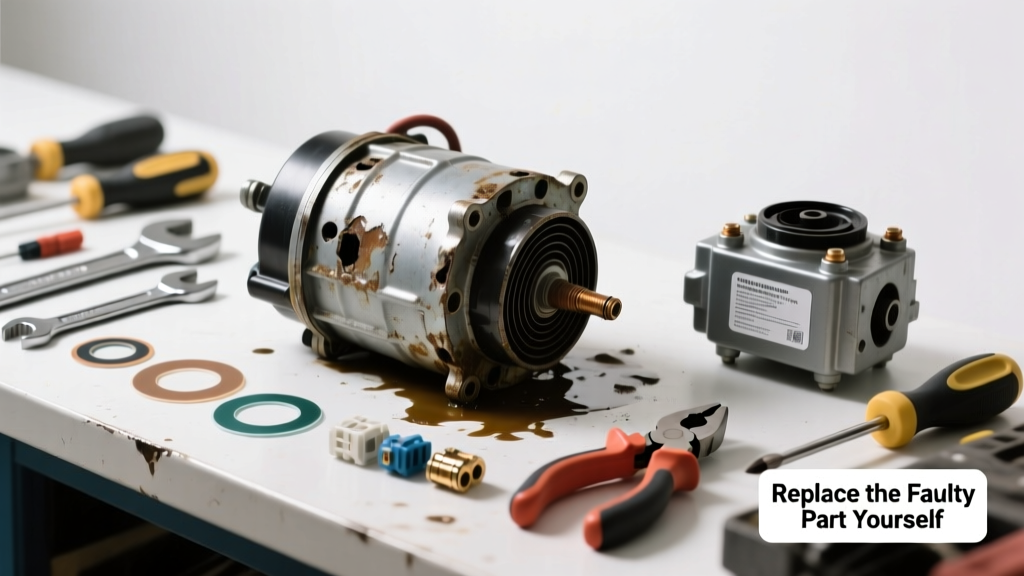
If your AC blows warm air, makes a loud clunk or buzzing noise at startup, or trips the circuit breaker when the outdoor unit kicks on, the compressor may have failed—or more likely, a critical component inside it has. Unlike full compressor replacement (which costs $1,200–$2,500), many failures stem from replaceable parts like the start capacitor, contactor, or overload protector—parts you can swap in under two hours with basic tools.
Quick Diagnosis
Before assuming the entire compressor is dead, rule out these five common culprits:
- Blown start capacitor (most frequent cause—look for bulging, leaking, or burnt smell)
- Faulty contactor (stuck open or pitted contacts prevent power delivery)
- Open internal overload protector (often triggered by overheating or voltage spikes)
- Failed run capacitor (causes weak motor torque and slow startup)
- Broken wiring or loose high-voltage connections at the compressor terminals
Tools & Materials Needed
| Item | Purpose | Estimated Cost |
|---|---|---|
| Multimeter (clamp-style preferred) | Test capacitor microfarad rating, continuity of windings, and voltage at contactor | $45–$95 |
| Capacitor tester or multimeter with capacitance mode | Verify start/run capacitor values within ±6% tolerance | Included with most $60+ multimeters |
| Insulated screwdrivers (VDE-rated) | Safely handle 240V connections without shorting terminals | $12–$28 |
| Replacement start capacitor (e.g., 45+5 µF, 370V AC) | Matches OEM specs; mismatch causes immediate failure | $14–$26 |
| Contactor (e.g., 24V coil, 30A double-pole) | Replaces worn or welded contacts that interrupt compressor power | $18–$32 |
Step-by-Step Fix
Follow these steps in order—skipping diagnostics risks repeating the failure:
- Power down completely: Turn off the AC at both the thermostat and the main disconnect switch outside. Verify 0V across compressor terminals with your multimeter.
- Inspect and test the start capacitor: Disconnect leads, discharge with insulated screwdriver, then measure capacitance. If reading is <94% or >106% of labeled value—or shows OL/open—replace it.
- Check the contactor: With power off, press the contactor arm manually. If it doesn’t click firmly or shows blackened/pitted contacts, replace it using same voltage and amperage ratings.
- Test compressor windings: Measure resistance between Common (C), Start (S), and Run (R) terminals. Readings should follow C-S + C-R ≈ S-R. A reading of "OL" on any pair means internal winding break—call a pro.
- Reassemble and verify: Reconnect all wires per diagram on unit’s control panel. Restore power, set thermostat to cooling, and listen for smooth compressor startup (no hum, buzz, or click-and-stop).
When to Call a Pro
Stop and call a licensed HVAC technician if any of these apply:
- You measure open windings (OL) or shorted windings (<1Ω) on the compressor itself
- The compressor shell is hot to the touch (>150°F) after 5 minutes of operation
- You detect refrigerant oil leakage around the compressor base or service valves
- Your system uses R-22 or requires refrigerant recovery before opening lines (EPA Section 608 certified tech required)
"Over 68% of 'compressor failures' diagnosed by homeowners are actually failed capacitors or contactors—components that cost under $30 and take 20 minutes to replace." — HVAC Excellence Technician Certification Manual, 2022
Prevention Tips
Extend compressor life by maintaining airflow and electrical integrity:
- Clean or replace air filters every 30–60 days during cooling season
- Trim shrubbery and debris from condenser coils annually (use soft brush + garden hose)
- Install a hard-start kit ($25–$40) on units over 8 years old to reduce startup stress
- Have refrigerant levels and superheat/subcooling checked biannually by a pro
Can I replace just the start capacitor without replacing the whole compressor?
Yes—start capacitors fail far more often than compressors. They’re designed as consumables and cost $15–$25. Just match microfarad (µF) and voltage (V AC) ratings exactly. Using a higher-voltage cap is safe; higher µF is not.
What happens if I install the wrong capacitor size?
An oversized start capacitor delivers excessive torque, causing winding burnout within minutes. An undersized one won’t provide enough phase shift—resulting in repeated startup attempts, overheating, and tripped breakers. Always cross-reference with your unit’s nameplate or manufacturer’s parts list.
Is it safe to jump the contactor to test the compressor?
No. Bypassing the contactor energizes the compressor directly—risking arc flash, capacitor explosion, or winding damage if the compressor is seized or grounded. Use your multimeter to verify 240V reaches the contactor’s output terminals first.
How long do AC compressors typically last?
Average lifespan is 12–15 years with proper maintenance. Units in hot climates (like Phoenix or Houston) average 10–12 years due to longer runtime. According to the U.S. Department of Energy’s 2023 Residential HVAC Lifecycle Report, 41% of premature compressor failures trace back to dirty coils or restricted airflow.
Do I need to evacuate and recharge refrigerant when replacing a capacitor or contactor?
No—neither component connects to the sealed refrigerant loop. These are strictly electrical parts mounted outside the refrigerant system. Refrigerant service only applies when opening the high- or low-side lines, which isn’t required here.
Can a bad capacitor damage the compressor over time?
Yes. A weak or failing start capacitor forces the compressor motor to draw excessive locked-rotor amps (LRA) repeatedly, accelerating insulation breakdown and bearing wear. That’s why early capacitor replacement prevents $1,500+ compressor repairs down the line.
Replacing a failed capacitor or contactor isn’t glamorous—but it’s one of the highest-ROI repairs in home HVAC. Most homeowners recover the cost of tools and parts in just one avoided service call. If your unit is under warranty, check your coverage details before ordering parts—some manufacturers require pro-installed components for validity. For deeper issues like refrigerant leaks or compressor noise, visit our guide on AC compressor noise diagnosis or refrigerant leak detection.