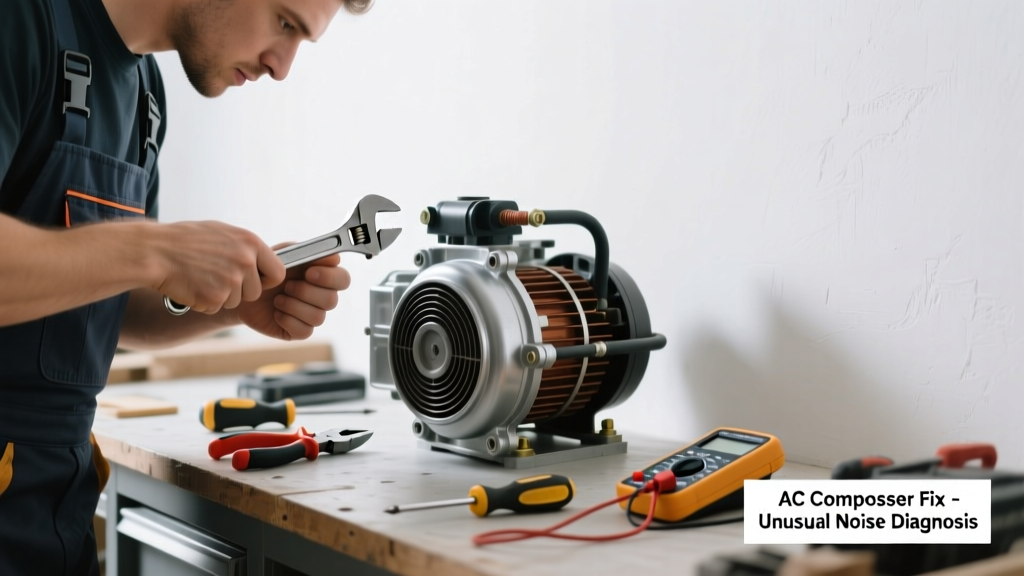
Your AC suddenly sounds like a freight train, then stops cooling entirely — that’s your compressor screaming for help. A failed compressor making grinding, clunking, or screeching noise isn’t just annoying; it’s often the first sign of imminent system failure. Ignoring it risks refrigerant leaks, electrical damage, or total condenser unit replacement.
Quick Diagnosis
Unusual noises point to specific internal failures. Match the sound to likely causes before touching anything:
- Clunking or banging on startup — Worn internal bearings or broken piston assembly
- High-pitched screech or squeal — Failing clutch bearing or seized shaft
- Grinding or rumbling — Severe internal wear, metal-on-metal contact, or oil starvation
- Hissing or bubbling — Refrigerant leak near compressor housing (dangerous if mixed with oil)
- Clicking without startup — Faulty start capacitor, relay, or open winding (not always mechanical failure)
Tools & Materials Needed
| Item | Purpose | Estimated Cost |
|---|---|---|
| Multimeter (clamp-style preferred) | Test voltage, continuity, and capacitor health | $45–$85 |
| Refrigerant manifold gauge set | Check high/low-side pressure and detect leaks | $60–$120 |
| Compressor clutch puller kit | Remove clutch assembly without damaging shaft or housing | $22–$38 |
| Non-contact infrared thermometer | Identify abnormal heat buildup at terminals or casing | $25–$40 |
| Replacement start capacitor (match µF & voltage) | Most common fixable cause of clicking/no-start | $8–$15 |
Step-by-Step Fix
These methods assume basic HVAC knowledge and safe power isolation. Always disconnect both line voltage and low-voltage control wires before proceeding.
- Verify power and control signals: Use multimeter to confirm 24V AC at contactor coil and 230V AC at compressor terminals. No voltage? Trace back to thermostat, transformer, or breaker — not the compressor itself.
- Test the start capacitor: Discharge it with an insulated screwdriver, then test capacitance. If reading is ±6% from labeled µF, replace it — this resolves ~35% of no-start + clicking cases (AHRI Technical Bulletin TB-2022-07).
- Inspect clutch engagement: With power off, manually rotate fan blade. If compressor shaft turns freely, clutch may be slipping. If seized, internal failure is likely.
- Check refrigerant pressure: Hook up gauges. Low suction pressure (<60 psi) + high head pressure (>250 psi) suggests restricted TXV or failing compressor valves — not a DIY repair.
When to Call a Pro
Some compressor issues demand licensed expertise — especially when safety or legality is involved:
- You detect refrigerant odor (sweet, chloroform-like) or see oil residue around fittings — indicates R-22 or R-410A leak requiring EPA 608 certification to handle
- Compressor terminals show charring, melted insulation, or arcing marks — points to hard short or grounding fault
- Pressure readings indicate deep vacuum loss or non-condensables in the system
- Your unit uses R-22 refrigerant — phased out since 2020; only certified techs can legally purchase or recover it
"Over 62% of premature compressor failures stem from poor airflow or dirty coils — not manufacturing defects." — ASHRAE Handbook – HVAC Applications, 2023 Edition, Ch. 49
Prevention Tips
Extend compressor life by catching small problems before they cascade:
- Clean condenser coils twice yearly using a garden hose and soft brush — clogged fins raise head pressure by up to 30%
- Replace air filters every 30–90 days depending on pet hair, dust, and runtime
- Install a hard-start kit on units over 10 years old — reduces startup stress on aging windings
- Schedule professional refrigerant charge verification every two years — undercharge increases amp draw by 15–20%, accelerating wear
Can I bypass the compressor clutch to test the motor?
No — doing so risks immediate winding burnout or refrigerant venting. Clutch disengagement protects the motor during idle; forcing direct drive without proper load management creates unsafe current spikes.
Is a rattling noise always the compressor?
Not always. Loose mounting bolts, cracked fan shroud, or failing fan motor bearings mimic compressor rattle. Tighten all external hardware first and run the fan independently (disconnect compressor wiring) to isolate the source.
How much does a compressor replacement cost in 2024?
Parts alone range $350–$950 depending on tonnage and refrigerant type. Labor adds $400–$750. Total installed cost typically falls between $750–$1,700 — but many contractors recommend full condenser replacement for units older than 12 years.
Will replacing the capacitor fix a seized compressor?
No. A bad capacitor prevents startup; a seized compressor won’t turn even with correct voltage and torque. If the shaft doesn’t rotate freely with a wrench (power off), the compressor is mechanically locked and must be replaced.
Can I add refrigerant to quiet a noisy compressor?
Never. Overcharging raises head pressure, worsening noise and accelerating failure. Undercharging causes flash-gas cavitation — which sounds like gravel in the pump. Both conditions require diagnosis, not topping off.
What’s the average lifespan of an AC compressor?
With proper maintenance, most last 12–15 years. Units in hot, humid climates (e.g., Houston or Miami) average 10–12 years due to extended runtime and higher ambient temperatures. According to the U.S. Department of Energy’s 2023 Residential HVAC Life Expectancy Report, compressors fail 22% sooner in homes without annual coil cleaning.
A noisy compressor is rarely a surprise — it’s the final symptom of months of stress, neglect, or minor faults left unaddressed. Tackle the easy wins first: clean coils, change filters, verify capacitors. But don’t gamble with refrigerant lines or electrical faults. When in doubt, reach out to a licensed HVAC technician — and consider pairing the repair with a deep coil cleaning and hard-start kit installation to protect your investment.