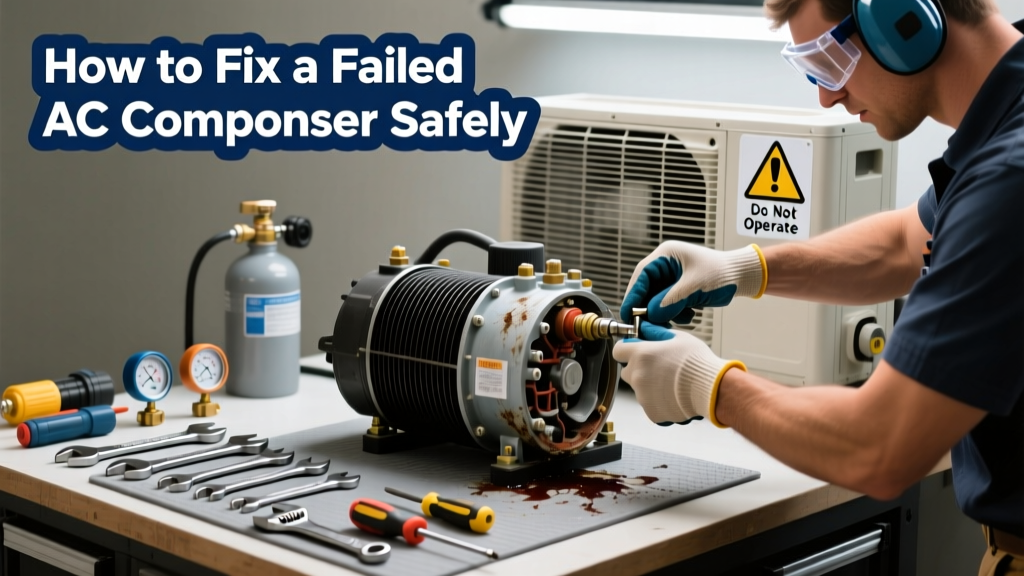
Your AC stops blowing cold air—and the outdoor unit is silent or humming but not starting. That’s often a failed compressor: the heart of your cooling system. Don’t panic yet—some failures are misdiagnosed, and a few fixes are within reach of a careful homeowner with basic electrical knowledge.
Quick Diagnosis
Before assuming the compressor itself is dead, rule out these common culprits first:
- Tripped circuit breaker or blown fuse at the disconnect box or main panel
- Faulty capacitor (swollen, leaking, or bulging—visible on top of the condenser)
- Dirty condenser coils restricting airflow and causing thermal shutdown
- Low refrigerant due to a leak (triggers low-pressure lockout)
- Failed contactor (no click when thermostat calls for cooling)
Tools & Materials Needed
| Item | Purpose | Estimated Cost |
|---|---|---|
| Multimeter (clamp-style preferred) | Test voltage at compressor terminals and capacitor output | $45–$85 |
| Capacitor tester or multimeter with capacitance mode | Verify microfarad rating matches nameplate (±6% tolerance) | $20–$60 |
| Condenser coil brush & garden hose | Clean debris from fins without bending them | $8–$15 |
| Replacement run capacitor (same uF/voltage rating) | Most common inexpensive fix—replaces failed capacitor | $12–$22 |
| Non-contact voltage tester | Confirm power is off before opening panel—safety first | $10–$18 |
Step-by-Step Fix
Only attempt these if you’ve confirmed power is present at the disconnect and contactor, and the compressor isn’t physically seized (see When to Call a Pro):
- Power down completely: Shut off the breaker AND pull the disconnect switch outside. Verify zero voltage with a non-contact tester.
- Inspect and test the capacitor: Discharge it safely with an insulated screwdriver across terminals, then test capacitance. If reading is >6% below label value, replace it.
- Clean condenser coils thoroughly: Use coil brush and low-pressure water spray—never high-pressure, which bends fins and reduces efficiency.
- Check refrigerant lines for frost or oil residue: Frost on suction line may indicate low charge; oil spots suggest a leak. Neither is a DIY repair.
- Listen and feel during startup: If compressor hums loudly for 3–5 seconds then cuts out, it’s likely locked up—or the start relay is faulty (on older units).
When to Call a Pro
Stop immediately and call a licensed HVAC technician if any of these apply:
- You measure open windings (infinite resistance) or short-to-ground (<1 ohm) on the compressor terminals
- The unit trips the breaker repeatedly after capacitor replacement
- You smell burnt insulation or see charring inside the condenser cabinet
- Refrigerant pressure testing or handling is required (EPA Section 608 certification mandatory)
- Your system uses R-22 or newer refrigerants like R-410A—leak detection, recovery, and recharge require specialized tools and licensing
"Over 70% of premature compressor failures stem from poor maintenance—not internal defects," states the Air Conditioning Contractors of America’s 2022 Field Service Benchmark Report.
Prevention Tips
Extend compressor life with consistent care:
- Replace air filters every 30–90 days—restricted airflow raises head pressure and overheats the compressor
- Schedule professional coil cleaning and refrigerant check annually (spring is ideal)
- Trim shrubbery and debris at least 24 inches from condenser unit for proper airflow
- Install a hard-start kit on units over 10 years old—it reduces startup stress on aging compressors
- Use a programmable thermostat to avoid short-cycling, which causes thermal fatigue
Can I replace the compressor myself?
No. Compressor replacement requires refrigerant recovery, vacuuming, precise charging, and EPA certification. Even experienced handymen risk fines up to $44,000 per violation under Clean Air Act enforcement rules. Always hire a licensed HVAC pro for this job.
How much does a new AC compressor cost?
Compressor-only replacement runs $600–$1,800 for parts and labor on most residential split systems. But if your unit is over 10 years old, full system replacement often makes more financial sense—new units are 30–40% more efficient and include 10-year warranties.
Is a humming sound always a bad sign?
Not always. A brief (1–2 second) hum at startup is normal. But sustained humming with no rotation means either a seized compressor or failed start capacitor—test the capacitor first before assuming worst-case.
Will a dirty air filter cause compressor failure?
Yes—consistently. According to the U.S. Department of Energy, a clogged filter can increase compressor runtime by up to 25%, accelerating wear and raising operating temperatures by 15–20°F. That heat degrades oil viscosity and damages internal bearings.
What’s the average lifespan of an AC compressor?
With proper maintenance, most compressors last 12–15 years. Units in hot, humid climates like Houston or Phoenix often fail closer to 10 years due to constant high-head pressure. Check your manufacturer’s warranty—many cover compressors for 10 years parts-only.
Can I use a universal capacitor instead of OEM?
You can—but only if microfarad (uF) and voltage ratings match exactly. Using a capacitor with higher uF can overheat the compressor motor windings. Always cross-reference the original part number using resources like HVAC parts lookup guides.
A failed compressor doesn’t always mean total system failure—but it does demand urgency and precision. Tackle the easy wins first (capacitor, coils, filters), document your findings, and know your limits. When in doubt, protect your safety and your warranty: call a certified technician. Your comfort—and your home’s long-term cooling reliability—depends on getting it right the first time.