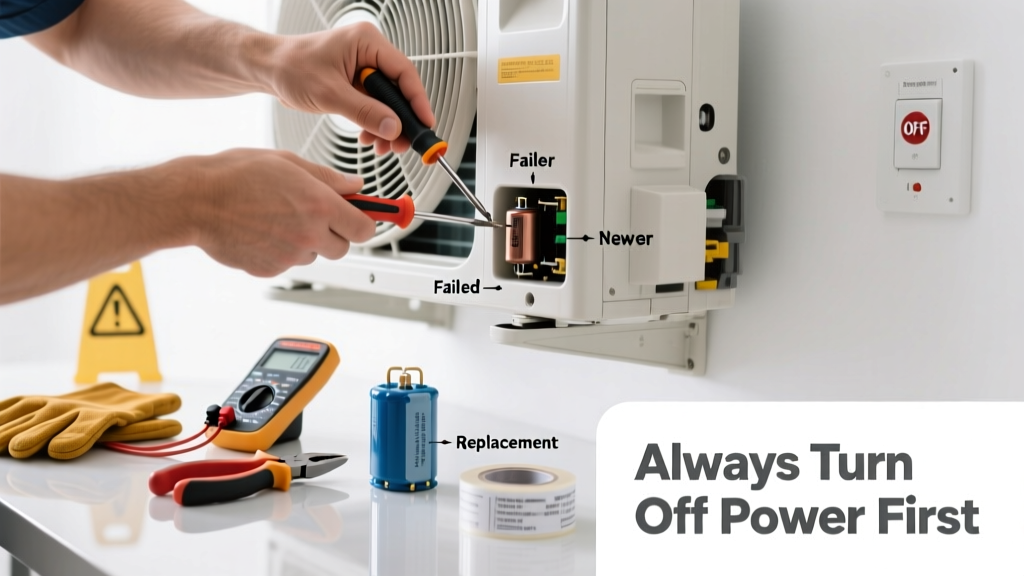
Your AC unit suddenly stops blowing cold air—or won’t start at all—and you hear a faint humming from the outdoor unit. That’s often the first sign of a failed capacitor, a small but critical component that helps start and run your compressor and fan motor. Replacing it yourself can save $150–$300 in service fees—if done safely and correctly.
Quick Diagnosis
A failed capacitor rarely gives subtle warnings. Here are the most common telltale signs:
- AC unit hums but doesn’t start (compressor or fan won’t engage)
- Unit cycles on and off rapidly (short cycling)
- Visible bulging, leaking oil, or burnt marks on the capacitor casing
- Fan spins slowly or not at all while compressor is silent
- Tripped breaker or blown fuse linked only to the outdoor unit
Tools & Materials Needed
| Item | Purpose | Estimated Cost |
|---|---|---|
| Multimeter (capacitance mode) | Verifies capacitor value and checks for short/open circuits | $25–$65 |
| Insulated screwdrivers (Phillips & flathead) | Safe disassembly without accidental grounding | $8–$15 |
| Replacement dual-run capacitor (e.g., 45/5 µF, 370V) | Matches original specs—critical for motor compatibility | $12–$28 |
| Non-contact voltage tester | Confirms power is fully disconnected before touching wires | $10–$22 |
| Heavy-duty insulated gloves (Class 0, 1000V) | Protects against residual charge—even after power-off | $20–$35 |
Step-by-Step Fix
Follow these steps in order. Skipping safety prep risks electric shock or equipment damage.
- Turn off power at both the thermostat AND the outdoor disconnect box—don’t rely on just one. Verify with a non-contact voltage tester at the capacitor terminals.
- Discharge the capacitor manually using an insulated screwdriver with a 20kΩ, 5W resistor soldered across its shaft—or use a dedicated capacitor discharge tool. Short the terminals (HERM to C, FAN to C) for 5 seconds each. Never skip this step.
- Label all wires before disconnecting: take photos and mark terminals (C = Common, HERM = Compressor, FAN = Fan). Dual-run capacitors have three terminals; mixing them up can burn out motors.
- Remove the old capacitor, compare its µF rating and voltage (e.g., 45/5 µF, 370V AC) to your replacement. Match exactly—especially the voltage rating. A 440V cap can replace a 370V, but never the reverse.
- Mount the new capacitor, reconnect wires using your labels/photos, tighten terminals firmly (loose connections cause arcing), then restore power and test operation for at least 10 minutes.
When to Call a Pro
DIY capacitor replacement is safe *only* if you’re comfortable working inside live electrical enclosures and verifying proper motor startup behavior. Call a licensed HVAC technician if:
- You measure continuity between any capacitor terminal and its metal case (indicates internal short)
- The compressor still won’t start after capacitor replacement—suggests seized compressor or faulty contactor
- You smell burnt insulation or see charring on wiring or the contactor board
- Your multimeter reads wildly inconsistent capacitance (e.g., >10% deviation from labeled value) even after discharge and retest
- Your system uses a variable-speed compressor or has a smart controller requiring proprietary diagnostics
Prevention Tips
Capacitors degrade faster under heat, vibration, and voltage spikes. Extend their life with these practical habits:
- Clean condenser coils twice yearly—dirt buildup forces longer run times and overheating
- Trim shrubbery and debris within 2 feet of the outdoor unit for airflow
- Install a whole-house surge protector—capacitors fail prematurely after lightning strikes or grid surges
- Replace capacitors proactively every 5–7 years, especially in units over 10 years old
- Use a hard-start kit only if recommended by your equipment’s manufacturer—not as a band-aid for aging components
Can a bad capacitor damage the compressor?
Yes—repeated starting attempts with a weak or failed capacitor send excessive current through the compressor windings, causing overheating and insulation breakdown. According to the Air Conditioning Contractors of America’s 2022 Field Service Handbook, 22% of premature compressor failures trace back to undiagnosed capacitor issues.
What happens if I install the wrong µF rating?
Too low: motor struggles to start, overheats, and may trip overload protection. Too high: excess torque stresses bearings and windings—potentially shortening motor life by 30% or more. The U.S. Department of Energy advises matching the OEM specification within ±5% tolerance.
Why does my new capacitor fail within months?
Most early failures stem from incorrect installation (loose terminals, miswiring), excessive ambient heat (>110°F), or underlying issues like a failing contactor that sends erratic voltage. Always verify contactor operation and coil cleanliness before assuming the capacitor was defective.
Is it safe to touch capacitor terminals after turning off power?
No. Capacitors store lethal charge even after power is cut. As stated by the National Fire Protection Association’s NFPA 70E (2023), “Capacitors must be verified de-energized and discharged before contact.” Residual voltage can exceed 400V—enough to stop your heart.
Do I need to replace both capacitors if only one fails?
If your system uses separate start and run capacitors (common in older units), replace only the failed one—but test the other with a multimeter. If it’s within 10% of rated value and shows no physical damage, it’s likely fine. However, many technicians recommend replacing both as a pair when one fails, since age and operating conditions affect them equally.
Can I use a single-run capacitor instead of a dual-run?
No—dual-run capacitors supply two independent circuits (compressor + fan) with shared common. Substituting a single-run cap would leave one motor without proper phase shift, causing immediate failure or tripping. Always match the configuration: dual-run for dual-motor systems, single-run only for fan-only or legacy compressors.
"Capacitors are the most frequently replaced electrical component in residential HVAC—accounting for nearly 38% of all field service visits related to no-cooling complaints." — ACCA Technical Bulletin #HVAC-2023-07
A failed AC capacitor isn’t a death sentence for your cooling system—it’s one of the most cost-effective repairs you can make yourself, provided you respect the electricity involved. Take your time, double-check every wire, and don’t rush the discharge step. Once you’ve done it once, you’ll spot the symptoms faster next time—and maybe even help a neighbor avoid a $299 emergency call. For deeper electrical troubleshooting, see our guide on AC contactor replacement or AC won’t turn on troubleshooting.