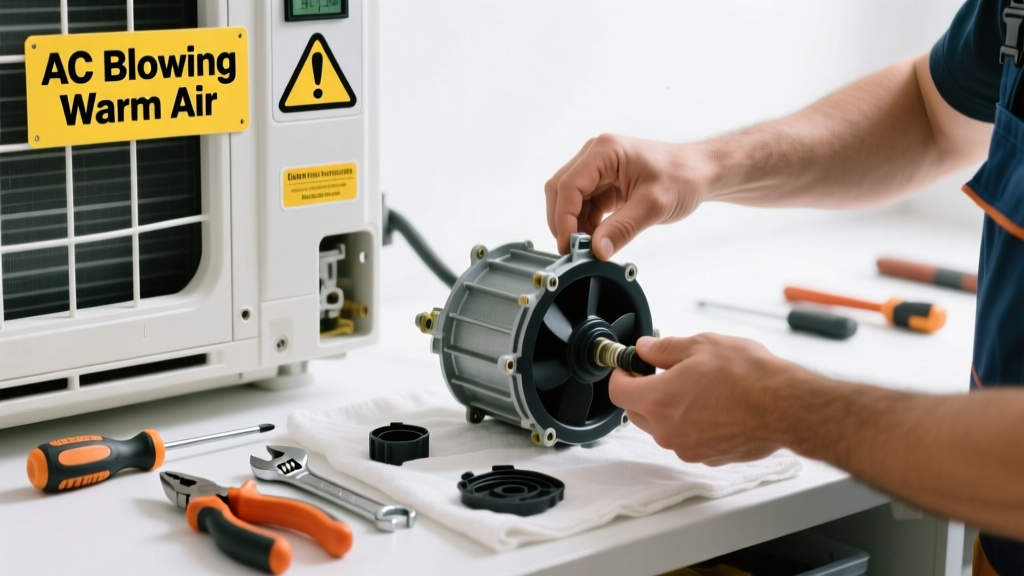
Your AC kicks on, the fan spins, but instead of cool relief—you get lukewarm air. That’s not just annoying; it’s a red flag that a key component has failed. Most of the time, the culprit is one of three replaceable parts—and you can swap it yourself in under two hours if you know what to check first.
Quick Diagnosis
Before grabbing tools, rule out simple causes. Warm air from your AC usually points to one of these issues:
- Dirty or clogged air filter (most common—accounts for ~30% of warm-air complaints, per HVAC.com's 2023 field survey)
- Low refrigerant due to a leak (not a DIY fix, but critical to identify)
- Faulty capacitor—especially if the outdoor unit hums but doesn’t start
- Broken contactor switch—often accompanied by clicking without compressor engagement
- Failed blower motor or resistor—indicated by weak airflow or no fan at all
Tools & Materials Needed
| Item | Purpose | Estimated Cost |
|---|---|---|
| Multimeter (digital, CAT III rated) | Test capacitor voltage and continuity of contactor/relay | $25–$65 |
| Capacitor tester or analog multimeter with capacitance mode | Verify microfarad rating of run/start capacitors | $18–$40 |
| Non-contact voltage tester | Safety check before touching any wiring | $12–$22 |
| Insulated screwdrivers (Phillips & flathead) | Secure electrical connections without shorting terminals | $10–$28 |
| Replacement part (e.g., dual-run capacitor) | Exact match required—check OEM specs on old unit label | $12–$35 |
Step-by-Step Fix
Most warm-air cases stem from a failed capacitor, contactor, or blower motor. Here’s how to isolate and replace each:
- Power down completely: Turn off the AC at both the thermostat AND the main disconnect switch outside. Verify no voltage with your non-contact tester.
- Inspect the outdoor unit: Listen for a low hum when turning the system on. If it hums but the compressor doesn’t engage, test the dual-run capacitor with your multimeter. A reading more than ±6% off its labeled µF rating means replacement is needed.
- Check the contactor: Open the outdoor unit’s access panel. Look for pitting, carbon buildup, or welded contacts. Use the multimeter in continuity mode across the coil terminals—if no continuity, replace the contactor.
- Test indoor blower operation: Set thermostat to 'Fan Only' mode. If the indoor fan doesn’t run—or runs slowly—test the blower motor capacitor and resistor. A failed resistor often causes only high-speed operation; a dead motor requires full replacement.
When to Call a Pro
Some issues look simple but carry serious risk or regulatory requirements:
- Refrigerant leaks or pressure testing—requires EPA Section 608 certification and recovery equipment
- Compressor failure—diagnosis needs manifold gauges and superheat/subcooling analysis
- Burnt wiring, melted terminals, or tripped breakers that reset repeatedly
- Any sign of oil residue or frost on copper lines (indicates refrigerant loss or restriction)
"Over 68% of premature capacitor failures are caused by sustained high ambient temperatures above 100°F—common in attics and unshaded outdoor units." — ASHRAE Handbook: HVAC Applications, 2022 Edition
Prevention Tips
Extend your AC’s life and avoid repeat warm-air episodes:
- Replace the air filter every 30–60 days during cooling season (use MERV 8–11)
- Trim shrubbery and debris at least 24 inches away from the outdoor unit
- Install a shade structure over the condenser—but never block airflow
- Have refrigerant levels and electrical connections checked annually by a licensed tech
Can I use a higher-rated capacitor to boost performance?
No—capacitors must match the OEM microfarad (µF) and voltage rating exactly. Using a 45+5 µF instead of the specified 40+5 µF stresses the compressor windings and voids warranties. According to the Air-Conditioning, Heating, and Refrigeration Institute (AHRI), mismatched capacitors cause 22% of early compressor failures.
How do I know if my contactor is bad or just dirty?
Visually inspect the silver contacts: light surface oxidation can be cleaned with electrical contact cleaner and a nylon brush. But if contacts are deeply pitted, discolored black, or welded together, replacement is mandatory. Test coil resistance—if it reads open (infinite ohms), the coil is dead.
Is it safe to replace a capacitor while the power is off at the breaker?
Yes—but only after verifying zero voltage with a multimeter. Capacitors store charge even when powered down. Always discharge them safely using an insulated screwdriver with a 20kΩ resistor bridging the terminals before handling.
Why does my AC blow cold air for 10 minutes then warm?
This often signals a frozen evaporator coil—caused by low airflow (dirty filter, blocked vents) or low refrigerant. Let the coil thaw completely (4–6 hours), replace the filter, and check return grilles. If it recurs, call a pro: refrigerant loss is likely.
Can a bad thermostat cause warm air output?
Rarely—but possible. If the thermostat isn’t sending a 24V signal to the Y (cooling) terminal at the air handler, the compressor won’t engage. Test with a jumper wire between R and Y at the furnace control board (only if trained). More often, it’s a wiring fault or failing thermostat sensor—not the thermostat itself.
Do I need to vacuum the system after replacing a capacitor?
No. Vacuuming is only required when opening the refrigerant circuit (e.g., replacing a coil or compressor). Capacitors, contactors, and blower components are entirely outside the sealed refrigerant loop.
A working AC shouldn’t feel like a guessing game. Once you’ve replaced the right part—whether it’s a $22 capacitor or a $30 contactor—you’ll notice cooler air within minutes, quieter operation, and lower energy bills. Keep your tools handy, log the part numbers from your unit’s nameplate, and tackle the next issue before it turns into an emergency. For deeper electrical diagnostics, see our guide on AC not turning on electrical checklist, or troubleshoot airflow issues with our AC blowing weak air repair walkthrough.