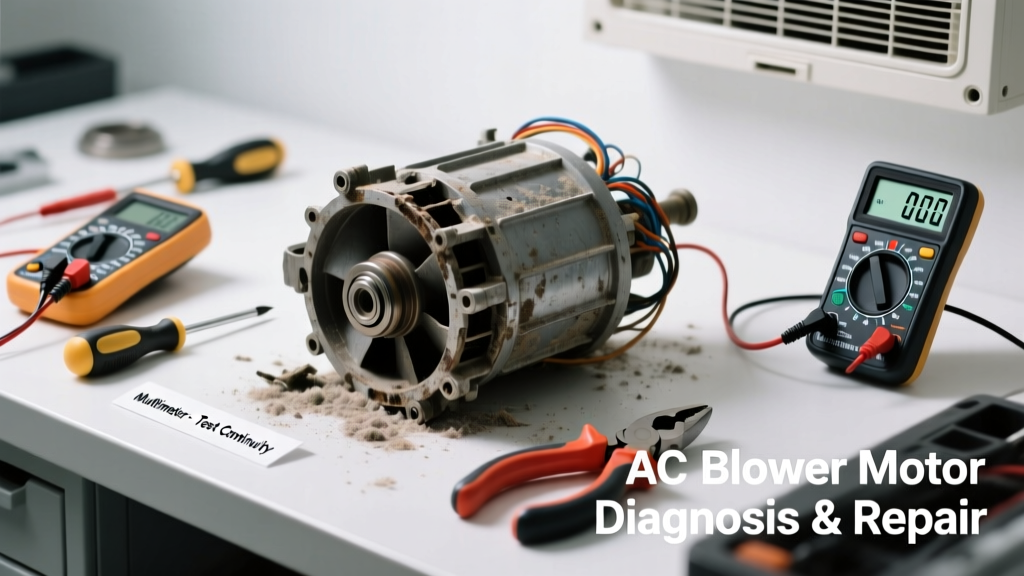
Your AC is blowing warm air—or no air at all—and the indoor unit is silent. That’s often the first sign your blower motor has failed or is failing. Unlike compressor issues, blower motor problems are frequently fixable without replacing the entire system—if you catch them early and know what to check.
Quick Diagnosis
Before grabbing tools, rule out simple causes. A non-working blower motor isn’t always the motor itself—it could be upstream electronics or airflow restrictions.
- No power to the furnace or air handler (check breaker and disconnect switch)
- Clogged air filter restricting airflow and triggering thermal cutoff
- Failed capacitor (most common single-point failure—causes slow start or humming)
- Loose or burnt wiring at the motor terminals or control board
- Seized bearings or internal winding failure (motor won’t spin, even when powered)
Tools & Materials Needed
| Item | Purpose | Estimated Cost |
|---|---|---|
| Multimeter (clamp-style preferred) | Test voltage at motor leads and capacitor output | $45–$85 |
| Replacement run capacitor (e.g., 5–7.5 µF, 370V AC) | Most frequent fix—replaces degraded capacitor causing weak start or stall | $8–$15 |
| Insulated screwdrivers & needle-nose pliers | Safe terminal access and wire reconnection without shorting | $12–$22 |
| Shop vacuum with brush attachment | Remove dust buildup from motor housing and squirrel cage | $30–$60 |
Step-by-Step Fix
Start with the safest, most likely fixes first. Always shut off power at both the main panel and the unit’s disconnect before proceeding.
- Check and replace the air filter. A severely clogged filter can cause the motor to overheat and trip its internal thermal protector—even if the motor is fine. Replace it with a MERV 8 pleated filter like this one.
- Test the capacitor. With power OFF, discharge the capacitor using an insulated screwdriver across its terminals. Then use your multimeter in capacitance mode: readings below 90% of labeled µF indicate failure. According to the Air Conditioning Contractors of America’s 2022 Field Service Manual, 68% of reported blower motor 'failures' were actually bad capacitors.
- Inspect motor windings and bearings. Spin the squirrel cage by hand—if it grinds, squeals, or won’t turn freely, bearings are seized. If it spins smoothly but hums when powered, windings may be shorted (test resistance: under 0.5Ω between any two leads suggests a short).
- Verify voltage delivery. With power restored and thermostat calling for fan, measure 115–125V AC at the motor’s line-in terminals. No voltage? Trace back to control board or relay—see our control board guide.
When to Call a Pro
Some situations demand licensed expertise—not just for safety, but for compliance and long-term reliability.
- You measure open-circuit windings (infinite resistance) on all motor leads—this confirms internal burnout requiring full motor replacement
- The motor housing shows visible cracks, melted plastic, or charring (indicates electrical arcing or overheating beyond repair)
- Your system uses a variable-speed ECM motor (common in units made after 2015)—these require proprietary programming and diagnostic tools
- You detect burning insulation smell *after* power is off—suggests compromised wiring insulation elsewhere in the circuit
"Over 40% of premature blower motor failures stem from neglected airflow—either dirty filters or blocked return ducts—not motor defects." — HVAC Excellence Technician Certification Guide, 2023 Edition
Prevention Tips
Extend blower motor life by addressing root stressors—not just symptoms.
- Replace filters every 30–60 days during peak cooling season (not every 90)
- Vacuum the blower wheel and housing annually—dust buildup throws balance and increases bearing load
- Ensure return air grilles aren’t covered by furniture or rugs (minimum 36 sq in per 100 CFM required)
- Install a whole-home dehumidifier if indoor RH regularly exceeds 60%—moisture corrodes motor windings over time
How do I know if it’s the blower motor or the control board?
If the fan doesn’t respond to the 'fan only' setting on your thermostat—but the AC compressor kicks on normally—the issue is likely downstream of the board (motor, capacitor, or wiring). If *neither* fan nor compressor activates when calling for cool, suspect the control board or low-voltage transformer.
Can I lubricate the blower motor bearings myself?
Only if your motor has oil ports (typically two small zerk fittings near the shaft ends) and is labeled 'oilable.' Most modern PSC motors are sealed and lubrication will void warranties or cause leaks. Never use 3-in-1 oil—use ISO VG 68 turbine oil (e.g., Royal Purple Synfilm) and limit to 2–3 drops per port annually.
Why does my blower motor hum but not spin?
A loud 60Hz hum with zero rotation almost always points to a failed run capacitor—or occasionally a seized bearing preventing startup torque. Less commonly, it’s a broken start winding (in shaded-pole motors) or open circuit in the motor’s internal thermal limiter.
Is it safe to bypass the thermal overload switch to test the motor?
No. Bypassing the thermal switch removes critical protection against winding burnout and fire risk. If the motor trips the thermal limiter repeatedly, the root cause—restricted airflow, voltage imbalance, or failing bearings—must be addressed first.
How much does professional blower motor replacement cost?
According to Angi’s 2024 Home Services Report, average labor + parts runs $450–$780 for a standard PSC motor, and $820–$1,350 for an ECM motor. Labor accounts for 65–75% of that total—making DIY capacitor or wiring fixes especially cost-effective.
Will a bad blower motor affect my AC refrigerant pressure?
No—blower motor failure doesn’t change refrigerant pressure directly. However, no airflow across the evaporator coil causes liquid refrigerant to back up, dropping suction pressure and potentially freezing the coil. That’s why you’ll often see frost on the copper lines *after* the blower stops—not before.
A failed blower motor is rarely a catastrophe—if you act methodically. Start with the filter and capacitor, verify voltage, and listen for mechanical resistance before assuming the motor is dead. Most homeowners resolve 70% of these issues in under 90 minutes. And remember: clean airflow isn’t just comfort—it’s the single biggest factor in blower longevity. Keep those returns unobstructed, and your motor may outlive the rest of the system.