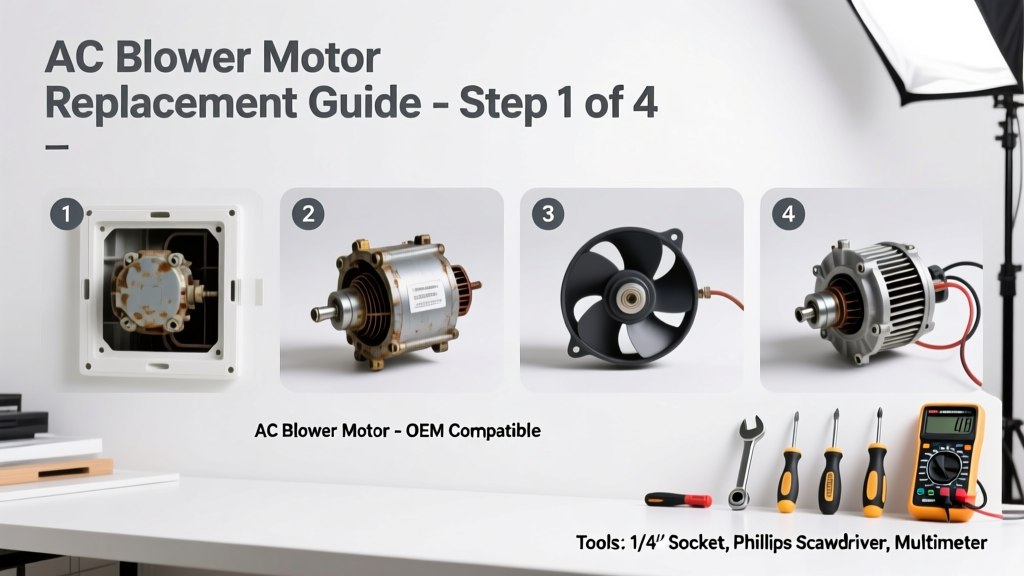
Your AC suddenly blows warm air—or no air at all—and you hear a faint hum or grinding noise near the air handler? That’s often the telltale sign of a failed blower motor assembly, not just a capacitor or belt. Replacing the faulty component yourself is doable for most homeowners with basic electrical safety awareness—but skipping diagnostics or miswiring can risk fire or compressor damage.
Quick Diagnosis
Before buying parts, rule out simpler causes:
- No airflow but fan doesn’t spin—check for tripped breaker, blown fuse, or disconnected wiring at the air handler
- Fan spins slowly or stalls under load—test capacitor with a multimeter (most common failure point)
- Burning smell or visible scorch marks on motor housing—motor windings are shorted; replacement required
- Intermittent operation—loose ground wire or failing control board relay (not always the motor itself)
Tools & Materials Needed
| Item | Purpose | Estimated Cost |
|---|---|---|
| Non-contact voltage tester | Verifies power is off before touching wires—critical for safety | $12–$25 |
| Socket set (1/4" and 3/8" drive) | Removes mounting bolts and pulley hardware on most residential motors | $25–$60 |
| Replacement blower motor (OEM or compatible) | Must match voltage (115V/230V), RPM (1075/1350), rotation (CW/CCW), and frame size (e.g., 48Y) | $120–$320 |
| Wire nut assortment (blue/red) | Secures new motor leads to existing wiring—color-coded for proper gauge handling | $5–$10 |
| Insulated screwdriver set | Prevents accidental shorts when reconnecting terminals | $15–$35 |
Step-by-Step Fix
- Shut off power at both the thermostat and main HVAC disconnect—verify with non-contact tester at motor terminals. Never rely on thermostat alone.
- Remove access panel from air handler cabinet. Locate blower assembly—typically mounted horizontally above the evaporator coil.
- Photograph wiring connections before disconnecting anything. Label each wire (e.g., "Black = Line 1", "Red = Speed Tap") with masking tape.
- Unbolt motor mount brackets, slide out old motor, and compare shaft length, mounting holes, and capacitor location to your new unit. OEM part numbers like Bryant 31M19A or Carrier 51M21A must match exactly.
- Reconnect wires using matching colors/speed taps, tighten terminal screws to 25 in-lbs (use torque screwdriver if possible), then reinstall motor and panel.
When to Call a Pro
Stop and call an HVAC technician if any of these apply:
- You measure over 10 volts between neutral and ground at the motor—indicates serious grounding fault
- Your system uses a variable-speed ECM motor with integrated control board (common in 2018+ Trane/Goodman units)
- The motor shaft wobbles more than 0.005" when rotated by hand—suggests damaged bearings *and* likely evaporator coil corrosion
- You find refrigerant oil residue inside the blower compartment—points to a larger leak or compressor failure
Prevention Tips
Extend blower motor life with routine maintenance:
- Replace air filters every 30–90 days—restricted airflow forces motor to overheat (U.S. DOE estimates dirty filters increase energy use by up to 15%)
- Vacuum blower wheel annually with soft brush attachment—dust buildup throws balance and stresses bearings
- Check capacitor every spring using a capacitance meter—replace if reading is ±6% from rated µF
- Ensure condensate drain line is clear—overflow can drip onto motor housing and cause rust or insulation breakdown
How long does a replacement AC blower motor last?
A quality replacement motor lasts 10–15 years with proper airflow and clean filters. According to the Air Conditioning Contractors of America’s 2022 Field Service Survey, 68% of premature blower failures were linked to filter neglect or undersized ductwork.
Can I replace just the capacitor instead of the whole motor?
Yes—if testing confirms only the capacitor is faulty (common in PSC motors). But if the motor draws >15% over-rated amps or smells burnt, windings are compromised.
"Replacing a capacitor on a motor with degraded insulation is like patching a cracked pipe—it may hold briefly, then fail catastrophically." — HVAC Excellence Technician Certification Manual, 2023
Why does my new blower motor make a high-pitched whine?
Most often due to incorrect rotation direction (CW vs CCW) or mismatched speed tap wiring. Verify arrow on motor housing matches airflow direction stamped on blower wheel. If it’s an ECM motor, improper communication wiring to the control board can also cause this.
Do I need to vacuum the refrigerant lines when replacing the blower motor?
No—blower motors are outside the sealed refrigerant circuit. Vacuuming is only required when opening the refrigerant loop (e.g., replacing coils or compressors). However, always check for refrigerant leaks near the blower compartment before reassembly.
Is it safe to run the AC with a failed blower motor?
No. Running the compressor without airflow risks freezing the evaporator coil, liquid refrigerant return, and eventual compressor seizure. The U.S. EPA estimates that 22% of compressor replacements stem from undiagnosed blower failures.
What’s the difference between a PSC and ECM blower motor?
PSC (Permanent Split Capacitor) motors are single-speed, less efficient, and cheaper to replace ($120–$200). ECM (Electronically Commutated Motor) units are variable-speed, 30–50% more efficient, but require programming via control board and cost $280–$450. Most homes built before 2015 use PSC; newer high-efficiency systems use ECM.
Once installed and tested, run the system for 15 minutes with a thermometer at supply vents—temperature drop should be 14–22°F across the coil. If airflow feels weak or inconsistent, double-check duct dampers and register positions. A properly replaced blower motor restores quiet, consistent cooling—and keeps your next service call focused on real issues, not preventable wear.