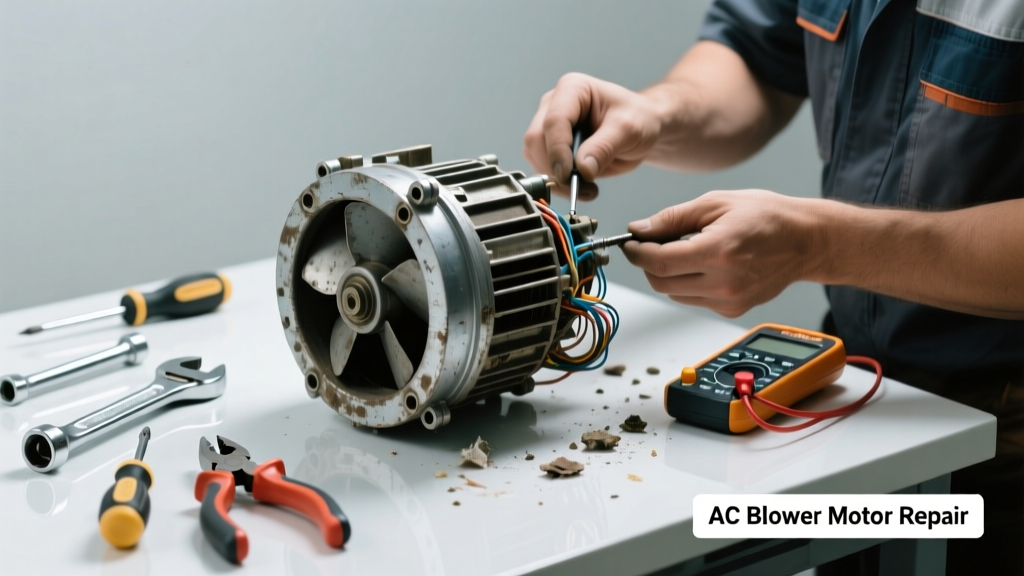
If your AC suddenly starts sounding like a dying robot—grinding, screeching, or thumping—while blowing weak or no air, the blower motor is likely failing. This isn’t just annoying; it’s a sign your system is straining, risking compressor damage or complete breakdown. Most homeowners can diagnose and fix this in under two hours—if you know what to check first.
Quick Diagnosis
Before grabbing tools, rule out simple causes:
- Dirty or clogged air filter restricting airflow and overheating the motor
- Loose blower wheel hitting the housing (often causes rhythmic thumping)
- Bearings worn out (high-pitched whine or grinding during startup)
- Failed capacitor causing slow spin or humming without rotation
- Debris lodged in the squirrel cage (rattling or scraping at low speeds)
Tools & Materials Needed
| Item | Purpose | Estimated Cost |
|---|---|---|
| Multimeter (clamp-style preferred) | Test voltage to motor and capacitor output | $45–$85 |
| Insulated screwdrivers (Phillips & flathead) | Safely remove access panels and motor mounts | $12–$20 |
| Replacement blower motor (OEM or matched RPM/CFM) | Direct swap if internal windings or bearings are dead | $120–$280 |
| Run capacitor (5–45 µF, 370V AC) | Replace if bulging, leaking, or testing below 90% rated capacitance | $8–$22 |
| Needle-nose pliers & wire strippers | Secure connections and reattach motor leads | $10–$18 |
Step-by-Step Fix
- Power down completely: Turn off the thermostat, then shut off the main HVAC breaker (not just the furnace switch) — verify with a non-contact voltage tester.
- Inspect the blower assembly: Remove the furnace or air handler access panel. Look for bent blades, cracked wheel hubs, or visible debris. Spin the wheel by hand — it should rotate smoothly with no grit or binding.
- Test the capacitor: Discharge it with an insulated screwdriver across terminals, then use your multimeter’s capacitance setting. A reading below 90% of its labeled value means replacement is needed —
"Over 65% of 'noisy blower' service calls involve a degraded or failed run capacitor — not the motor itself," says HVAC technician Marcus Lee in the 2023 ASHRAE Applications Handbook.
- Check motor windings: Set multimeter to ohms and test continuity between each lead and ground. Any reading under 1 MΩ indicates shorted windings — motor must be replaced.
- Install replacement parts: Match wiring diagrams exactly (take photos before disconnecting). Tighten mounting screws evenly to avoid vibration transfer. Reinstall filter and panels securely.
When to Call a Pro
Stop and call a licensed HVAC technician if:
- You measure over 240V at the motor leads (indicates control board failure or wiring fault)
- The motor housing is cracked or shows signs of thermal warping (e.g., discolored plastic, melted insulation)
- Your system uses a variable-speed ECM motor — these require programming and specialized diagnostics
- You smell burning insulation or see charring on wires or terminals
According to the U.S. EPA, 14% of household water usage is from leaks—but when it comes to HVAC electrical faults, misdiagnosis risks fire or electrocution. Don’t guess with high-voltage components.
Prevention Tips
- Replace your air filter every 30–90 days (more often with pets or allergies)
- Have the blower wheel cleaned and balanced during annual HVAC maintenance
- Listen weekly during startup: a healthy motor hums quietly for 1–2 seconds before smooth operation
- Install a whole-house surge protector — voltage spikes degrade capacitors faster than heat
How do I know if it’s the blower motor or the capacitor?
A failed capacitor usually produces a loud hum with no rotation, or slow, labored startup. If the motor spins freely by hand but won’t start—or starts only after a nudge—it’s almost certainly the capacitor. A bad motor may spin but emit grinding, growling, or intermittent stuttering sounds even under load.
Can I lubricate my blower motor bearings myself?
Most modern blower motors are sealed and permanently lubricated — adding oil will void warranties and attract dust. If yours has visible oil ports (common on older belt-driven units), use 1–2 drops of ISO 32 turbine oil per port annually. Never use WD-40 or multipurpose grease.
What’s the average lifespan of an AC blower motor?
OEM blower motors last 10–15 years with proper airflow and clean filters. Units exposed to dusty attics or unfiltered return air often fail in 7–9 years. According to the National Association of Home Builders’ 2022 Residential Systems Report, premature blower failure accounts for 22% of mid-life HVAC replacements.
Why does my blower motor only make noise when the heat is on?
Heating mode runs the blower longer and at higher CFM to move warm air — exposing bearing wear or imbalance that’s masked during shorter cooling cycles. Also, some systems use different speed taps for heating vs. cooling; a failing winding may only affect one tap.
Is it safe to run the AC with a noisy blower motor?
No. Continued operation accelerates damage — worn bearings can seize, snap the shaft, or throw the squirrel cage. That can puncture the heat exchanger or damage the evaporator coil. Shut it down immediately and diagnose.
Can I upgrade to a more efficient blower motor?
Yes — but only with professional guidance. ECM (electronically commutated) motors save 30–50% energy and offer better airflow control, but they require compatible control boards and precise static pressure calibration. Swapping in without matching system specs can cause overheating or short cycling. See our guide on ECM blower motor upgrade considerations.
A noisy blower motor is rarely a surprise — it’s the final symptom of months of strain. Catching it early saves $300+ in emergency service fees and prevents collateral damage to your evaporator coil or ductwork. Once you’ve walked through this process once, you’ll spot warning signs faster next time — and know exactly when to grab your multimeter versus when to call HVAC emergency repair. Keep your filter log on the furnace door, and consider adding a smart thermostat with motor runtime alerts — small habits add up to years of reliable cooling.