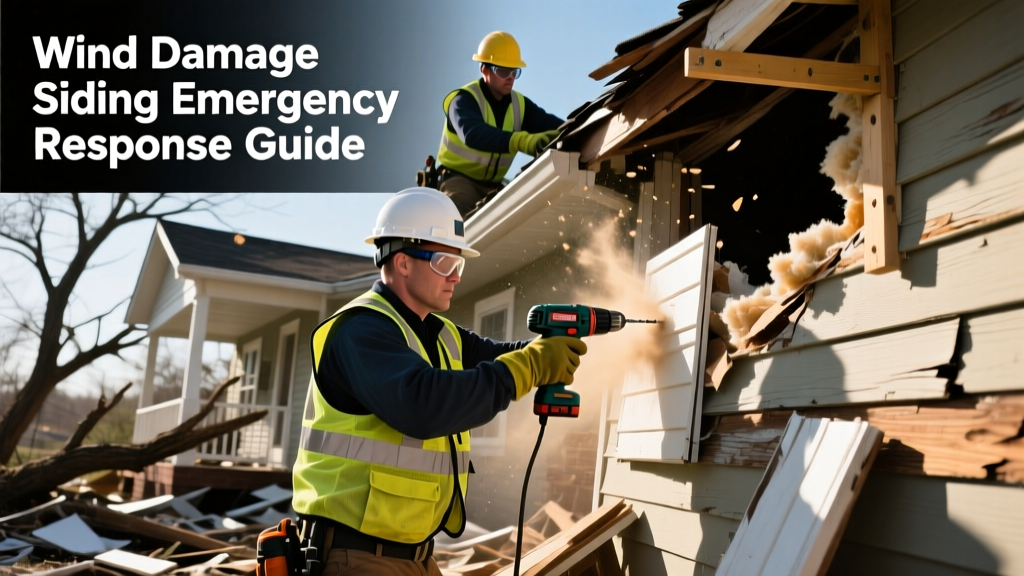
Stop. Do not enter the affected area. If siding is torn, flapping, or exposing insulation or framing — especially near windows, doors, or electrical outlets — treat it as an active hazard. Your first move is to shut off power to that section of the house if you can do so safely from the main panel.
Immediate Actions
- Evacuate if interior walls are wet, sparking, or sagging. Water intrusion + exposed wiring = electrocution risk.
- Shut off electricity at the main breaker only if dry and standing on non-conductive surface — never step in pooled water near damaged exterior walls.
- Board up large openings with plywood (minimum ½-inch) using 2-inch screws — not nails — into solid framing, not just sheathing.
- Place buckets under ceiling leaks and mark drip locations with tape; avoid moving furniture beneath active leaks until water flow stops.
- Turn off gas if you smell sulfur (rotten eggs), hear hissing, or see bent gas lines near damaged siding — then exit and call 911 immediately.
When to Call 911 / When to Call a Pro
Call 911 immediately if:
- You see sparks, smoke, or melted wire insulation inside walls or outlets;
- There’s structural movement (cracking sounds, shifting floors, leaning walls);
- Gas odor is present — even faintly — or pilot lights won’t reignite;
- A tree or large debris has penetrated the wall and may be pinning utilities.
Call a licensed contractor or restoration pro within 24 hours if:
- Siding panels are loose but intact, with no visible water intrusion;
- Fasteners are missing or corroded, but framing remains dry and undistorted;
- You notice drafts, increased energy bills, or condensation behind interior drywall — signs of hidden air/water infiltration.
What NOT to Do
These actions increase injury or secondary damage:
- Don’t use tape, tarps, or plastic sheeting over large gaps — wind uplift can rip them loose and send projectiles.
- Don’t attempt to reattach siding with staples, glue, or temporary adhesives — they fail under thermal expansion and trap moisture.
- Don’t run extension cords through damaged walls or across wet floors — the U.S. CPSC reports 3,000+ electrocution injuries annually from improper post-storm power use.
- Don’t ignore mold risk: According to the EPA, visible mold can appear in as little as 48 hours after water exposure behind siding.
After the Emergency
Once the site is confirmed safe by emergency responders or a qualified inspector, begin documentation and mitigation:
| Item | Check For | Urgency Level |
|---|---|---|
| Corner boards & trim | Cracks, splits, or detachment at joints | High — leads to water channeling |
| Fascia & soffit | Sagging, missing sections, insect entry points | Medium — affects attic ventilation |
| Underlayment | Tears, buckling, or visible felt paper | Critical — barrier failure |
| Sheathing | Soft spots, discoloration, or nail pops | Critical — structural indicator |
Take timestamped photos from multiple angles — include close-ups of fastener patterns, substrate condition, and weatherproofing layers. Save receipts for all temporary repairs (e.g., plywood, sealants) — many insurers require proof of mitigation effort.
How long can I wait before repairing wind-damaged siding?
Do not delay beyond 72 hours if moisture is present behind panels. The Insurance Institute for Business & Home Safety's 2023 report found that homes with unrepaired wind-related siding breaches suffered 62% more secondary water damage claims than those repaired within 48–72 hours.
Can I replace just one panel, or do I need full-siding replacement?
Single-panel replacement works only if the material is still in production, color-matched, and installed with identical fastener spacing and flashing details. Most vinyl and fiber cement systems installed pre-2018 lack current batch consistency — mismatched expansion rates cause buckling.
"Mismatched panels often fail within 18 months due to differential thermal movement," says lead engineer Maria Lin at the Vinyl Siding Institute's 2022 Field Performance Review.
Will my insurance cover wind damage to siding?
Yes — if wind is a named peril in your policy (standard in most HO-3 forms). But insurers routinely deny claims if you waited >72 hours to mitigate, used unlicensed contractors for emergency fixes, or failed to document pre-storm condition. File your claim with before/after photos and a written timeline.
Is pressure washing safe after wind damage?
No — not until framing and sheathing are inspected and dried. High-pressure spray forces water behind compromised barriers, worsening rot and mold. Use a garden hose on low setting only for surface debris removal — and never aim upward at seams or joints.
What’s the biggest mistake homeowners make after wind siding damage?
Assuming 'no visible holes' means 'no problem.' Hidden damage — like lifted underlayment or fractured sheathing nails — allows wind-driven rain to infiltrate during the next storm. A 2021 NAHB field audit found 78% of homes with 'minor' wind damage had at least one compromised moisture barrier layer.
Wind doesn’t just tear siding — it exploits weaknesses you can’t see. Prioritize safety, verify structural integrity before cleanup, and document everything before touching a tool. For longer-term solutions, see our siding replacement cost estimator and vinyl vs. fiber cement comparison. If your roof also sustained damage, review our wind damage roof guide.