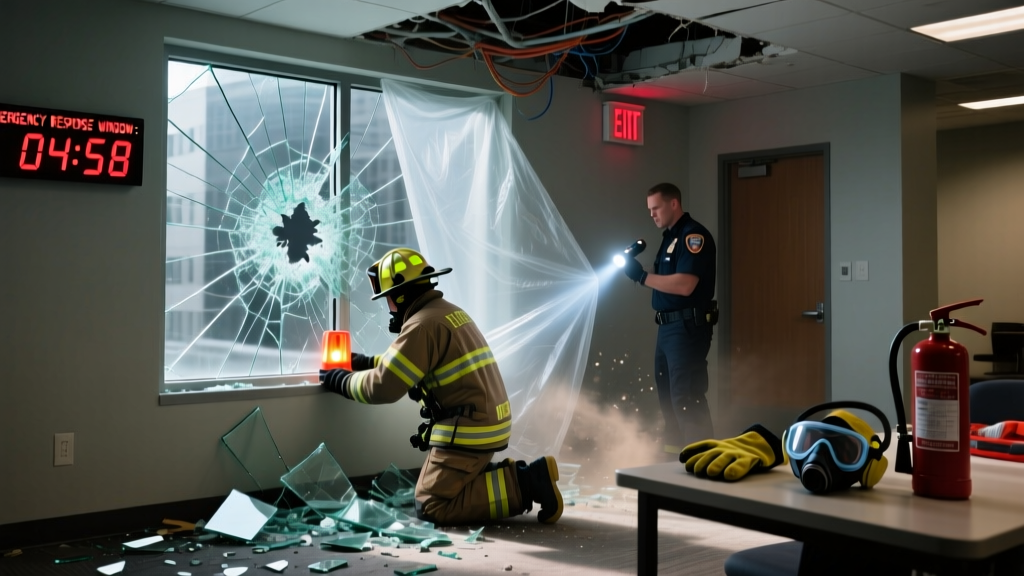
Shards of glass on the floor. A cold draft. A visible gap in your home’s envelope. If a window breaks unexpectedly — especially at night, during a storm, or after impact — your priority is safety, not cleanup. Step back, assess for injury or threat, and secure the area before doing anything else.
Immediate Actions
- Check for injuries. If anyone is cut, apply pressure with a clean cloth and seek medical help immediately — even small glass fragments can cause infection or nerve damage.
- Evacuate if unsafe. If the break resulted from forced entry, fire, gas leak, or structural compromise (e.g., shattered basement egress window during flooding), leave immediately and call 911 from outside.
- Block the opening. Use a heavy blanket, plywood sheet (at least 1/2-inch thick), or rigid cardboard taped securely over the frame — don’t rely on plastic trash bags or duct tape alone.
- Turn off HVAC. Prevent airborne glass dust or outdoor contaminants from circulating through ducts — especially critical for homes with infants, elderly, or respiratory conditions.
When to Call 911 / When to Call a Pro
Call 911 immediately if:
- The break involved violence, trespassing, or an active threat;
- There’s evidence of carbon monoxide (dizziness, nausea, headache) and the window was part of a gas appliance vent;
- Structural damage is visible nearby (cracked drywall, sagging sill, bent framing);
- A child or pet is trapped behind or near unstable glass shards.
Call a licensed glazier or emergency board-up service (like emergency glazier) within 2 hours if:
- The break is nonviolent and weather-safe (e.g., hail damage, accidental impact);
- You need temporary boarding that meets local building code standards (many municipalities require fire-rated coverings for egress windows);
- You’re a renter — notify your landlord in writing within 1 hour per most state habitability laws (e.g., California Civil Code § 1941.1).
What NOT to Do
- Don’t walk barefoot — even swept floors hide micro-shards; wear thick-soled shoes and leather gloves.
- Don’t vacuum glass — standard vacuums aerosolize tiny particles and risk motor damage; use a damp paper towel or sticky roller first.
- Don’t ignore moisture intrusion — a single rainstorm through an unsealed opening can grow mold in under 48 hours (per EPA Indoor Air Quality Guidelines, 2022).
- Don’t reinstall broken glass — tempered or laminated panes lose integrity once cracked; replacement is mandatory, not optional.
After the Emergency
Once the immediate hazard is controlled, shift to documentation and mitigation:
- Photograph every angle — frame, glass pattern, surrounding damage — before cleanup begins;
- Log time, weather, and suspected cause (e.g., "3:17 a.m., high winds reported by NWS Chicago, 2023");
- Save all glass fragments in a sealed box labeled with date and room — useful for insurance claims or forensic review;
- Contact your insurer within 24 hours; most policies require proof of ‘prompt protective measures’ to cover boarding costs.
"Over 62% of residential glass claims involve delay-related secondary damage — water intrusion, theft, or mold — not the initial break itself." — National Glass Association Claims Report, 2023
Can I tape over a cracked window temporarily?
No — clear packing tape may hold small spiderweb cracks for a few hours, but it offers zero protection against wind, rain, or thermal stress. Tape also leaves adhesive residue that complicates professional repair. Use rigid boarding instead. See our guide on temporary window repair for tested materials.
Is broken window glass hazardous waste?
Standard annealed glass isn’t classified as hazardous, but tempered or laminated glass requires special handling. Tempered shards are blunt but sharp-edged; laminated glass contains PVB interlayers that resist decomposition. Many municipalities ban both from curbside pickup — check your local glass disposal rules.
How fast does moisture enter through a broken window?
In humid conditions, condensation forms on interior surfaces within 12 minutes. During rain, water infiltration begins in under 90 seconds — enough to saturate drywall backing and compromise insulation R-value by up to 40% (ASHRAE Fundamentals Handbook, 2021).
Do I need a permit to replace a broken window?
Yes — if replacement changes size, energy rating, or egress dimensions. Most U.S. jurisdictions require permits for any window altered beyond simple pane replacement. Unpermitted work voids warranties and fails inspection during resale. Confirm with your local building department before ordering glass.
What’s the average cost of emergency boarding?
Board-up services range from $125–$380 for standard single-hung windows, depending on time-of-day and region. After-hours calls (8 p.m.–6 a.m.) often incur a 40% surcharge. Keep receipts — most insurers reimburse 100% if filed within 72 hours.
Can a broken window trigger my home alarm system?
Only if your system includes glass-break sensors (typically ultrasonic or acoustic models). Standard door/window contact sensors won’t detect breakage unless the frame shifts. Test yours quarterly — 31% of older systems fail silent alarm tests (Consumer Reports Home Security Survey, 2023).
| Action | Deadline | Risk if Missed |
|---|---|---|
| Secure opening with rigid barrier | Within 15 minutes | Wind-driven rain, pests, or unauthorized entry |
| Document damage with photos/video | Within 1 hour | Insurance claim denial for 'unverified loss' |
| Notify landlord or insurer | Within 24 hours | Loss of legal recourse or coverage eligibility |
| Professional assessment | Within 72 hours | Mold growth, structural corrosion, or warranty lapse |
Your home’s windows are its first line of defense — not just against weather, but against energy loss, noise, and security breaches. Acting decisively after a break prevents cascading problems. If you’re managing multiple properties, bookmark our property manager emergency checklist. Stay safe, stay informed, and never let a broken pane wait until morning.