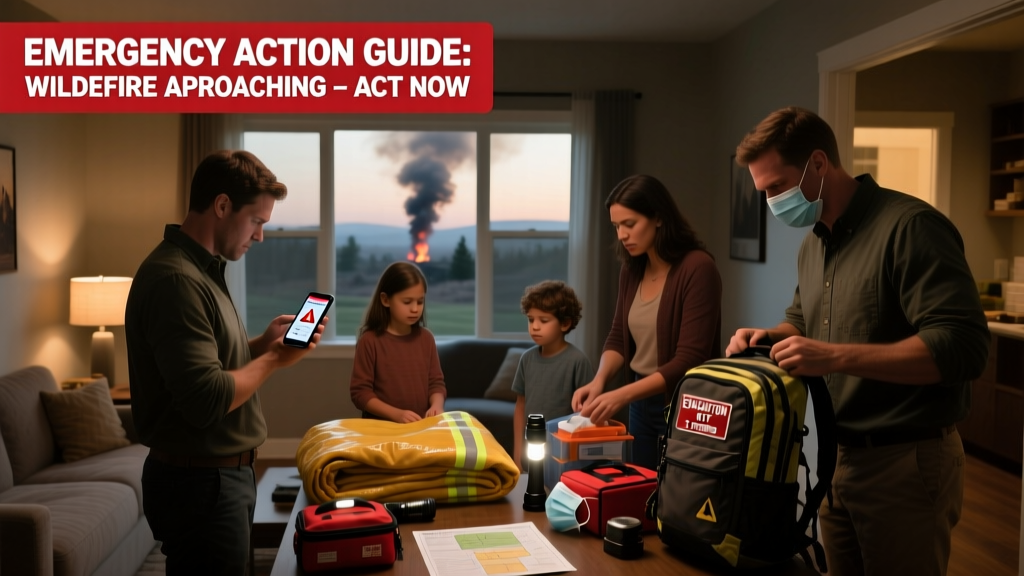
Grab your go-bag and move to a safe interior room with no windows—right now. If embers are already landing on your roof or nearby vegetation is igniting, evacuation may no longer be safe; shelter-in-place is your only option.
Immediate Actions
- Close all windows, doors, and attic vents—even if it’s hot inside. Embers can enter through gaps as small as 1/8 inch (National Fire Protection Association, NFPA 1141-2022).
- Turn off gas at the main valve if instructed by authorities—or if you smell gas and suspect a leak.
- Fill sinks, bathtubs, and buckets with water. You’ll need it for extinguishing spot fires and wetting towels.
- Move flammable furniture away from windows and exterior walls. Shut blinds and curtains to block radiant heat.
- Wear long-sleeved cotton or wool clothing, leather gloves, and sturdy shoes—no synthetics that melt.
When to Call 911 / When to Call a Pro
Call 911 immediately if:
- Flames or heavy smoke are visible within 1 mile of your location;
- You see embers igniting structures or vegetation within 500 feet;
Call a licensed fire mitigation contractor after the immediate threat passes—but only if you’re safely sheltered or evacuated—to assess defensible space, roof integrity, and ember entry points. Do not delay evacuation to consult a pro.
What NOT to Do
- Don’t open windows to check smoke direction—it invites embers and superheated air.
- Don’t use plastic sheeting to cover vents—it melts and blocks airflow needed for shelter-in-place cooling.
- Don’t wait for official evacuation orders if you see active fire approaching within 2 miles and winds exceed 20 mph.
- Don’t assume your sprinkler system will save your home—most residential systems lack pressure and coverage to stop wildfire ignition (Insurance Institute for Business & Home Safety, IBHS 2023 Wildfire Report).
After the Emergency
Wait for official “all clear” before stepping outside—even if flames appear gone. Smoke and ash linger, and downed power lines or hot debris pose serious risks.
Once cleared:
- Document damage with timestamped photos and video—before touching anything.
- Check for hidden embers in gutters, under decks, and in mulch beds using a metal rake (never bare hands).
- Test indoor air quality with a PM2.5 monitor; levels above 35 µg/m³ require HEPA filtration (EPA AirNow guidelines, 2024).
- Contact your insurer within 24 hours—many require initial reports before cleanup begins.
How do I know if my home is in the evacuation zone?
Use your county’s emergency alert system—like AlertSanDiego or LA County Notify—and cross-reference with CalFire’s real-time incident map. Don’t rely solely on neighbors’ actions; zones shift rapidly with wind and fire behavior.
Should I try to defend my home myself?
No. Untrained residents defending homes account for 23% of civilian wildfire fatalities (U.S. Fire Administration, 2022 National Fire Data Center report). Your priority is life—not property. Only trained firefighters with proper PPE and command structure should engage.
What if I have pets or livestock?
Bring pets indoors immediately—use carriers or leashes. For livestock, open pasture gates (so animals can flee) but remove halters and nylon straps that could catch fire. Keep horses in open fields—not near barns or fences. Pre-identify animal-friendly shelters via ASPCA’s Pet Disaster Preparedness Map.
Is it safe to drink tap water after a wildfire?
Not without testing. Wildfires can contaminate municipal water with benzene, ash particulates, and damaged pipe coatings. The CDC recommends boiling water for one minute only if advised—and using bottled water until your utility issues a “water is safe” notice. Test kits are available through local health departments.
Can I re-enter my home right after flames pass?
No. Wait for fire officials’ all-clear. Structural integrity may be compromised—floors, roofs, and walls can collapse hours later. Ash-covered surfaces may contain caustic residues or asbestos from burned building materials. Wear N95 masks and gloves even during brief inspections.
What’s the biggest mistake people make during wildfire approach?
“The most common fatal error is delaying evacuation until visibility drops below 100 feet—by then, escape routes are often blocked, and radiant heat can incapacitate drivers in under 60 seconds.” — Dr. Janice M. Loomis, CAL FIRE Wildland-Urban Interface Division, 2023
| Condition | Action Window | Source |
|---|---|---|
| Embers landing on roof | 0–3 minutes to extinguish or evacuate | NFPA Standard 1144, Table 4.3.2 |
| Smoke visible within 1 mile | Evacuate immediately—do not wait | CA Office of Emergency Services, 2024 Evacuation Protocol |
| Flame front within ½ mile | Shelter-in-place only—evacuation is likely fatal | IBHS Shelter-in-Place Guidelines, 2023 |
Wildfire moves faster than most realize—especially uphill and with wind. Your safest choice is always early, decisive action. Review your plan tonight. Charge your devices. Know two evacuation routes. And remember: no home is worth your life.