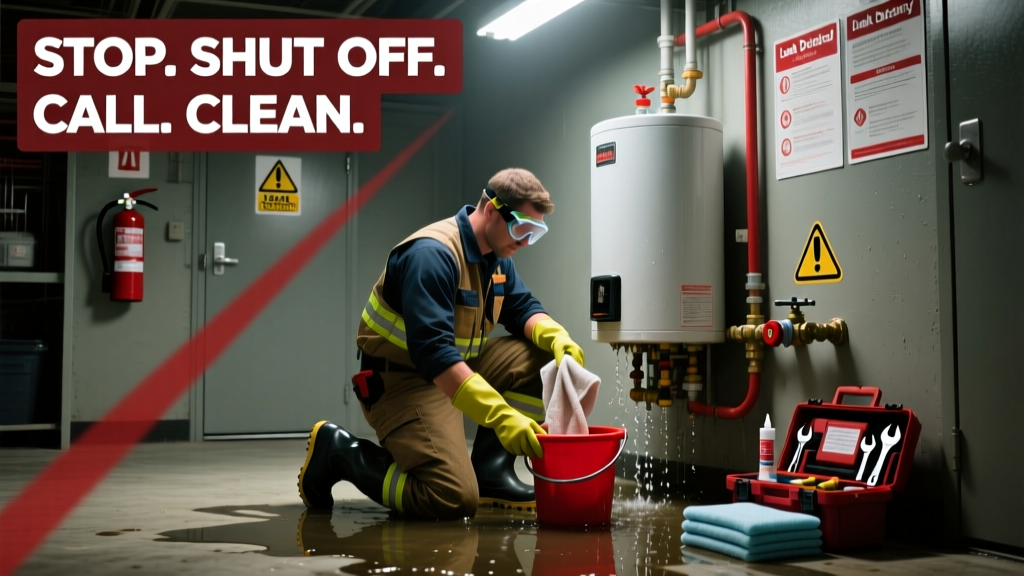
Turn off the water supply valve immediately — it’s usually located on the cold-water pipe near the top of the tank. If you can’t locate it or it’s seized, shut off the main house water at the street or basement shutoff.
Immediate Actions
- Shut off power: For electric heaters, flip the breaker labeled "Water Heater" in your electrical panel. For gas units, turn the gas control knob to "Off" (not "Pilot") — do not attempt to relight it.
- Close the cold-water inlet valve — typically a blue-handled gate or ball valve on the pipe entering the top of the tank.
- Open a hot-water faucet on the lowest floor (e.g., basement sink) to relieve tank pressure and slow leakage.
- Place buckets or towels under the leak — but only if safe to approach. Never stand in standing water near electrical panels or outlets.
- Evacuate the area if you smell gas (rotten egg odor), hear hissing from the tank, or see steam or pooling water near electrical wiring.
When to Call 911 / When to Call a Pro
If you detect the distinct sulfur-like odor of natural gas, hear a loud hiss or bang, or see flames or smoke, evacuate immediately and call 911 from outside. Do not use light switches, phones, or appliances indoors.
For non-gas emergencies — like steady dripping from a T&P valve or tank seam — call a licensed plumber within 2 hours. According to the U.S. EPA, water heater leaks account for nearly 14% of household water waste — but more critically, a ruptured tank can release up to 50 gallons in under 60 seconds.
Is it safe to use hot water while leaking?
No. Using hot water increases internal pressure and may worsen the leak. Shut off all hot-water fixtures until the system is assessed.
Can I patch a leak temporarily?
Never use tape, epoxy, or sealant on pressurized tanks. The American Society of Home Inspectors (ASHI, 2022) explicitly warns that temporary fixes on water heaters create false confidence and risk catastrophic failure.
What NOT to Do
- Don’t ignore even small drips — corrosion often spreads rapidly once breached.
- Don’t try to tighten connections with wrenches unless you’re trained; over-torquing can crack fittings or tank threads.
- Don’t drain the tank yourself unless you’ve confirmed power/gas are fully off and you have a proper drain hose route — improper draining can flood basements or damage flooring.
- Don’t delay calling a pro because the leak seems minor. A 2023 report from the Insurance Institute for Business & Home Safety found that 68% of water heater failures escalated to full rupture within 72 hours of first visible leakage.
"A leaking water heater isn’t just inconvenient — it’s a structural and electrical hazard waiting to accelerate. Shut it down now, document everything, and treat it as urgent." — Licensed Master Plumber Maria Chen, Roto-Rooter Plumbing & Water Cleanup, 2024
After the Emergency
Once power, gas, and water are secured, assess damage methodically. Photograph every angle of the leak, surrounding drywall, flooring, and electrical outlets. Save receipts for any emergency cleanup services — many insurers require proof of prompt mitigation.
| Item | Why It Matters | Deadline |
|---|---|---|
| Photos/video of leak origin | Proves source and timing for insurance claims | Within 1 hour |
| Moisture meter readings (if available) | Documents hidden saturation behind walls/floors | Within 24 hours |
| Plumber’s written diagnosis | Required for replacement cost coverage | Within 48 hours |
| Dry-out log (dates/times/humidity) | Prevents mold disputes with adjusters | Ongoing for 5 days |
How long can I go without hot water?
Most households manage 3–5 days safely — but prioritize showering at gyms or relatives’ homes if the heater is gas-powered and the leak compromises venting integrity. See our water heater replacement cost guide to prep financially.
Does homeowner’s insurance cover water damage from leaks?
Yes — if you acted promptly and the cause wasn’t neglect (e.g., ignoring rust stains for months). Review your policy’s “sudden and accidental” clause. File your claim within 72 hours using photos and the plumber’s report. Learn more in our home insurance claims guide.
Should I replace with tankless or traditional?
Tankless units eliminate storage-related rupture risk but require upgraded gas lines or 240V circuits. A 2023 National Association of Home Builders survey found 41% of replacement buyers chose hybrid heat-pump models for reliability and energy rebates. Compare options in our tankless vs. tank comparison.
Water heater leaks rarely resolve on their own — and delaying action risks electrocution, scalding, structural rot, or mold. Your fastest path to safety is shutting off utilities first, then contacting qualified help. Don’t wait for the drip to become a flood.