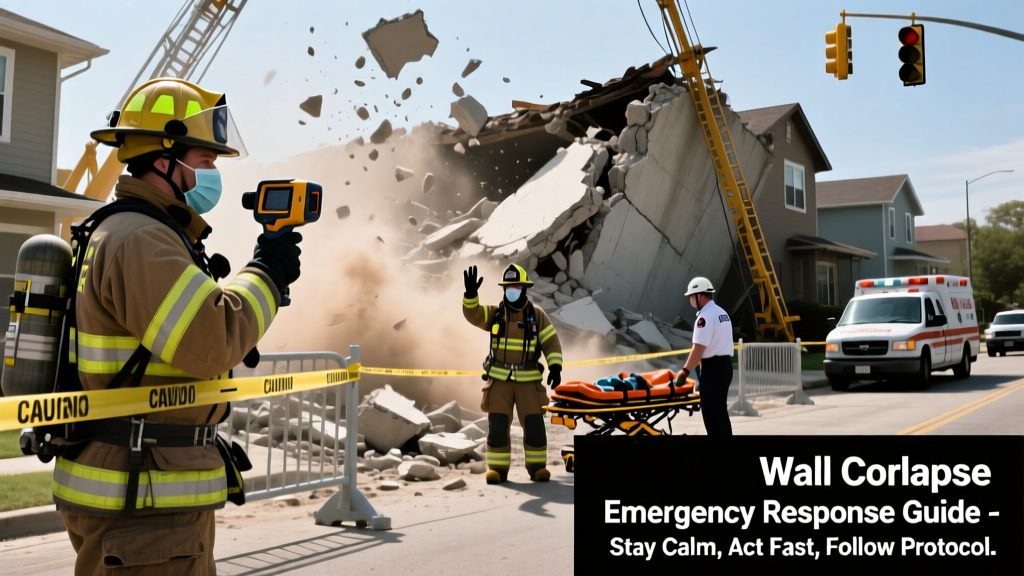
If you hear loud cracking, groaning, or see sudden bulging or bowing in a wall — get out immediately. Do not stop to grab belongings. Move to a safe outdoor location or interior room away from exterior walls and windows.
Immediate Actions
- Evacuate everyone from the building without delay — do not wait to confirm danger.
- Once outside, move at least 100 feet from the structure to avoid falling debris or secondary collapse.
- Account for all occupants — including pets, children, and those with mobility challenges.
- If someone is trapped and you can safely reach them without entering unstable zones, shout to assess responsiveness — but do not re-enter.
- Call 911 from a safe location — even if no injuries are visible; hidden structural failure may worsen rapidly.
When to Call 911 vs. a Structural Engineer
Call 911 immediately if:
- There’s an active collapse or imminent risk (e.g., visible movement, dust plumes, or audible creaking).
- Someone is injured, trapped, or unaccounted for.
- Gas smell, electrical arcing, or water main break accompanies the collapse.
Call a licensed structural engineer or certified home inspector after emergency responders clear the site — never before. According to the American Society of Civil Engineers’ Guidelines for Post-Disaster Safety Assessment (2022), only trained professionals can determine load-bearing integrity.
What NOT to Do
- Do not enter the building — even briefly — to retrieve items, pets, or documents.
- Do not use light switches, phones, or open flames near gas leaks or dust clouds.
- Do not assume adjacent walls are safe — lateral load shifts often compromise connected structures.
- Do not attempt DIY shoring or bracing — improper support increases collapse risk by up to 70%, per FEMA’s Residential Structural Collapse Mitigation Handbook (2021).
After the Emergency
Once authorities declare the area safe for brief, supervised re-entry:
- Document damage with timestamped photos and video — capture cracks, displacement, foundation gaps, and ceiling separation.
- Turn off main utilities: gas (at the meter), electricity (at the breaker panel), and water (at the shut-off valve).
- Secure temporary tarps over openings — only if weather permits and you’re on stable ground with no overhead hazards.
- Contact your insurance provider within 24 hours — most policies require prompt written notice for structural claims.
Is it safe to sleep in the house after partial wall collapse?
No. Even localized failure indicates compromised load paths. The U.S. Department of Housing and Urban Development advises against occupancy until a Level 2 structural evaluation is completed — typically involving laser scanning and load testing.
Can I remove fallen drywall or insulation myself?
Only after air quality testing confirms no asbestos (common in homes built before 1980) and mold spores are below 500 spores/m³. Wear N95 respirators, goggles, and gloves — and bag debris in 6-mil polyethylene.
"Disturbing collapsed wall material without containment can aerosolize hazardous fibers and pathogens — turning a structural event into a respiratory health crisis." — Dr. Lena Torres, Indoor Environmental Specialist, AIHA Journal, 2023
What’s the difference between a load-bearing and non-load-bearing wall collapse?
Load-bearing walls support roof/upper-floor weight — their failure often causes domino-style collapse, sagging floors, or cracked ceilings in adjacent rooms. Non-load-bearing walls (like bathroom partitions) usually cause localized damage only. But visual identification is unreliable: 38% of walls misidentified as ‘non-structural’ by homeowners were later confirmed load-bearing in post-collapse forensic reports (National Association of Home Builders, 2022 Structural Misidentification Study).
How fast does secondary collapse happen?
Most secondary collapses occur within 2–4 hours of initial failure, especially during temperature shifts or rain. Wet masonry loses 40–60% of compressive strength within 90 minutes of saturation (ACI 530.1-22, Section 4.2.3). That’s why emergency crews treat all compromised walls as time-sensitive hazards.
Should I hire a general contractor or structural engineer first?
A structural engineer — always. General contractors cannot legally assess safety or sign off on structural repairs in 47 states. Their role begins only after engineering approval. See our guide on structural engineer vs. contractor roles for state-specific licensing rules.
Where can I find disaster assistance for wall collapse repairs?
Federal assistance is rare for non-natural-disaster wall failures (e.g., aging infrastructure or poor renovation), but some states offer low-interest loans through programs like the Home Repair Grant Directory. Check your county’s Building Safety Division for emergency repair permits — many waive fees for life-safety fixes.
Wall collapse is rarely isolated — it’s a symptom of deeper structural stress. Whether caused by water intrusion, foundation settlement, or unauthorized modifications, every incident demands professional evaluation before reoccupancy. Don’t guess. Don’t delay. Prioritize people first, then documentation, then expert assessment. For related guidance, see foundation crack emergency steps and how water damage silently weakens walls.
| Time Since Collapse | Action Required | Responsible Party |
|---|---|---|
| 0–5 minutes | Full evacuation + 911 call | All occupants |
| 5–30 minutes | Account for people/pets; report injuries or entrapments | Designated safety lead |
| 30–120 minutes | Utility shutoff (if safe); establish safe staging zone | Trained adult occupant |
| 2–24 hours | Engineer inspection request; insurance notification | Homeowner/renter |
| 24+ hours | Permit application for stabilization; air/mold testing | Licensed contractor + IH consultant |